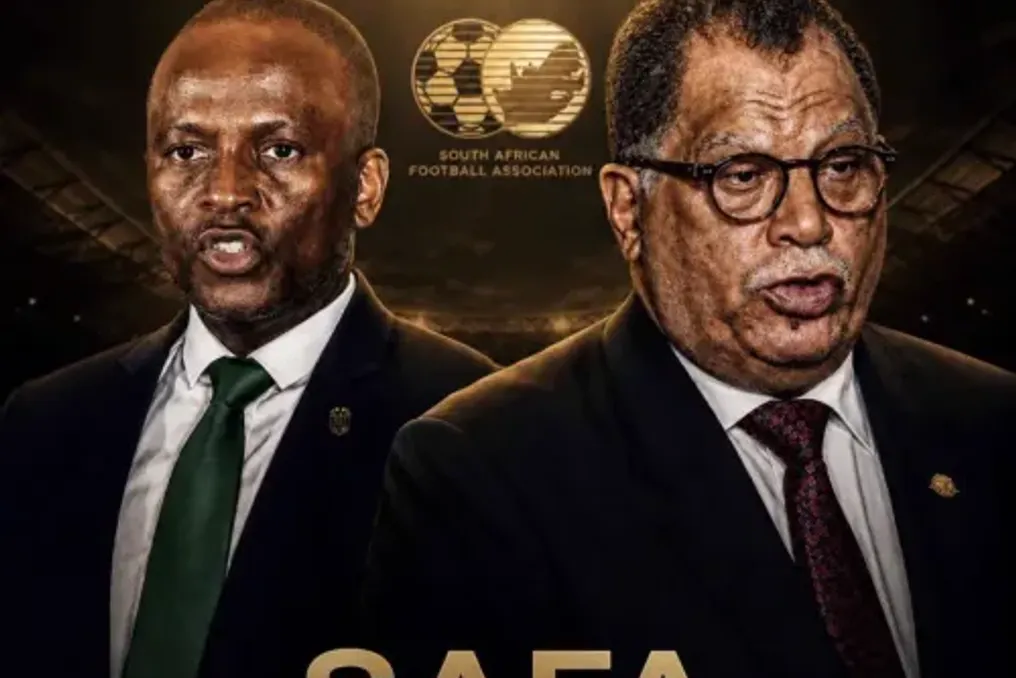
Against the backdrop of upcoming critical elections in South African football on September 12th, the future of the sport remains uncertain. The question arises whether the incumbent leader, Danny Jordan, can maintain his control, or if it is time for a new perspective under Sandile Zungu's leadership.
The author recalls events from 1996 when Mark Williams scored two goals against Tunisia in the Africa Cup of Nations (AFCON) final, leading to South Africa's victory in AFCON 1996. The country also won the Rugby World Cup in 1995 the previous year.
One cannot forget the moment when Bafana captain Neil Tovey lifted the '96 AFCON trophy next to former President Nelson Mandela. This moment was defining for South Africa, demonstrating reconciliation to the world.
Immediately after this final, South African football entered the top 20 of the FIFA rankings until former Bafana striker Phil Meyiinga scored the decisive goal that allowed the team to qualify for the 1998 World Cup in France. Among the great players of that time were Eric Tinker, Andre Arrendes, Mark Fish, Sean Bartlett, Benny McCarthy, Lucas Radabe, Dr. Humalo, and Linda Buthelezi, who brought South African football onto the world stage.
However, the situation began to deteriorate when Clive Barker resigned from his post in 1997 under immense pressure from SAFA, around the same time Danny Jordan was appointed as SAFA's Chief Executive Officer. Many believe Barker should have completed his work coaching Bafana and taken the team to the 1998 World Cup, as the decisions made cost the country dearly.
The appointment of Philippe Truscier to lead the 1998 World Cup became an example of how power, money, and personal ambition led to collapse. Since then, South African football has never fully recovered, and some argue that new personnel are necessary.
In 2026, South African football will face an election that will define the next decade. On September 12th, the South African Football Association will hold elections in Gauteng, where a two-way contest will take place between the incumbent Danny Jordan and Sandile Zungu, owner of the AmaZulu club.
The author believes this is not just a presidential vote, but a referendum on the principles guiding SAFA and the football community as a whole. Jordan's era was characterized by strength and control; he helped transform SAFA into its current organization and played a key role in hosting the 2010 World Cup in the country and on the continent, while also serving as SAFA president for three terms, which is a monumental achievement.
Yet, his 13-year tenure, starting in 2013 and extended in 2022, is also a problem. The author wonders whether Jordan wants to end his career as a hero or remain too long, becoming a villain.
Jordan's history in football administration is described as a polarized legacy: on one hand, monumental achievements on the world stage, and on the other, recent management crises, financial difficulties, and criminal charges. South African football possesses talent, but it lacks a functional, accountable federation. SAFA has become an organization with a lack of funds, needing rescue to cover player salaries.
There are several high-profile administrative and financial violations, including issues with finding a training base and recent visa errors that disgraced the nation. Added to this is the delay in appointing the next Bafana coach and the failure to utilize VAR technology despite allocating 20 million rand from the Treasury. Furthermore, Jordan was arrested on suspicion of using about 1.3 million rand from SAFA funds to hire a PR firm and a private security company for personal use. Although he denies guilt, the raid on the SAFA House by the Hawks in 2024 damaged sponsor trust.
Therefore, there is a call for new personnel, and this is a structural, not a personal, request. Football needs a federation capable of paying players on time, processing visas correctly, and implementing VAR. It needs a modern, professionally managed business, not a fiefdom. Sandile Zungu, a successful businessman and AmaZulu club owner, offers a fresh approach. He achieved a historic second place in the DStv Premiership in just one season by implementing corporate professionalism and modernizing the administration.
Zungu's proposal is based on financial transparency and structural reforms: audited reports, a constitution not used to suspend regional activities, investment in youth development, and a clear separation of powers between the president and the administration. Zungu will challenge the current leadership by promoting business discipline.
In conclusion, the author emphasizes that South African football deserves a dignified exit for Jordan, not a humiliating one. His contribution to hosting the continent's largest sporting event must be protected. A smooth transition of power would allow him to become a patriarch of African football, rather than participating in crisis meetings. These elections determine what kind of federation the country desires: a political structure or a service organization for all football participants.