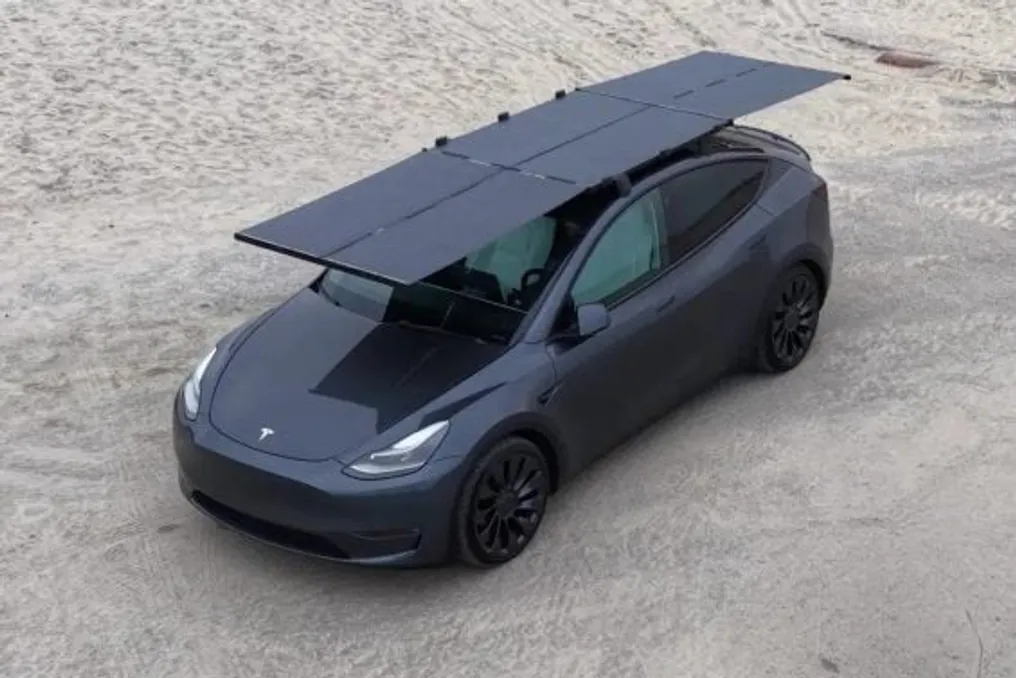
A Californian startup aims to transform an electric vehicle's roof rack into a portable power station. The company Dart Solar has introduced a modular system of foldable solar panels that, according to the company, can be installed on almost any electric vehicle. Under favorable sunny conditions, the system is capable of restoring a range of 24 to 34 kilometers per day.
Each module generates 500 W and triples in size when unfolded: it measures 1.47 m when folded and reaches about 4.3 m when deployed. This process takes approximately ten seconds, according to the manufacturer's information. Two such modules fit on a standard roof, forming a 1000 W kit, which is used in the company's calculations. For vans, RVs, and pickups, there is an option to install modules next to each other, which can also function as awnings, reaching configurations of 1500 W, 2000 W, or 2500 W. For example, Dart Solar reports that a 1500 W system can be installed on the flat roof of a Tesla Cybertruck.
The company was founded in 2024 by inventor Omid Sadeghipour, a Tesla owner. Many prototypes preceded the current product, with each one becoming more compact and less bulky.
The system generates energy both while moving and when the vehicle is stationary; however, during movement, the panels must remain folded, which significantly reduces the surface area exposed to the sun. Furthermore, an aerodynamic effect occurs, which is critical for a vehicle whose efficiency is measured in kilometers per kilowatt-hour. Dart Solar claims that the design intrudes only 3.8 cm into the airflow, which was tested at 160 km/h, and that measurements on the Tesla Model Y showed a resistance increase of between 1% and 2%. This data has not been independently verified.
In previous versions, the 960 W kit sold for $2,950 USD, equivalent to approximately 15.1 thousand Brazilian reais at the current exchange rate, and the unit itself that converts solar energy to alternating current cost from $1,950 USD, or about 10 thousand reais for those who already owned the equipment. The system weighs about 41 kg and can support up to 23 kg of additional load on the roof using an adapter. The projected lifespan is ten years. The product is not sold in Brazil.
Estimates of restored range are based on favorable insolation conditions, and Brazil has an advantage in this area. According to the Atlas of Brazilian Solar Energy from Inpe, the average global horizontal solar radiation in Brazil is about 5.15 kWh/m² per day nationwide, with the Northeast region reaching 5.5 kWh/m², which is higher than the figures recorded in European countries that are leaders in photovoltaic energy generation.
The proposed solution does not eliminate the need for grid connection but serves as a way to reduce dependence on fast charging stations during regular trips and in regions with insufficient charging infrastructure.