Households in South Africa are experiencing severe difficulties managing monthly budgets as expenses for utilities, transport, and food consume an increasing share of their income, turning the cost of living crisis into a struggle for survival for families.
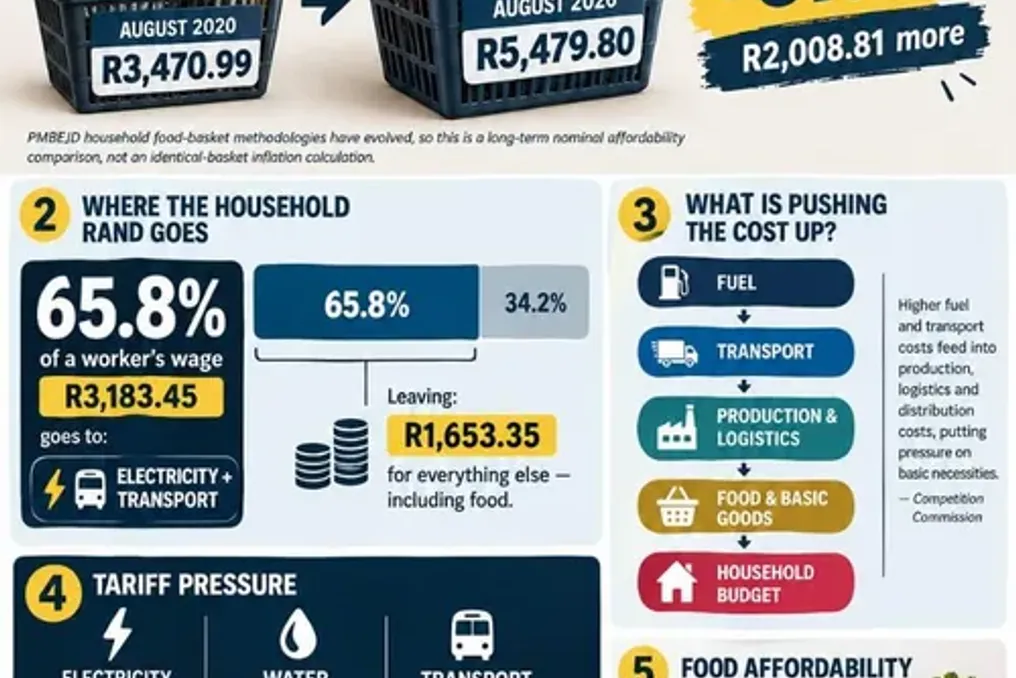
Recent data on household affordability demonstrates this problem, despite a seemingly lower overall inflation rate. In August, the average cost of a food basket was R5 479.80, according to the Pietermaritzburg Economic Justice and Dignity Group (PMBEJD). Although this amount was 0.9% lower than in July, it remained 1.8% higher than a year ago. Of 44 tracked products, 19 increased in price, while 25 decreased.
The group's director, Marvin Abraham, notes that families do not receive income but rather allocate money across fixed expenditure items: food, electricity, and transport. They first pay for the most essential things that cannot be avoided.
Abraham emphasizes: 'Households do not receive income and do not allocate fixed amounts for food. First, they pay for absolute necessities: rent or mortgage, electricity, transport.' He adds that the food budget only appears after these basic expenses are covered, and purchases are made with the remaining funds, which often leads to buying smaller quantities and less nutritious food.
The group's calculations show how little is left of 'what remains.' In August, R3 183.45 was spent on electricity and transport, accounting for 65.8% of a worker's salary, leaving R1 653.35 for food and other necessities. Thus, the affordability crisis is related not only to the price of bread, chicken, or maize meal, but also to the competition between several unavoidable expenses for the same income.
The Competition Commission's report for August 2026 also highlights the current pressure, warning that fuel price shocks have consequences far beyond petrol stations. The Commission points out that the first half of 2026 was characterized by a 'significant increase in fuel costs,' driven by geopolitical tensions and disruptions in global oil supply chains, exacerbated by exchange rate pressure.
The Commission notes that the rise in fuel and transport costs has spread not only to commuting but has also increased production, logistics, and distribution costs across the economy, putting upward pressure on essential goods. The Commission believes that the task is to balance the financial sustainability of vital services with the burden on households, especially when tariffs rise faster than inflation, and vulnerable populations do not receive effective support.
For workers, the problem boils down to whether income can keep pace with rising prices. Abigail Moyo, a representative of the United Association of South Africa (UASA) union, stated that households are already on the brink of collapse. She added that the rise in fuel prices will only intensify the financial pressure on ordinary South Africans whose budgets are already severely strained.
Moyo argued that the solution cannot be to expect workers to absorb the increased costs themselves. She noted that the adjustment of fuel prices is the reason why UASA and its members in the sugar sector went on strike to fight for wage increases and benefits that match inflation. She called on the government to review fuel pricing mechanisms, including fuel and excise taxes, and employers to recognize inflation-linked salary indexing as necessary for workers' survival amid the rising cost of living.
Pensioners feel particular pressure. At SASSA offices in Wentworth, Durban, pensioners are demanding an increase in the old-age grant to R5 000 per month, arguing that the current amount does not cover basic living needs. The maximum old-age grant is R2 400 per month, and for recipients over 75 years old, it increases to R2 420. Pensioner Quinton Eri describes the situation as extremely difficult: 'We barely make ends meet on R2400. Our water bill keeps going up. We go to Sasa, and then sometimes we sit here for two or three days because they don't work. Life has become a huge struggle. You can't even afford to buy the food you eat. The food we buy is not enough. So we worry about where the next meal will come from.'
He also noted that even buying meat has become a luxury, as people are forced to eat chicken because they cannot afford mutton or beef. Social activist Jean Chodry stated that pensioners are forced to cope with the responsibilities of supporting other family members. He insisted that pensions should be doubled at least, as besides themselves, they care for grandchildren, have utility bills, rent, and groceries.
A petition launched by Jay C Alex titled 'Support South African Pensioners to Restore Dignity and Respect' has gathered over 33,000 confirmed signatures calling for increased support for pensioners struggling with food, medicine, and electricity shortages.
The consequences extend to children. The group calculated that the basic nutritious basket for a family of seven cost R6 597.25 in August, and the average cost of providing one child with a basic nutritious diet was R961.96, while the child grant is R580. Abraham warned that when households are forced to sacrifice nutrition, the consequences go far beyond the monthly grocery bill. He described it as an intergenerational poverty trap that starts right at the table of young children under five. For him, relief cannot come solely from lowering food prices; a significant impact on the quantity of food purchased will come from reducing electricity and transport costs.