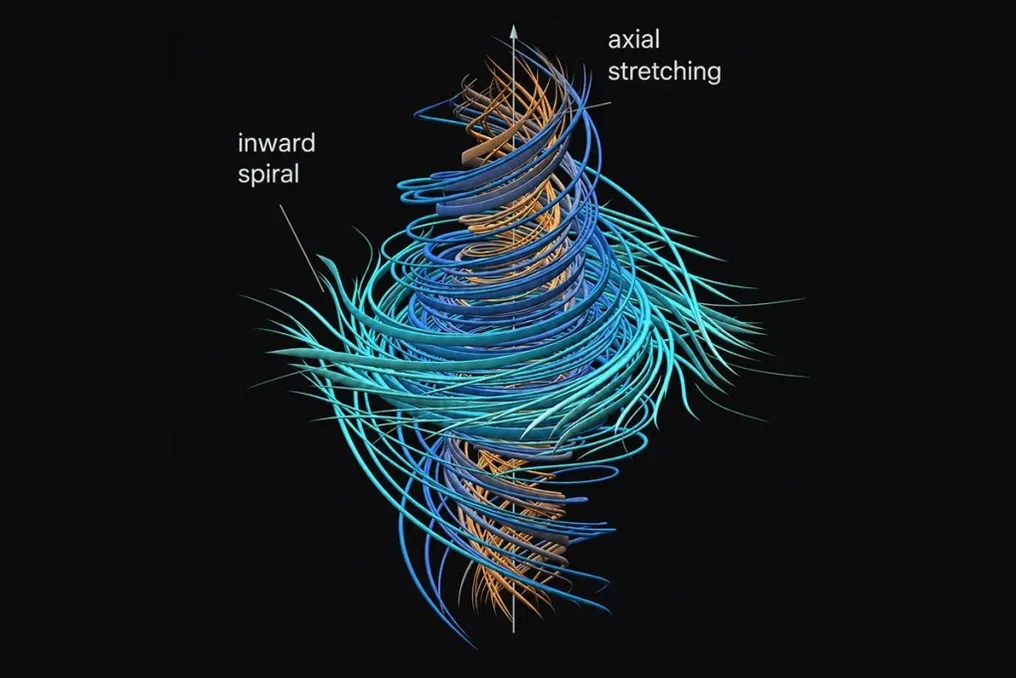
OpenAI has announced that its internal artificial intelligence system was able to find a solution to one of the seven Millennium Prize Problems—the Navier–Stokes existence and smoothness problem. Mathematicians have been working on this issue for many decades.
Along with the statement of the proof, the company provided its formalized version in the Lean system. The Navier–Stokes equations are used to describe the movement of gases and liquids, for example, when modeling airflow, weather, and blood circulation. The main point of contention concerned the possibility of singularities arising—states that violate the smoothness of the mathematical model—during the initially smooth movement of a three-dimensional fluid over a certain period of time. OpenAI claims that its system demonstrated such a possibility.
According to the company's data, approximately 10,000 AI agents participated in this task. The solution was reached on September 5th after about 88 hours of operation, and the subsequent formalization and verification of the proof in Lean required an additional 17 hours. During the process, the agents exchanged 2.7 million messages and generated approximately 130 billion output tokens.
The journal Nature noted this announcement as a potentially significant breakthrough in mathematics, but for now, it is only a claimed result. For official recognition of this achievement, the Clay Mathematics Institute requires that the proof undergo independent review and receive broad approval from the scientific community. According to the institute's regulations, the candidate for the prize must publish the solution at least two years before consideration. A prize of one million dollars is allocated for each of the seven Millennium Prize Problems, but OpenAI stated its refusal to claim this award.
Furthermore, it was previously reported that the GPT-6 Astra model successfully passed all 48 levels of the 'I am not a robot' test, which simulates various types of CAPTCHAs. To complete these tasks, the artificial intelligence independently interacted with the interface and performed screen content recognition.