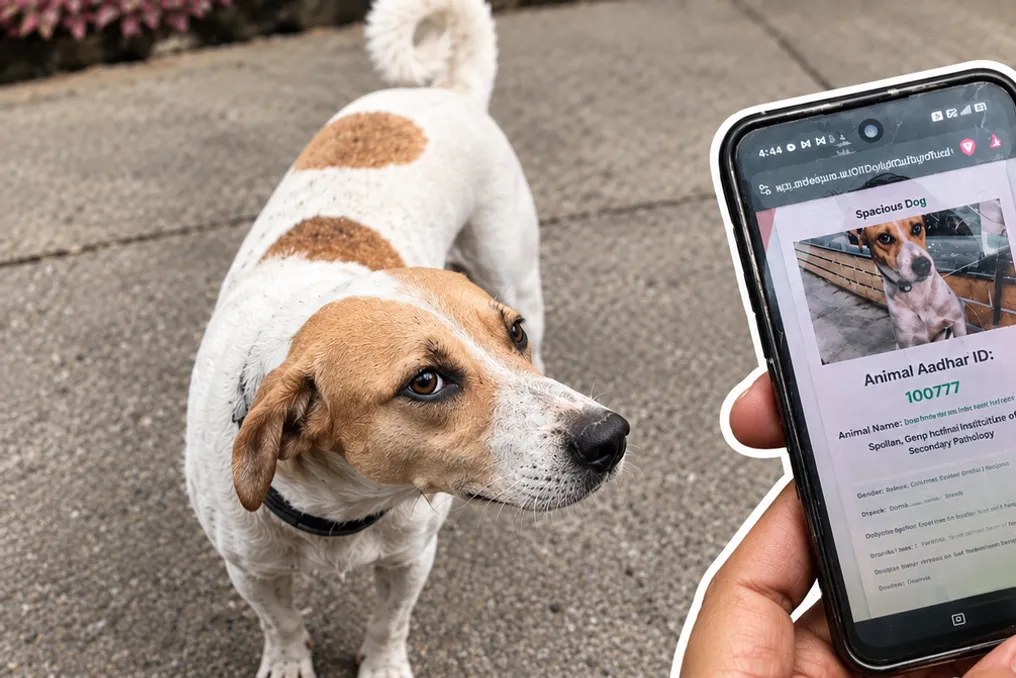
In February 2026, a dog entered the classroom of the Indian Institute of Technology Bombay (IIT Bombay), climbed onto a desk, and took a supervisory position over the class. Students captured this moment, and the video was posted on Instagram, after which the dog was nicknamed 'Dogesh Bhai' and garnered over two million views.
Despite the internet quickly shifting attention, the question raised by the dog remained relevant: who is responsible for the safety, identification, and care of the thousands of free-roaming dogs in the city or on campus?
IIT Bombay proposed a solution several months later by equipping stray animals, including Dogesh Bhai, with reflective collars featuring QR codes. These codes are linked to the animal's data, including its movement history and vaccination certificate.
The QR code reveals the dog's complete history
By scanning this code, a student or caretaker can view the dog's 'Aadhaar ID,' as well as information about its previous locations, current whereabouts, and confirmation of rabies vaccination. This single detail determines how the campus treats the dog daily: whether it is left alone, marked for health checks, or approached by strangers.
This system formalizes the years of work done by student volunteers who have long advocated for sterilization and vaccination as the only sustainable way to ensure the safety of both dogs and people, instead of the removal methods used by some other institutions.
The timing of the implementation was not accidental. In May 2026, the Supreme Court upheld its directive that municipal bodies must sterilize, vaccinate, and systematically register every stray dog under their supervision, and also permit permanent dog keeping instead of leaving them near schools, hospitals, and railway stations.
This ruling revived the framework established by the Animal Birth Control Rules and effectively informed every civic body in the country that selective management of strays is no longer legal, requiring digital, verifiable records.
From one campus to an entire city
The Mumbai Municipal Corporation (BMC) adopted this directive and applied the same QR code logic previously tested by IIT Bombay, but on a city-wide scale. On August 20, 2026, the BMC signed an agreement with Ridlan AI Foundation, a non-profit organization based in Mumbai, to install reflective collars with QR code support on sterilized and vaccinated stray animals throughout the city.
The foundation's founder, Akshay Ridlan, developed the initial version of this idea in 2020 after his own street dog, Kalu, went missing, realizing there was no simple way for a stranger to identify a community dog or learn its medical history.
What started as a way to reunite lost dogs with the people who fed them has now become official urban infrastructure. It is the same shift that allowed citizen-created real-time rescue apps to subtly fill gaps that municipal systems could not address on their own.
For Mumbai officials, scanning the collar instantly confirms the status of sterilization and vaccination, reducing the need to recapture the same dog and providing feeders with documentary proof that a specific animal is accounted for. This is precisely the type of management needed for a figure like Dogesh Bhai to remain protected when cameras stop recording.
5 ways to help a street dog
For most of us, street dogs are part of daily life. You might see the same dog sleeping near a grocery store, waiting at your building gate, or following a local feeder during dinner. Over time, some of them become familiar faces.
The safety of these dogs and the people around them partially depends on residents' actions when problems arise. Below are five simple ways to help:
Report a dog needing attention:
If you notice a dog that is injured, unsterilized, or behaving unusually aggressively, report it to your municipal corporation's animal birth control helpline, via an app, or WhatsApp number. Provide the exact location, nearest landmark, and, if possible, a photograph. This significantly increases the chances of the team finding the right dog.
Scan the collar before acting:
If the dog wears a QR code collar, scan it. Within seconds, you can check whether the dog has already been sterilized and vaccinated, and if someone is caring for it. Such a small scan can prevent the unnecessary recapture of an already vaccinated dog.
Feed responsibly:
If you feed community dogs, use a fixed location and time, preferably in a designated feeding area, away from school gates, stairs, entrances, and busy corners. A predictable routine is also beneficial for the dogs. If there is no feeding point in your area, residents can raise this issue with the Residents' Welfare Association (RWA) or the local office and ask for such a point to be designated.
Dedicate your time if you can:
Local animal welfare groups and ABC centers often need help transporting dogs to sterilization camps, caring for them post-surgery, or updating vaccination records. Even a few hours can make a difference. Those who prefer financial contributions can support reliable organizations conducting sterilization and vaccination campaigns.
Know what to do after a bite or scratch: immediately wash the wound and seek medical attention for post-exposure vaccination without delay. Rabies is preventable with timely treatment, so quick response is crucial.
For a dog like Dogesh Bhai, this is what care looks like after the Instagram reel ends. Someone knows who he is. Someone knows if he was vaccinated. Someone can recognize when he is missing, injured, or needs help. His reflective collar may be small, but it represents something that could benefit every community dog: a name, a record, and people who know they are responsible for its well-being.