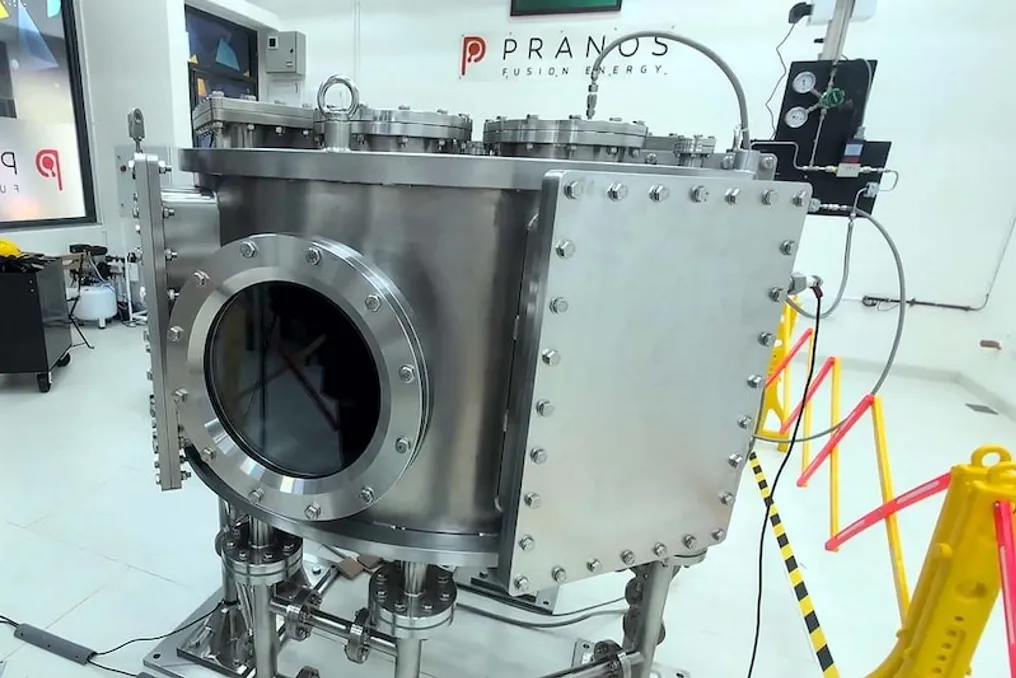
The private sector in India has taken a significant step in nuclear fusion research. The startup Pranos Fusion from Bangalore has created plasma in its PRAGYA tokamak for the first time. This tokamak, which has a radius of about 40 centimeters, was developed by the company in approximately eight months.
PRAGYA is not intended for electricity generation; it is a test facility where the company will conduct continuous experiments. The company plans to operate this facility for about 20 years, aiming to perform around 3000 plasma pulses annually, equivalent to 10–12 experiments daily. The collected data may contribute to the development of larger fusion reactors in the future.
A tokamak is a device where very hot plasma is controlled using magnetic fields. To achieve fusion, gas is heated to extremely high temperatures, turning it into plasma. The goal of fusion is to combine small atoms to generate energy, similar to the process occurring on the Sun. Scientists have been trying to control this process on Earth for energy production for many years.
Pranos Fusion, based in Bangalore, introduced PRAGYA—the first compact tokamak reactor developed by the private sector in India. Co-founder and CEO of Pranos, Shaurya Kaushal, presented the first detailed photograph of PRAGYA.
The primary objective at PRAGYA is to study methods for more efficient plasma control. Furthermore, work will be conducted on the tokamak design, plasma control system, and plasma diagnostics technologies. The company will also focus on working with high-temperature superconducting magnets used in fusion reactors to control plasma. Continuous experiments will provide the company with a large volume of data that will serve as a basis for improving the technologies of future fusion reactors.
Pranos Fusion has set long-term goals. The company plans to launch HTS magnets by 2027 and then create a net energy gain reactor called PraniQ by 2030. Net energy gain means that the energy produced exceeds the energy consumed to run it, although this is currently only a company goal. It is important to note that PRAGYA itself is not a net energy gain reactor.
The company aims not only to develop technologies through PRAGYA but also to train a large number of scientists and plasma physicists. For this, long-term experiments will be conducted at PRAGYA, providing scientists and students with the opportunity to study and work with fusion technology. The company hopes that this will stimulate research in fusion and related fields in India. The creation of plasma in PRAGYA is an initial step in this direction, and further experiments will show how far the company can advance toward its major fusion goals.