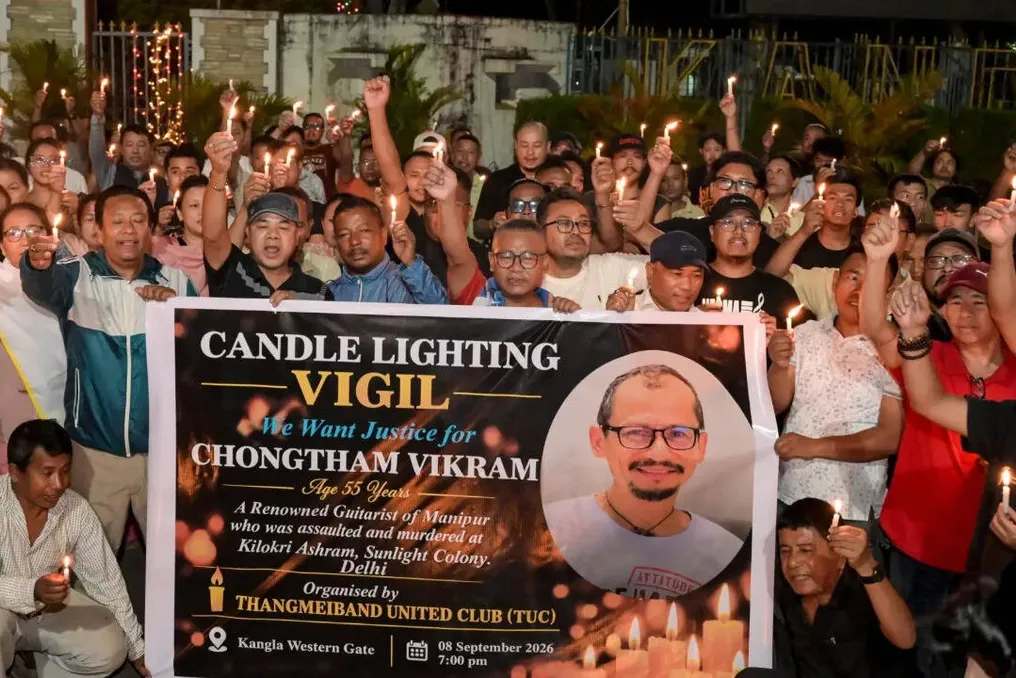
A group of civil society and human rights organizations has expressed its condemnation of the death of Chongtam Vikram, a teacher and singer from Manipur, who was reportedly killed by a mob in Delhi on Monday. These groups have demanded a thorough investigation into a possible racial motive behind the attack.
The joint statement was prepared following a meeting of representatives from Manipur Students’ Association Delhi (MSAD), Manipur International Youth Centre (MIYC), People’s Progressive Alliance Manipur (PPAM), Karwan-e-Mohabbat (KeM), North East India Support Centre and Helpline (NEISCH), and Human Rights Alert (HRA). The meeting took place on September 8 at the Centre for Justice Studies in Sarvodaya Enclave, New Delhi.
The organizations emphasized that Vikram's murder should not be treated as an isolated criminal incident. They insist that his case must be examined within the broader context of racial prejudice and violence faced by residents of Northeast India.
The statement reports that a First Information Report (FIR) under number 0296 has been registered at the Sunlight Colony police station, according to sections 103(2) and 3(5) of the Bharatiya Nyaya Sanhita, 2023. Section 103(2) pertains to murder committed by a group of five or more people jointly, motivated by race, caste, community, gender, place of birth, language, or personal beliefs. Section 3(5) provides for vicarious liability if multiple people commit a crime with a common objective.
The organizations noted that the current police investigation appears insufficient to address what they describe as a wider pattern of racist crimes against the residents of Northeast India. They also drew attention to the recommendations of the MP Bezarua Committee, established by the Union Home Ministry, which submitted its report in 2014. This committee recommended measures to combat discrimination, violence, and vulnerabilities faced by people from Northeast India.
The groups stated that most of these recommendations, including the proposal for specific criminalization of racial acts, remain unimplemented. Furthermore, they pointed to the lack of a comprehensive legal framework specifically regulating racial discrimination. The statement notes that Article 15 of the Constitution prohibits discrimination on several grounds but does not explicitly list skin color, origin, national, or ethnic background.
The organizations also referred to recommendations issued by the UN Committee on the Elimination of Racial Discrimination (CERD) on August 25, 2026. They strongly urged the Centre to adopt comprehensive anti-discrimination legislation with a clear definition of racial discrimination, covering both direct and intersecting forms of discrimination in public and private spheres.
The groups demanded an impartial and transparent investigation into Vikram's death, including an analysis of any racial motive based on evidence. They also called for the identification and prosecution of all perpetrators, including those who may have participated, facilitated, or encouraged the attack. The organizations strongly requested the authorities to ensure that the case is not investigated merely as a routine criminal offense, ignoring its alleged racial aspects.
Additionally, they called for immediate measures to prevent further racial violence against the residents of Northeast India, as well as institutional mechanisms to combat racial discrimination and hate violence. The groups called for support, protection, and compensation for Vikram's family, as well as ensuring the family's protection from intimidation, harassment, or further victimization.
The statement read: 'Justice for Chongtam Vikram is not just a demand for accountability for one murder. It is a demand for dignity, equality, security, and the fundamental right to live free from racial violence for all residents of Northeast India.'
The meeting concluded with a two-minute moment of silence in memory of Vikram and in solidarity with his grieving family.