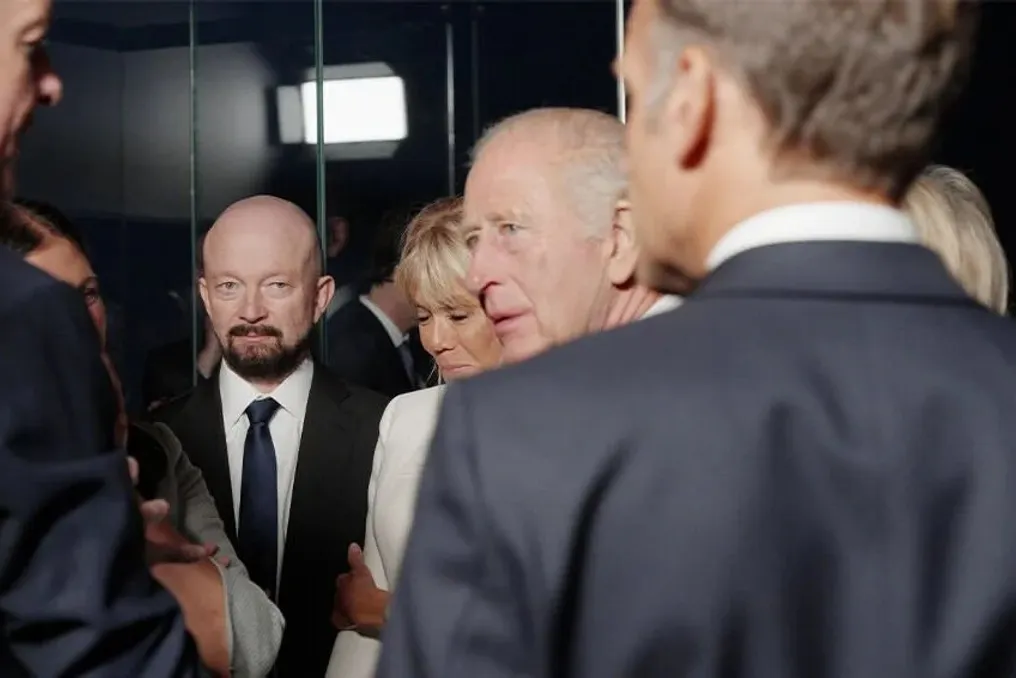
The British Museum is preparing to host the most anticipated exhibition in its history—the return of the Bayeux Tapestry to England. This fragile 70-meter artifact narrates the Norman conquest of England in 1066 and is scheduled to be displayed over the next eleven months, attracting hundreds of thousands of visitors.
Since 1931, the British government has sought to obtain the Bayeux Tapestry from France, and it only arrived at the museum this summer under heavy guard. Tickets for the first four months of the exhibition, dubbed the 'show of a generation,' sold out within hours, marking the largest sales day in the museum's 273-year history.
A significant part of this success was made possible by the financial support of a billionaire philanthropist whose name appears on promotional posters. He maintained a low profile at the official reception, where he was seen alongside dignitaries, including King Charles, French President Emmanuel Macron, and UK Prime Minister Andy Burnham, who viewed the medieval embroidered cloth through protective glass.
Sponsor's Link to Defense Technologies
Igor Tulchinsky, founder, CEO, and chairman of the US-based investment firm WorldQuant, was appointed as the sponsor of the Bayeux Tapestry exhibition in February. Media outlets valued this deal at £5 million ($6.75 million). Next month, he will chair a charity ball at the museum in recognition of his support for the tapestry.
However, among Tulchinsky's other business interests is a venture fund focused on defense technologies located in Israel. This fund is headed by a recently retired army commander who promoted the use of remotely operated vehicles in Gaza, which one human rights group called a 'direct tool for committing genocide.'
The sponsorship deal preceded the launch of Tulchinsky's new fund, WorldQuant Genesis, based in Tel Aviv, in April. Although the scale and exact nature of WorldQuant's investments in defense technology remain unclear, information about Tulchinsky's business interests in Israel is likely to raise new questions for the museum, which has already faced demands from members of parliament to investigate the removal of some mentions of Palestine from galleries, as well as criticism regarding controversial sponsorship agreements.
Last week, The Guardian reported that the museum showed the Bayeux Tapestry during a private viewing for Peter Thiel, a billionaire and founder of the tech company Palantir, which supplies advanced data analysis and artificial intelligence software to the Israeli army.
The artists' network Artists for Palestine UK called the British Museum's decision to collaborate with Tulchinsky 'outrageous.' Neither the British Museum nor WorldQuant responded to numerous inquiries from Middle East Eye for comment on this article.
Operations in Gaza and Lebanon
WorldQuant Genesis is led by Major General Saar Zur, a high-ranking former military officer who commanded the Northern Corps and a maneuver unit of the Israeli army. This structure was created to support ground forces carrying out advance and consolidation tasks in enemy-controlled territory during the first year of the war in Gaza. During this period, Israel is accused of conducting a campaign of genocide against Palestinians, as well as operations against Hezbollah in Lebanon. Zur changed his duties in October 2024 and retired shortly thereafter. He then joined the advisory board of Ottopia, a startup supplying the Israeli army with remote-controlled drone technologies.
In his work for Ottopia, Zur described the deployment of these machines as 'force multipliers' in Gaza. He stated on the Ottopia website: 'Teleoperation is crucial for unmanned operations as it enhances ground superiority by reducing losses, improving maneuver resilience, and increasing combat effectiveness.'
Ottopia characterizes its technology as 'battle-tested' in roles such as 'direct combat' and 'target engagement.' In addition to advertising remotely controlled bulldozers, Ottopia founder Amit Rosenzweig also admitted that the company supplied the Israeli army in Gaza with armored personnel carriers (APCs) loaded with explosives. Rosenzweig noted: 'He can drink coffee while using a joystick to control a tank or APC or whatever he needs to control to get the job done.'
Application of Technology in Gaza
Human rights groups link the use of such remotely operated vehicles by the Israeli army in Gaza and Lebanon to indiscriminate attacks on civilians and the systematic destruction of buildings and neighborhoods. According to monitoring by Euro-Med Human Rights Monitor, Israel began using remotely operated vehicles loaded with explosives in densely populated residential areas of Gaza in May 2024. Their use intensified in October 2024, when Israel implemented the so-called 'Generals' Plan,' aimed at depopulating northern Gaza and forcibly relocating its residents.
By August, September, and October 2025, Euro-Med Monitor documented the destruction of approximately 300 residential units daily, with the Israeli army using about 15 explosive 'robots' per day, amounting to roughly 100 tons of explosives used against residential areas. Residents of Gaza City told MEE in September 2025 that the explosions caused by these machines were 'more destructive than airstrikes,' instantly turning multi-story buildings into ruins. Many residents fled their neighborhoods in terror.
Shaban, a resident of eastern Gaza City, reported: 'If the building was seven stories high, it became ruins. You can't even say there was a building there before. Just tiny pieces of stone.'
Although the ceasefire agreement in Gaza between the US, Hamas, and Israel in October 2025 reduced or halted their use, Euro-Med Monitor recorded an escalation in the use of explosive vehicles in northern and eastern Gaza over the past two months. Anas Jerjavi from Euro-Med Monitor told MEE: 'For example, during August, we documented the sabotage of about two to three remotely operated explosive vehicles per week in areas near the Yellow Line'—which denotes the withdrawal line of Israeli forces.
Jerjavi told MEE that direct destruction of cultural heritage sites resulting from the operation of these vehicles has not yet been recorded. Nevertheless, cultural heritage sites have been affected by Israeli military operations in areas where these explosive vehicles were used, including several locations in Jabalia, Gaza City, such as the Old Omar Mosque, the Byzantine Church, the Al-Mataf Hotel, Sheikh Saad Mosque, and the home and shop of Rajab Ibrahim Abdarabboh.
Jerjavi emphasized: 'It is clear that the use of these weapons took place in densely populated areas containing homes, religious sites, and other elements of Gaza's historical and cultural fabric.' He added: 'Thus, their large-scale use posed a serious threat not only to the lives of civilians and residential buildings but also to the cultural heritage inherent to these communities.'
Euro-Med Monitor informed MEE that it cannot independently confirm that the vehicles documented in Gaza were operated using Ottopia technology. However, the vehicles found in Gaza share several common characteristics with the type of remotely operated vehicles described by Zur and in the company's marketing materials.
In an article for the company, Zur described how he provided 'teleoperation solutions for a wide range of IDF vehicles—bulldozers, trucks, and others' after the Hamas attacks on October 7, 2023, and the start of the war in Gaza. In Lebanon, entire towns and villages along the southern border were deliberately demolished by the Israeli army, including several heritage sites such as the Shrine of Prophet Benjamin in Mukhabib. Although remotely operated vehicles have been observed in Lebanon, there has been no report that they were used in the demolition of Lebanese settlements.
Israeli Defense Minister Yoav Gallant stated that the army is replicating the pattern of destruction observed in Gaza in southern Lebanon. Ottopia did not respond to numerous requests from MEE for comment. There are no suggestions of a link between Tulchinsky and Ottopia.
'Cultural Genocide'
In April, the Israeli business newspaper Calcalist reported that Tulchinsky's newly launched fund, WorldQuant Genesis, will finance 'early-stage research companies combining AI, robotics, and biotechnology.' It was noted that the fund has already invested in NavAiro, described as 'an Israeli defense technology startup developing solutions to counter swarms of inexpensive drones.' Tulchinsky stated: 'Even against a complex reality, my commitment to Israel and its future remains unchanged. Israel possesses an exceptional combination of world-class universities, military experience, and the ability to cope with a complex and difficult reality, making it one of the most fascinating places in the world for growth.'
Tulchinsky was born in Belarus in the Soviet Union but emigrated to the US in childhood. He has long-standing business interests in Israel, where WorldQuant has maintained an office in Ramat Gan, near Tel Aviv, since 2009. In an interview with the Jerusalem Post in March, Tulchinsky stated that he had been providing financial support to the Israeli army since the Hamas-led attacks on October 7, 2023, and the start of the war in Gaza, and regularly visited the country. He said: 'Initially, I helped the army financially. I gave them money, and they did everything.'
When the interviewer pressed for more details on the nature of his donations to the army, Tulchinsky clarified that he transferred the money through an organization.
Artists for Palestine UK noted in a statement to MEE that remotely operated bulldozers and explosive vehicles contributed to damage and destruction to over 70 percent of the total documented cultural heritage sites in Gaza, including a UNESCO World Heritage site under threat. They stated: 'These mosques, shrines, historic houses, archaeological mounds and excavations, ancient artifacts, cemeteries, palaces, fortresses, mosaics, fountains, baths, monasteries, and churches were built by Palestinians, Romans, Egyptians, Greeks, Persians, Nabataeans, Assyrians, and others over centuries.' They added: 'Too many are now lost forever in the ruins, which, according to the UN, could constitute cultural genocide.'
The network noted that Tulchinsky appears to be seeking to profit from Israel's military activities through his business interests in the country, calling his sponsorship of the Bayeux Tapestry exhibition 'disgraceful.' They questioned: 'How could the museum's board members conclude that Tulchinsky, with his ties to the ongoing erasure of Gaza and parts of Lebanon, is a suitable sponsor? And, more fundamentally, why are basic ethical standards, human rights, and international law not guiding factors in making such decisions, even before considering reputational damage?'
The British Museum has previously faced criticism and protests over previous corporate sponsorship deals, including a ten-year deal worth £50 million ($67.5 million) with oil giant BP to fund the 'Masterplan' reconstruction project.
}, {