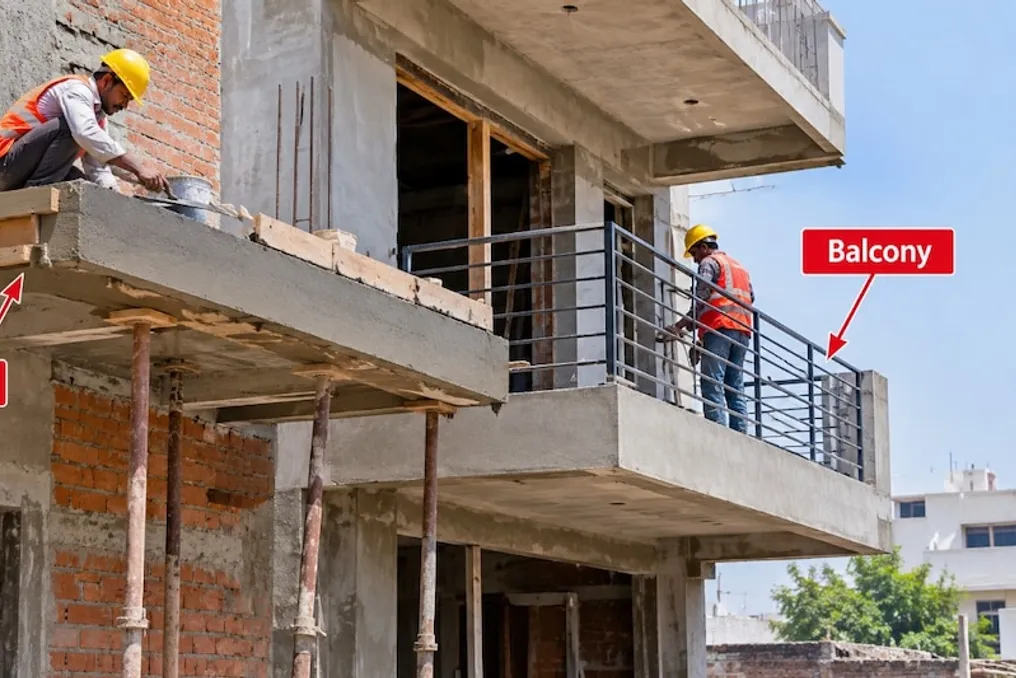
When constructing cornices (chhajja) and balconies in a house, it is crucial to pay attention to safety requirements, strength, and current state regulations. This is especially relevant because sometimes a cornice may extend beyond private property or partially occupy road territory.
Before building a cornice or balcony, you must familiarize yourself with the relevant rules and building bylaws. Generally, above the ground in front of a house facing the road, a cornice can be extended by approximately 3 feet (about 75 cm) or from 0.75 to 1 meter. However, this depends on local rules of the city council, municipality, or panchayat, as well as the width of the road. To do this, you need to obtain permission from the city council or development authority.
By law, it is forbidden to build cornices over a public road or sewer ditch outside the boundaries of your property, as this is considered illegal. If the road is narrow or has a width of less than 30 feet in a local settlement, some rules allow an extension of 2.5 to 3 feet.
Nevertheless, building codes vary across different states and city councils, so there are no universal rules for all places. The possibility and permissible length of a cornice are determined by the rules of the local council or governing body. In commercial zones or on main streets, there may be a complete ban on extending cornices.
If the road boundary starts at your private land, extending a cornice onto the road or public area is considered an illegal encroachment, which the administration can dismantle at any time. Therefore, before starting construction of a residential building, you should obtain an approved plan from the nearest city council or local authority and definitely request precise information on the current building codes.
Before starting the construction of a cornice or balcony, you must ensure its reliability. The choice of structure must correspond to the purpose for which the cornice is planned, and building codes must be observed. Generally, a cornice is considered safe for sun and rain protection if its length is between 1.5 and 3 feet.
If you plan to build a cornice or balcony longer than 3 feet, you must use hidden beams or proper reinforcement according to an engineer's recommendation. If you extend the cornice only by 1.5–2 feet (approximately 24 inches), you can manage with a standard slab, although caution is necessary for safety. For cornices ranging from 2.5 to 3 feet, suspended beams should be used. If the cornice exceeds 4–5 feet and a balcony is planned above it, a lintel beam must be used.