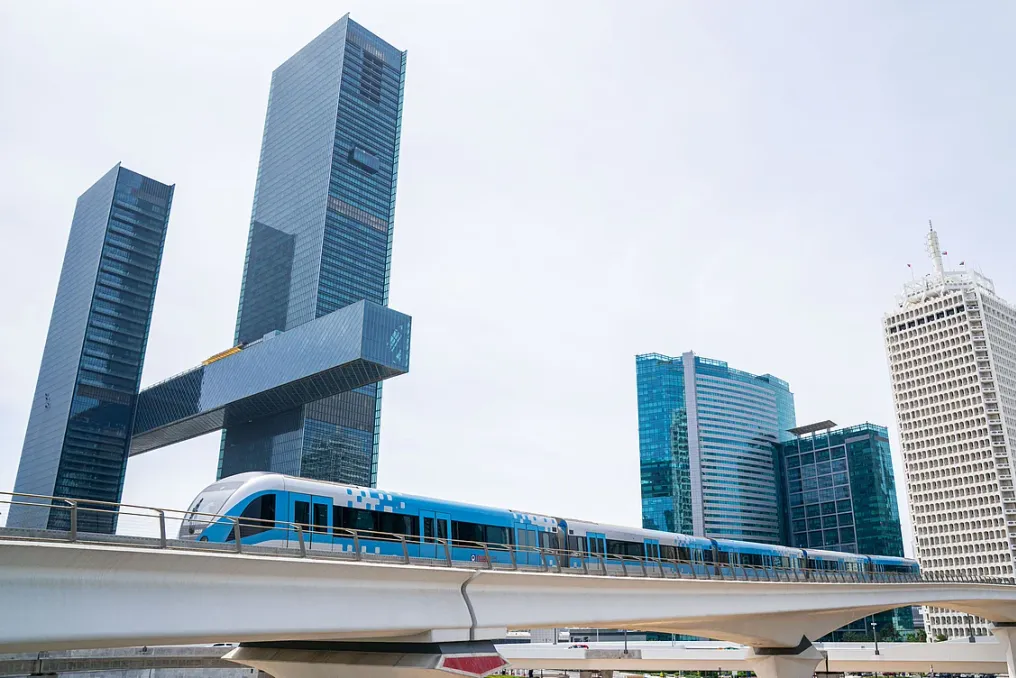
A dream conceived in the 1990s came to life on September 9, 2009, when the Dubai Metro began operations. Seventeen years later, this system continues to set new standards for urban transport.
Although research into the Dubai Metro started in the 1990s, planning for the railway network began in 2003. The start of this ambitious project was marked by the signing of the Dubai Metro project agreement between His Highness Sheikh Qasim Sultan, Director General of the Dubai Municipality, and Susumu Uchida, Director and Board Member of Mitsubishi Heavy Industries, on May 29, 2005.
In February 2007, as part of the Dubai Metro project, surveyors marked the location of the Emirates Towers Metro Station along Sheikh Zayed Road, preceding the construction of tracks and stations.
A photograph from April 25, 2008, shows the installation of a metro engine and two carriages on the track at Jebel Ali Metro Station during the construction of the Dubai Metro.
After three years of construction, the Dubai Metro commenced operations on September 9, 2009. The first passenger was Sheikh Mohammed bin Rashid Al Maktoum, who boarded the train at Mall of the Emirates Station alongside other officials.
The Dubai Metro first appeared in Indian cinema through filming for a song in the blockbuster 'Dabangg' featuring Salman Khan and Sonakshi Sinha at Khalid Bin Al Waleed Station, now BurJuman. This was the first film shoot inside the Dubai Metro, with scenes taking place both at the station and inside the train.
Two years after the successful operation of the Red Line, Sheikh Mohammed bin Rashid Al Maktoum inaugurated the Green Line of the Dubai Metro, which was a significant step in the emirate's public transport development. Initially, the line spanned 23 km and had 18 stations; the Union and Khalid bin Al Waleed stations (now BurJuman station) served as interchange points with the Red Line. Today, the Green Line covers 22.5 km and includes 20 stations, connecting key areas of Deira and Bur Dubai.
In February 2012, the Dubai Metro was listed in the Guinness Book of Records as the world's longest driverless metro network, combining the Red and Green Lines for a total length of 75 km.
In January 2013, the metro transformed into a Dubai-style fashion runway. The event, organized by the Dubai Events and Promotions Establishment (DEPE) in collaboration with Bloomingdale's as part of Dubai Fashion 2013, was the first of its kind in the region. Express Fashion brought models and designers onto a moving train, turning a ride on the Dubai Metro into an unconventional fashion show.
In June 2016, Dubai approved the Metro Route 2020 project worth 10.6 billion dirhams, awarding the contract to a consortium of French, Spanish, and Turkish companies. Sheikh Mohammed bin Rashid Al Maktoum ordered the immediate commencement of the project, which allowed for the extension of the Dubai Metro's Red Line by 15 km from Nakheel Harbour and Tower Station to the Expo 2020 site. This expansion included seven stations, including the interchange station, Expo Station, three elevated, and two underground stations, significantly improving connectivity to major exhibition and business centers in Dubai.
On November 1, 2018, Dubai set another Guinness World Record when passengers from 96 nationalities traveled together in the metro, forming a human chain at Etisalat Metro Station. This record was part of the Public Transport Week celebration organized by the Roads and Transport Authority (RTA). Sheikh Nahyan bin Mubarak Al Nahyan and Mattar Al Tayer were awarded the title of world record holders on behalf of Dubai. This achievement surpassed the previous record of 75 nationalities set by Norway in 2013, highlighting the role of the Dubai Metro as a symbol of the city's multicultural community.
In March 2019, Dubai Metro stations were transformed for the first time into vibrant music venues, where international musicians performed for passengers at five stations. The first festival introduced live music into daily metro commutes, adding a new cultural experience to Dubai's public transport system.
Even during the Covid-19 lockdown, on September 9, 2020, the Dubai Metro celebrated its 11th anniversary with a special Executive Council meeting held at Expo Station. The meeting was chaired by the Crown Prince of Dubai and Chairman of the Executive Council, Sheikh Hamdan bin Mohammed bin Rashid Al Maktoum, underscoring the growing importance of the metro to the transport network and Dubai's development.
In June 2025, Sheikh Mohammed laid the cornerstone for the Blue Line of the Dubai Metro, marking another significant milestone in Dubai's transport expansion. This 30-kilometer line with 14 stations will connect nine key areas and is expected to serve around one million residents by 2040. The Blue Line is scheduled to open to the public on September 9, 2029, coinciding with the 20th anniversary of the Dubai Metro.
The Blue Line will feature the world's tallest metro station, Emaar Properties Station, which will rise 74 meters above ground. It will also include Dubai's first metro bridge crossing the Dubai Creek, spanning 1.3 km, further enhancing connectivity between city districts.
In April 2026, Sheikh Mohammed approved the Golden Line of the Dubai Metro project, valued at 34 billion dirhams, proposing a 42-kilometer underground line with 18 stations. The Golden Line is slated to open on September 9, 2032, marking another important chapter in Dubai's long-term public transport vision.
In its first year of operation, the Dubai Metro transported just under six million passengers. In 2026, the network carried 136.5 million passengers in the first half of the year, demonstrating its growing role in the emirate's public transport system. The busiest stations were BurJuman and Union, serving the Red and Green Lines, with figures of 8.4 million and 6.5 million passengers, respectively.
From the launch of the WO-RK coworking space, the first of its kind, at BurJuman Metro Station in June 2024, to providing couriers with a dedicated rest area in August 2026, the Dubai Metro is more than just a means of transportation in the city. These initiatives reflect Dubai's customer-centric approach to public transport, creating spaces that not only move people efficiently but also support their comfort, well-being, and daily needs.