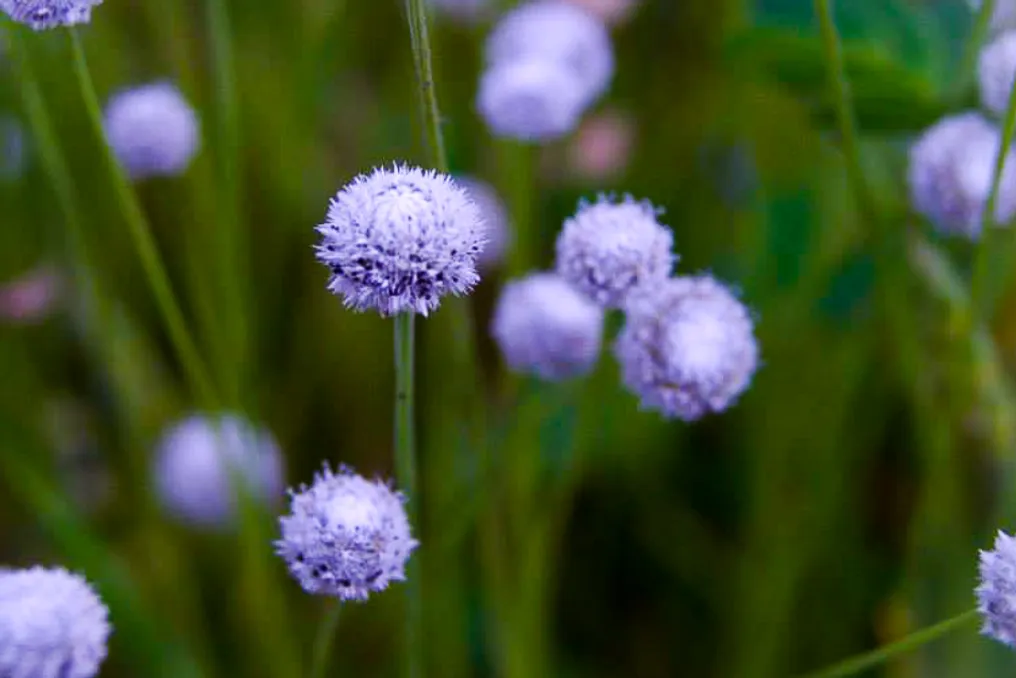
During the monsoon season, the rocky plateaus of Maharashtra undergo significant changes. Rainwater collects in shallow depressions, seasonal flowers appear, among which grow plants so small they are easy to miss.
Upon close inspection of Sundew leaves, tiny droplets reflecting light can be seen. They resemble dew, giving the plant an almost delicate appearance. However, these glistening droplets are sticky traps for insects.
Plants belonging to this group include Davbindu (Dew drop), Gavti Davbindu (local name Drosera indica), and Seetechi Aasave (local name Utricularia purpurascens). These local names refer to small carnivorous plants that appear on the famous Maharashtra plateaus during the monsoons.
Davbindu, or Drosera burmanni, is a tiny plant hugging the ground. Drosera indica, locally known as Gavti Davbindu, has thin leaves covered with glistening droplets. Another carnivorous plant found near Kaas, Utricularia purpurascens, is known by the local name Seetechi Aasave.
Every monsoon, such plants appear on the rocky plateaus of Maharashtra, becoming part of a seasonal ecosystem that exists for only a few rainy months before the landscape changes again.
How the monsoon transforms bare rocks into a living landscape
Consider the Kaas plateau in Satara. In dry months, its surface can look like solid rock with very sparse vegetation. However, a transformation begins in June thanks to the monsoons. Water collects in small hollows, and by August and September, seasonal grasses and flowers spread across the plateau.
Lateritic plateaus are found in parts of the Western Ghats of Maharashtra, including the Panchgani-Mahabaleshwar landscape and the northern Western Ghats. The word 'lateritic' sounds technical, but the landscape itself is easy to visualize. Laterite is a hard, iron-rich rock formed through intense weathering, usually in regions with abundant rainfall. On these plateaus, it creates a rocky surface with an extremely thin layer of soil.
These conditions make it difficult for many plant species to grow. Nevertheless, for some highly specialized species, this is a habitat to which they have adapted. In a 2012 study, botanists Manoj M. Lekhak and Shrirang Yadav surveyed 10 high-altitude lateritic plateaus in southwestern Maharashtra. They recorded 356 species and five varieties of herbaceous plants, including 67 endemic species. These high-altitude lateritic plateaus are locally called 'Sadas.'
Why do these tiny plants eat insects?
Typically, plants obtain nutrients such as nitrogen and phosphorus from the soil. However, on these rocky plateaus, the soil can be acidic, fine, and nutrient-poor. Carnivorous plants have adapted to supplement what they get from the soil with nutrients from tiny prey. Predation is one of the adaptations that helps plants overcome deficiencies in nutrients such as nitrogen, phosphorus, and sulfur.
A 2025 study conducted by Sarita Gosavi, Pratiksha Mestry, Swapnil Vyas, and Ankur Patwardhan and published in the Journal of Threatened Taxa covered the Panchgani lateritic plateau in the Satara district. Researchers recorded 189 plant species from 54 families, including 78 endemic taxa. Carnivorous plants accounted for 4.7% of the registered flora. This study also noted Utricularia albocaerulea as a vulnerable species and Utricularia praeterita as endangered.
How the glistening sundew catches its prey
The capture strategy of Davbindu begins with tiny hair-like structures covering its leaves. At their tips is a sticky substance. In the sun, these droplets sparkle like dew, which explains the local name Davbindu, related to dew drops. An unwary insect lands on the leaf and gets stuck. The plant then uses digestive enzymes to break down the prey and absorb nutrients from it. For the plant, this predation serves as a nutritional supplement; insects provide nutrients that are hard to obtain from poor soil.
The trap of the bladderwort is hidden from sight
Utricularia, or bladderwort, uses a different method. Its name comes from the tiny bladders found on the plant. These traps can create a suction mechanism that pulls in microscopic aquatic organisms when triggered. In Kaas, Utricularia purpurascens is locally called Seetechi Aasave. The mechanism may differ greatly from the sticky leaves of sundew, but both plants have adapted to the same fundamental problem: obtaining nutrients in habitats where the soil offers very little.
Life cycle synchronized with Maharashtra rains
These plateaus follow a seasonal rhythm shaped by the monsoons. Early rains bring the first seasonal plants and orchids. By August and September, flowering reaches its peak, with species of Eriocaulon and carnivorous Utricularia becoming noticeable. As the monsoons end, grasses predominate, and the seasonal vegetation begins to disappear. Thus, the plateau follows its own seasonal clock; what a visitor sees heavily depends on the time of their arrival.
Why these rocky plateaus can be underestimated
This short seasonal life cycle can lead to these habitats remaining unnoticed. A visitor arriving in summer might only see hard rocks and sparse vegetation. During the rains, the same surface reveals flowers, grasses, and carnivorous plants adapted to its thin soils and seasonal wet patches. Research on the Panchgani plateau showed that tourism, grazing, and soil alteration are among the factors affecting its plant diversity. Many of these plants grow in extremely thin soil or seasonal wet areas. Therefore, disturbing the surface can damage the microenvironments they depend on. The monsoon demonstrates that the dry landscape can hide most of the year: a highly seasonal ecosystem where even tiny patches of soil and water support unusual forms of plant life. Among the smallest are Davbindu, Gavti Davbindu, and Seetechi Aasave, appearing with the rains, catching their tiny prey and becoming part of the plateau's brief annual burst of life.