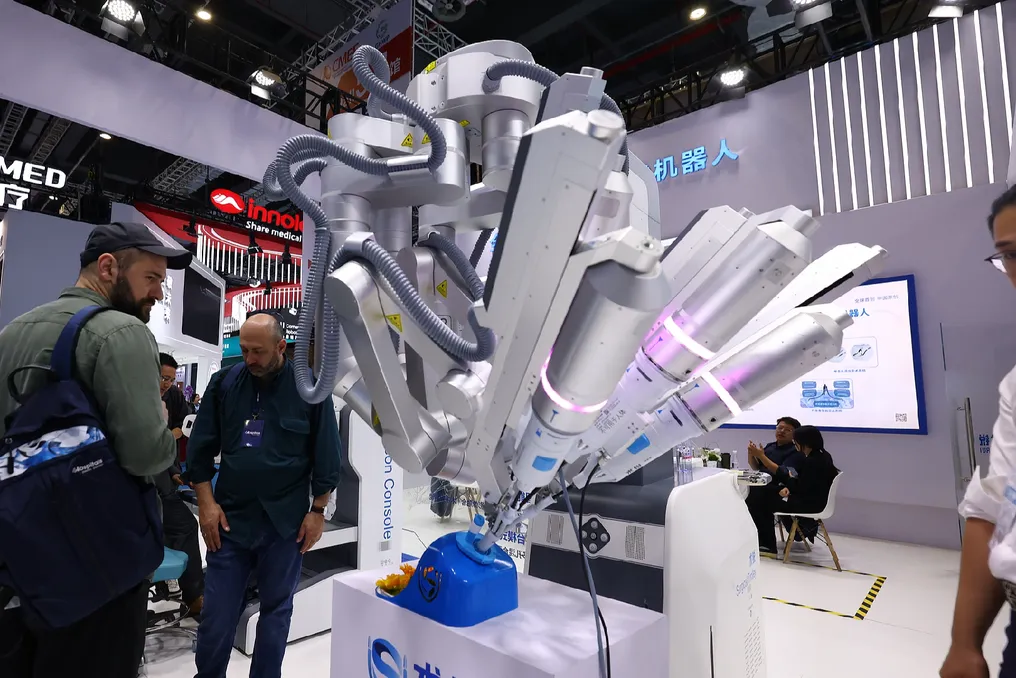
A recent case in the operating room of a Barcelona hospital demonstrated the integration of Chinese technologies into global healthcare. During the summer, surgeons at Val d'Ebron Hospital, one of Spain's leading public hospitals, used a robotic system developed and manufactured in Beijing to remove damaged tissue from a 12-year-old boy suffering from multiple kidney stones and organ damage. The operation was performed through a single incision only 2.5 centimeters wide, controlled from a console.
According to the hospital, this was the first pediatric operation in Europe performed using a single-access robot. This machine was a single-port robotic system from Surgerii Robotics in Beijing, supplied under a contract worth 2.42 million euros. This amount is the highest registered price for a Chinese surgical robot sold abroad and exceeds the price of the main system from the US market leader.
The Chinese robot successfully passed the hospital's tender requirements by offering installation and revalidation within 30 days, training ten leading surgeons across five departments, and performing eleven operations.
The deal in Barcelona is just an example of a broader trend: in the first half of 2026, China exported 480 million yuan ($71 million USD) worth of surgical robots, a 3.3 times increase compared to the previous year. Furthermore, export markets expanded from 23 countries and regions to 49, according to the General Administration of Customs (GAC).
China's export structure is changing as rapidly as its trade volumes. The Surgerii robot uses a self-developed 'serpentine arm' capable of bending at various angles and compensating for the surgeon's natural tremor. Over 95% of this robot's components are manufactured in China, which reduces costs by approximately half or a third compared to foreign competitors.
Simultaneously, developments are occurring in factories. In Shenzhen, desktop 3D printers from Bambu Lab have become an integral part of workshops from Mexico to Brazil, allowing small manufacturers to create flexible small-batch production lines without significant initial investment. In the first half of the year, China exported 3.62 million 3D printers, a 90.2% increase, and the export value rose by 109.3% to 9.61 billion yuan, according to customs data.
A significant portion of the new demand comes from regions where established Western suppliers have had little presence for a long time. In Astana, Kazakhstan, 20-year-old Zhansaya Abdurakhmanova studies computer vision and robotic manipulator control at the Workshop, as part of a professional training program supported by China. Under this program, Tianjin Institute of Vocational Education in China has established an AI training center jointly with L.N. Gumilyov Eurasian National University. Zhansaya told Hintian that such skills are in high demand. The workshop has already trained about 100 instructors and over 30 students. In May, President Kassym-Jomart Tokayev signed a decree on implementing AI in secondary schools across the country, including a pilot project to reduce the educational gap between urban and rural areas.
China's tools for intelligent water resource management are also reaching countries affected by climate change. At the Great Rivers Forum 2025 in Wuhan, an AI-based flood early warning platform attracted the attention of UNESCO's Centre for Wet Tropics in Kuala Lumpur, which is studying China's 'sponge city' approach—a method of designing cities to absorb and reuse rainwater—to combat increased rainfall in Malaysia. Chinese water projects in Pakistan, Guinea, and Sudan have improved access to water and electricity for millions of people.
Trade volumes are substantial. China's trade with Belt and Road Initiative partners increased by 14.8% in the first half of the year, reaching 12.97 trillion yuan, which accounts for slightly more than half of the total volume. Trade with Africa grew by 19.6%, and with Latin America by 16.2%; exports of high-tech products jumped by 39%.
At Khalifa Port in Abu Dhabi, the container terminal, jointly built and operated by COSCO Shipping Ports and Abu Dhabi Ports, has become one of the busiest hubs in the Persian Gulf since its opening in December 2018. In 2024, it handled 1.845 million TEUs, a 36% increase from the previous year, and accommodated over 1000 voyages. Its general manager notes that continuous intelligent upgrades have made it 'the smartest terminal in the Middle East.'
This project represents a miniature global supply chain: gantry cranes from Shanghai by ZPMC manufacturer, electrical automation from German Siemens, and systems integration from China.
In Malaysia, a joint venture between the Chinese industrial internet company GYMD and local partner Altel Group, observed by Prime Minister Anwar Ibrahim, became the country's first comprehensive provider of digital services for the automotive value chain. At the national automaker Proton's factory, the Geega platform, industrial software that digitally manages entire production sites, links manufacturing and supply. The BRICS smart manufacturing solutions catalog released this year attributes to this platform a reduction in equipment downtime by 10–20%.
Macroeconomic indicators confirm this trend. According to GAC, China's imports grew by 22.1% in the first half of 2026, outpacing exports by 8.7 percentage points, contributing more to trade growth than exports themselves.
Returning to Barcelona, the boy's two-day recovery served as a human thread in a much larger story. As noted by GAC Deputy Administrator Wang Jun, stable Chinese supply chains are becoming 'a key node connecting all parties in mutually beneficial cooperation.'