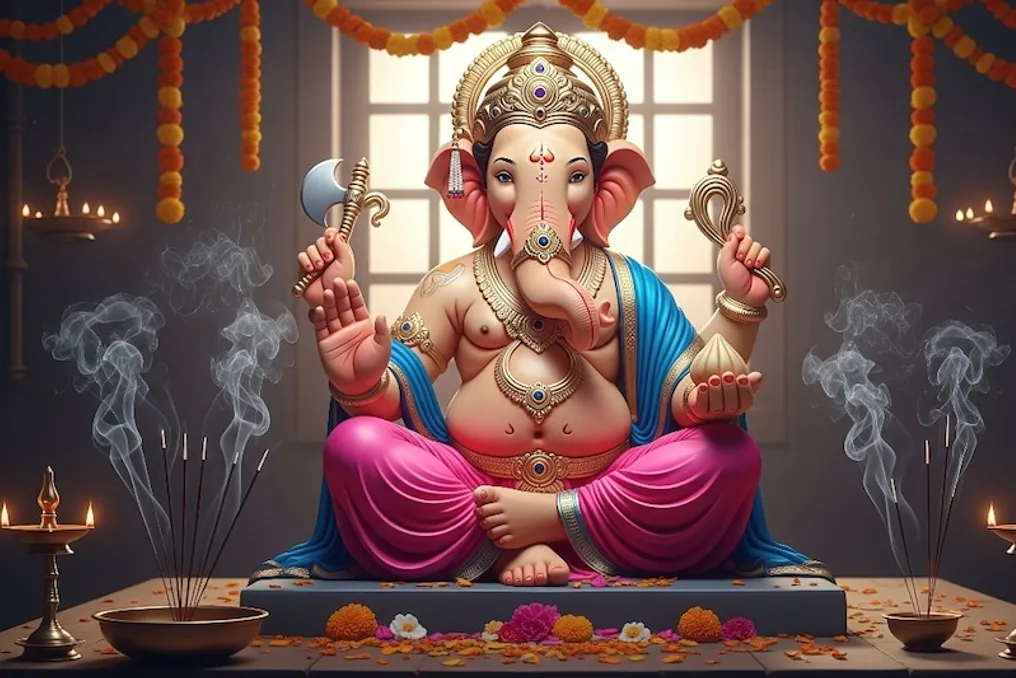
There is a belief that the head of Ganesha, which legend says was severed by Mahadeva (Shiva) thousands of years ago, is preserved in this mysterious cave. Many people are amazed by these stories. According to the common story, one day the god Shiva separated his son Ganesha's head from his body in anger. However, after this, he revived him by attaching the elephant head to the body.
The question arises: where did that head of Ganesha, severed by Shiva, go, and where is it today? Before learning this secret, it is necessary to tell how this whole story began.
According to legends, Parvati created Ganesha with her own hands. It is said that one day Mother Parvati was about to take a bath. She formed the figure of a boy from her ubtan and breathed life into him with her own power. Thus, the boy was born, whom his mother named Ganesh. Parvati entrusted Ganesh to guard the entrance while she bathed, not letting anyone inside. The boy Ganesh obeyed his mother's command and began guarding the door.
At this time, the god Shiva approached them and tried to enter. The boy Ganesh did not recognize the god Shiva, so following Mother Parvati's order, he did not allow Shiva to enter. Shiva repeatedly tried to convince Ganesh, but he did not move. Seeing this, Shiva became angry. He warned Ganesh, but when he did not obey, Shiva struck him with the trishula, severing the head from the body.
According to belief, the blow of Shiva's trishula was so strong that the human head of the boy Ganesh flew off the body and fell into the underworld (Patala Lok), far from Kailash. When Mother Parvati came out of the bath and learned about this incident, she was deeply distressed and angry. Seeing her son in such a state, Parvati demanded that Shiva revive Ganesh.
Where is Ganesha's head located in Patala Bhubneshwar?
Seeing Parvati's sorrow, the god Shiva ordered his ganas to find Ganesha's head. However, when all the ganas returned empty-handed, Shiva ordered them to bring the head of any creature they encountered on the way. After this, the ganas brought the head of an elephant calf. Shiva placed the elephant head on Ganesh's body and revived him. Since then, Ganesh is also known as Gajanan.
It is interesting that according to one of the beliefs, the real human head of Ganesha is still in the cave. It is said that the head that Shiva cut off in anger was installed precisely in this cave. This cave is known as Patala Bhubneshwar. A stone figure of Ganesha, known as Adi Ganesh, is depicted here. This cave is located approximately 14 kilometers from Gangolihata in the Pitargarh district of Uttarakhand state.
According to beliefs, Adi Shankaracharya discovered this cave in the Kali Yuga.
Brahma-Kamala with 108 petals
It is believed that Lord Shiva himself protects the severed head of Ganesha in the Patala Bhubneshwar cave. Directly above the stone figure of Ganesha is a rock shaped like a Brahma-Kamala with 108 petals. It is recounted that divine drops continuously drip from this Brahma-Kamala onto the stone figure of Ganesha. According to religious beliefs, Lord Shiva himself installed this Brahma-Kamala here.
The mystery related to four ages
There is also a belief that four stones symbolizing four ages are installed in this cave. One of these stones is considered a symbol of Kali Yuga. It is said that this stone slowly moves upwards. According to belief, the Kali Yuga will end on the day this stone touches the ceiling of the cave. Although this is a religious belief, there is no scientific proof for it.
Numerous religious symbols in the cave
Inside the Patala Bhubneshwar cave, there are many religious signs and figures. It is believed that shrines of Kedarnath, Badrinath, and Amarnath can be seen here. Near the figure associated with the Baba Amarnath cave, large stone structures are visible, which are considered symbols of Shiva's hair. Furthermore, there is a belief that figures related to Shiva's asceticism, such as Kamandal and Khadun, are inside the cave.
It is also said that the image of Kala Bhairava's tongue can be seen in this cave. According to religious beliefs, if a person can enter through the mouth of Kala Bhairava and reach his tail, he will attain liberation.
Does a secret path lead to Kailash?
Another very mysterious belief is connected to the Patala Bhubneshwar cave. It is said that a secret passage leads from this cave to Kailash. However, this claim also lacks confirmed scientific or historical basis.
Another belief, related to the epic Mahabharata, states that the Pandavas stopped near this cave on their way to heaven. It is said that they sought blessings from Ganesha and played Chaupar with Lord Shiva. Today, Patala Bhubneshwar is famous for its mysterious cave and religious beliefs.