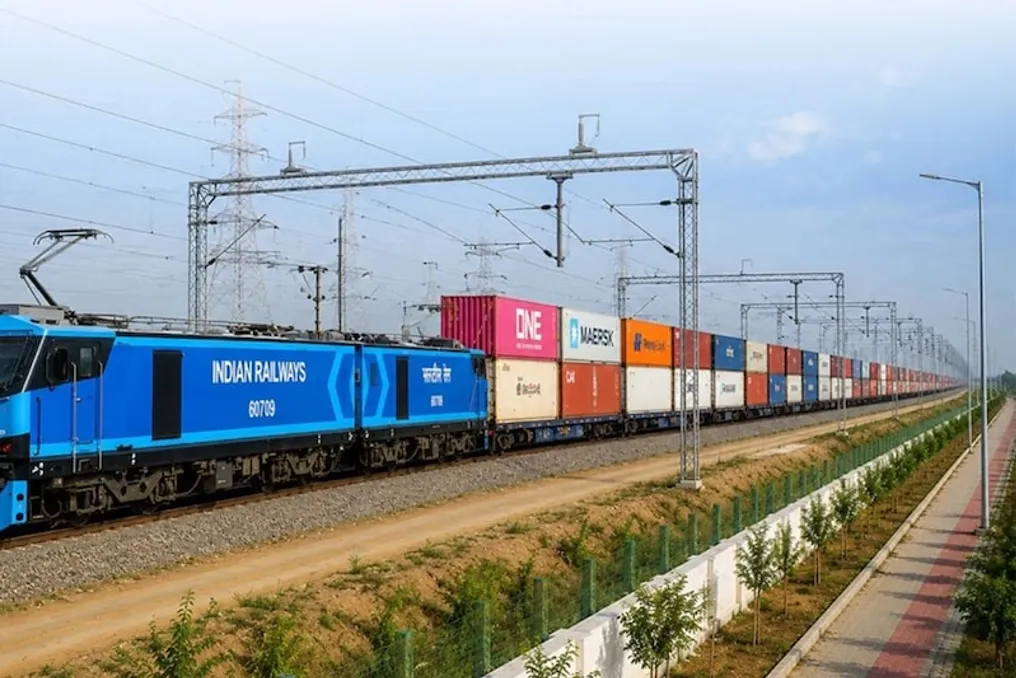
Significant changes occurred in the country's freight transport network on Tuesday. Prime Minister Narendra Modi inaugurated an important section of the Dedicated Freight Corridor (DFC) in Vadodara, after which the entire 2843-kilometer DFC network became operational. The completion of the last three sections, totaling about 326 kilometers, allowed the Western Dedicated Freight Corridor (WDFC) of 1506 kilometers to be fully commissioned.
The WDFC stretches from Jawaharlal Nehru Port (JNPT) in Navi Mumbai to Dadri near Delhi. With the launch of sections between New Sanand (N)-New Makarpura, New Umbargon-New Safle, and New Safle-JNPT, the entire network of this corridor is now operational. The final stretch from Vaitarna (Safle) to JNPT is also now available for freight trains. This connection will allow for the accelerated delivery of goods arriving from major ports such as Mumbai Port, Pipavav, Mundra, and Kandla to Delhi and major North Indian markets, in addition to JNPT.
WDFC handles the transportation of ISO containers from JNPT, Mumbai Port, Pipavav, Mundra, and Kandla to Inland Container Depots (ICDs) located in Tuglakabad, Dadri, Dhandari Kalan, and Hatuvase. Furthermore, an increase in the transport of commodities such as fertilizers, grains, salt, coal, iron ore, steel, and cement is expected.
The need for a dedicated freight corridor arose due to the prolonged congestion of the country's main railway routes with both passenger and freight trains. On key trunk lines, such as Mumbai-Delhi and Hauzra-Delhi, capacity reached 115–150 percent. Therefore, it was decided to create a separate corridor for freight trains to segregate routes for passenger and freight services and increase the speed of both types of transport.
The Eastern Dedicated Freight Corridor (EDFC) is the country's second major freight network. This corridor, spanning approximately 1337 kilometers, runs from Ludhiana in Punjab to Sonnagar in Bihar and primarily serves the coal and mineral traffic of Eastern India. Within the EDFC, there is a 936-kilometer electrified double-track section between Sonnagar and Dadri, as well as a 401-kilometer electrified single-track section between Ludhiana (Sahanewal) and Khurja.
One of the significant advantages of the full commissioning of the EDFC in October 2023 is that it bypasses many densely populated cities, including Mirzapur, Prayagraj, Kanpur, Itawu, Firozabad, Tundla, Hathras, Aligarh, Hapur, Meerut, as well as areas like Muzaffarnagar, Ambala, Rajpura, Sarhind, Doraha, and Sahanewal.