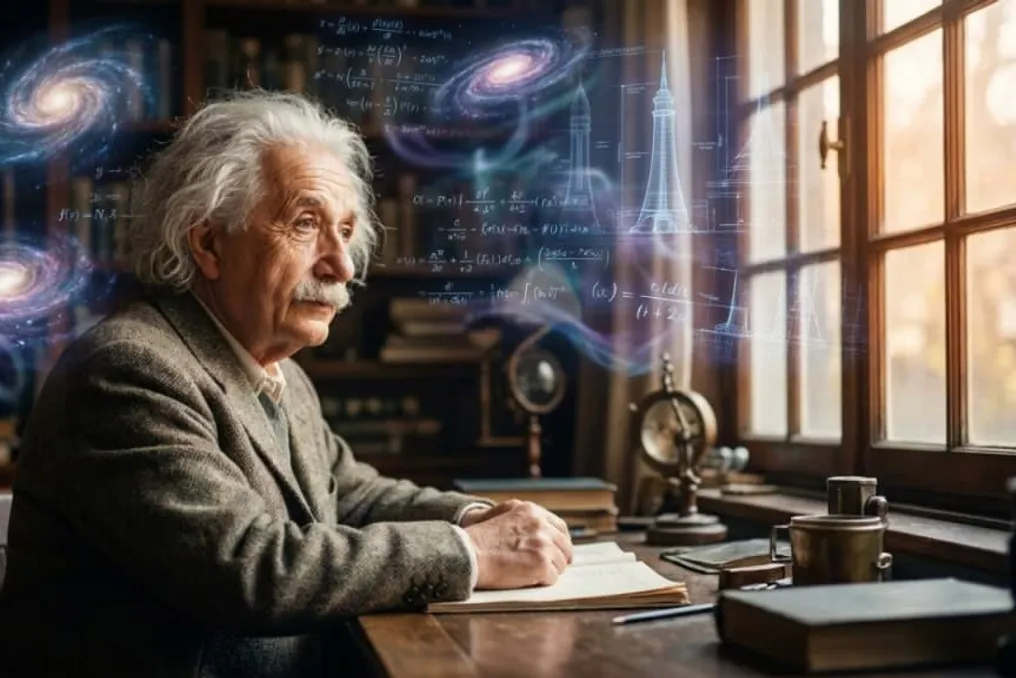
Researchers have successfully observed, for the first time, a gravitational effect predicted by Albert Einstein's theory in a falling quantum object. This experiment demonstrated that one of the pillars of gravity theory maintains its compatibility with quantum mechanics under the tested conditions.
The investigation was conducted by an international group composed of scientists from Ben-Gurion University of the Negev, the University of Ulm, and the University of Oxford, with the participation of Nobel laureate physicist Sir Roger Penrose. The findings were published in the journal Science Advances on September 2nd.
This result is significant because modern physics relies on two highly successful structures that still lack complete unification: quantum mechanics, which describes the behavior of tiny particles, and Einstein's theory, which explains gravity, the fall of bodies, and large-scale cosmic structure. The new test focused precisely on the area where these two descriptions intersect.
Experiment Details
The quantum phase measured during the experiment corresponded to the prediction obtained by applying Einstein's equivalence principle to this specific type of quantum wave. This principle postulates, in a simplified manner, that gravity must be nonexistent locally for an observer in free fall, which illustrates the sensation of weightlessness felt in a falling elevator.
Although this principle has already been validated with high accuracy using ordinary matter, the challenge lay in testing it directly on quantum entities, which have the ability to exhibit wave-like behavior and traverse multiple paths simultaneously.
The researchers emphasize that although previous work had used quantum particles to measure gravity, the difference in this new study was performing the first direct measurement of the expected quantum phase for a body in free fall.
Ron Folman, the study's lead author, stated: "This is a unique paper because it combines a difficult experiment with a long-range theoretical interpretation about one of the most fundamental questions in physics: how can gravity, described by Einstein's theory, and quantum theory be unified into an understanding of the Universe?" Vlatko Vedral, a professor at the University of Oxford and co-author, added that the experiment pushed quantum mechanics to one of its most intriguing frontiers.
Limitations and Next Steps
Despite the relevance of the outcome, the scientists themselves are cautious about defining the limits of this discovery. They clarified that the experiment did not generate a unified theory between quantum mechanics and gravity, nor did it prove that gravity itself is quantum. What was demonstrated is that Einstein's equivalence principle remains consistent with quantum mechanics within the scope of the analyzed conditions.
Additionally, the result does not invalidate the hypothesis proposed by Roger Penrose, which suggests that quantum mechanics may fail when objects with sufficient mass maintain superposition states for prolonged periods. However, the current experiment did not use objects with enough mass or prolonged superpositions to test this speculation.
The team plans to expand the methodology to include heavier objects, such as nanodiamonds, and tests for this purpose are already underway in the same group at Ben-Gurion University of the Negev. The research involves collaborations between Ben-Gurion University of the Negev, the University of Oxford, the University of Southampton, the German Aerospace Center, the Ulm Quantum Technologies Institute, the University of Ulm, and Texas A&M University.