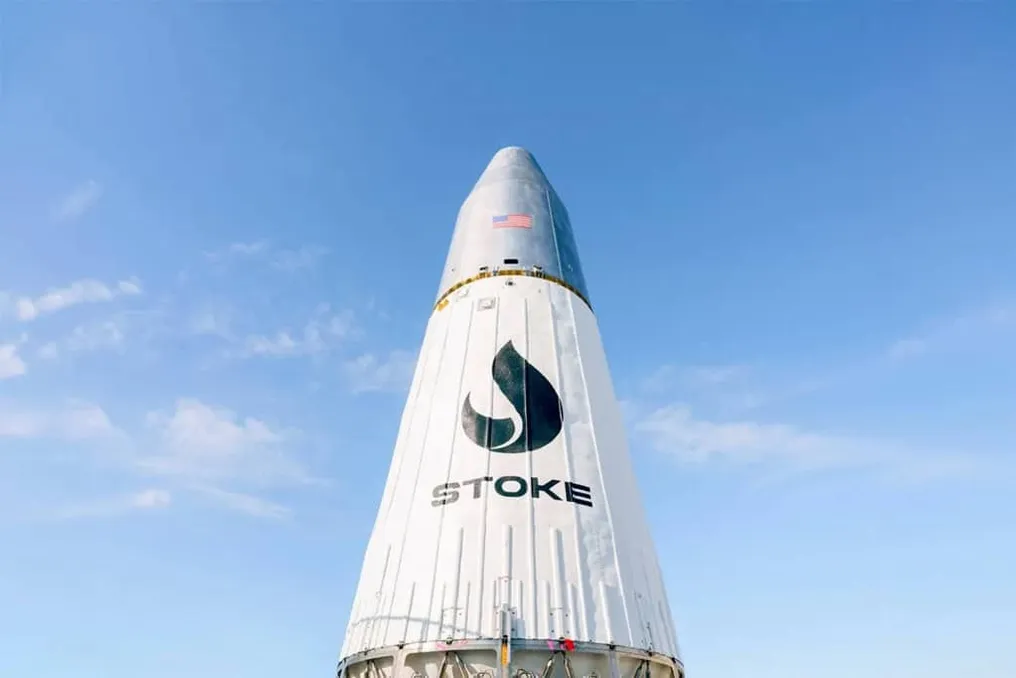
Stoke Space secured an investment of over US$1 billion (approximately R$5.1 billion) in its Series E funding round. This capital aims to boost the development of fully reusable rockets and compete with SpaceX in the low-cost launch sector. The company confirmed the initial closing of this round, which was led by Point72 Ventures and Spark Capital.
The raised funds will be allocated to expanding production capacity, increasing flight cadence, and financing the creation of a new generation of rockets. With this new investment, Stoke Space now totals US$2.3 billion (about R$11.7 billion) raised to date.
Thermal Protection Strategy
Andy Lapsa, CEO of Stoke Space, told TechCrunch that this round is crucial for scalability, allowing for infrastructure construction, increased production and flight frequency, as well as financing the second-generation vehicle.
Among the participating investors were General Innovation, Glade Brook Capital, US Innovative Technology, Washington Harbour Partners, Woven Capital, and Y Combinator. A crucial technical challenge is protecting the rocket's second stage during atmospheric re-entry, where it experiences extreme temperatures. While SpaceX faces difficulties in defining ideal materials and configurations for this protection, Stoke opts for an active cooling solution.
The company plans to circulate super-cooled liquid hydrogen through the vehicle's thermal protection system. According to Lapsa, this technology has already been extensively tested on land and will be implemented in the first flight. He added that it is possible to circulate excess coolant, adopting a cautious approach in initial flights.
Rocket Schedule and Capacity
Stoke's first rocket, named Nova Pathfinder, is scheduled for its inaugural flight in early 2027. This estimate was established after conducting various structural and operational tests of the first stage at the company's facilities in Moses Lake, United States. The subsequent phase will involve individual engine and stage ground tests before integrating them onto the launch platform.
Lapsa explained that the ground system and the rocket were tested separately, and the next step is to combine them. Stoke already has launch contracts for the Pathfinder, which can carry up to three metric tons to low Earth orbit, which Lapsa considers the largest debut vehicle from an American rocket company.
Despite the planning, the company itself acknowledges the inherent risks, given that few rockets complete their first flights strictly on schedule and with total success; merely reaching orbit would be a milestone for the startup. Lapsa assured that Stoke has several Pathfinder vehicles in production and is confident in putting them on the market and into orbit, regardless of this funding round.
Additionally, Stoke presented the Nova Block 2, a larger rocket that has been under development for years. Based on Pathfinder technologies, the Block 2 will have the capacity to carry 15 metric tons to low Earth orbit, slightly surpassing the capacity of the Falcon 9. The intention is to put this new rocket into operation in 2029, coinciding with the period Elon Musk predicted for the retirement of the Falcon 9.
For Lapsa, a potential discontinuation of the Falcon 9 would increase the disparity between supply and demand for launches. He stated that regardless of the Falcon 9's retirement, the space industry and economy grow at the same pace as launches, especially those aimed at third-party customers. The relevance of this scenario is accentuated by the advancement of Starship, allowing companies and governments to compete for space with their own SpaceX projects. Stoke, however, has not disclosed plans to operate its own space assets.
Competitive Expansion in Europe
Stoke is not the only one seeking capital to challenge SpaceX. The Exploration Company (TEC), a European company, announced a Series C round of US$450 million (about R$2.3 billion), making it the largest Series C ever achieved by a European space company. TEC operates in Germany, France, Luxembourg, Spain, and Italy and will use the new funds to create a European alternative to the services offered by SpaceX.
This fundraising occurred at a time of growing demand for orbital launches and the perception that space infrastructure cannot solely depend on SpaceX. TEC is led by Hélène Huby, a French citizen with two decades of experience at Airbus and ArianeGroup. Her goal is to transform the company into a European provider of reusable vehicles capable of carrying heavy payloads.
The company already has 10 contracted Nyx missions, totaling over US$2 billion (about R$10.2 billion) in commitments. Clients include entities such as the European Space Agency (ESA) and NASA. TEC's core project is Nyx, a reusable capsule similar to SpaceX's Dragon, which will transport cargo and, eventually, people. The objective is for Nyx to dock with the International Space Station (ISS) and return safely to Earth by November 2028.
The resources will also initially finance the Storm engine program, which will serve as the basis for future launches. Huby acknowledges that Europe needs to progress significantly to compete in the large launcher segment, citing Isar Aerospace, which recently launched its Spectrum rocket from Norway, but emphasizing that TEC aims for a much larger vehicle.
For Huby, expanding space infrastructure is vital due to projected growth in orbital applications. She predicted that in the next five to ten years, half of broadband communications could come from space, and data centers might be in orbit, requiring giant rockets and high launch frequency. To achieve this pace, TEC focuses on reusability, planning to use full-flow combustion cycles in its engines, a technology employed by SpaceX and Stoke.
TEC's expansion received endorsement from European authorities, including French President Emmanuel Macron and European Commission President Ursula von der Leyen. The announcement was made shortly before the International Space Summit in Paris, France, an event where the company signaled possible new disclosures about its project.