Many people have childhood memories that raise questions about their veracity. An example of this is the SEAT commercials, which were present in Brazil for a brief period, from the mid-1990s to the beginning of the following decade. At that time, television dominated the media, and ads shown during programming were the main way brands and products were exposed to the public.
There is a phenomenon known as the Mandela Effect, where there is a conviction that something was a certain way, but the reality is different. The author recalls believing that the ads said 'SIAT' (pronounced like Fiat, but with an S instead of an F), but later research confirmed that the correct name was 'SEAT.'
A ten-year-old child's analysis, who already showed interest in cars, hypothesized that the intention might have been to confuse the brand with Fiat, which had been established in Brazil for over twenty years. The author realized that SEAT was a newly arrived brand, coinciding with the boom in imports that occurred after the opening of Brazilian ports in 1990.
SEAT actually started as a manufacturer of Fiat models under license in Spain. This agreement was conceived in 1948 and culminated in the inauguration of SEAT in 1950. Several iconic Fiat models were renamed SEAT, maintaining similar visuals and names. The first was the SEAT 1400, based on the Fiat 1400, a family car designed by Dante Giacosa, available as a sedan or station wagon, equipped with a 1.4-liter four-cylinder engine and a four-speed manual transmission.
Later, in 1957, the SEAT 600 appeared, which was a licensed version of the Fiat 600. This model replicated the Italian success and became one of the highest-volume cars produced by SEAT in its early years, symbolizing the so-called Spanish Miracle, a period of intense economic growth between 1959 and 1974, which ended with the 1973 Oil Crisis.
Another relevant model was the SEAT 1430, sold between 1969 and 1975, which was a rebranded Fiat, specifically the Fiat 124. In 1977, two years after the car was discontinued, SEAT participated for the first time in the World Rally Championship (WRC) using a 1.8-liter engine at the Monte Carlo Rally, achieving third place overall.
Even with the economic slowdown, SEAT continued its development. In the 1980s, the brand launched its first original model, the SEAT Ronda. This caused a conflict with Fiat, which alleged direct copying of the Fiat Ritmo, given that the vehicles were very similar. The case was taken to the Paris Arbitration Chamber, where SEAT presented an example of the Ronda with the differences painted yellow, leading the commission to conclude that the models were sufficiently distinct.
This disagreement, combined with the impact of the Oil Crisis, led the companies down separate paths. In 1982, the partnership ended when SEAT and the Spanish government requested a large investment from Fiat to maintain the business.
Volkswagen took advantage of the situation, seeing SEAT as a vulnerable entity after the break with Fiat. In 1982, Carl Hahn, then leader of Volkswagen, identified an opportunity: SEAT needed robust financial support, and VW sought to expand its operations beyond German borders.
Initially, the collaboration was practical, with SEAT assembling German vehicles, such as the Passat/Santana and the Polo, in Spain. The relationship quickly deepened: in 1986, Volkswagen acquired the majority of shares in the Spanish brand, completing the acquisition at the end of 1990. SEAT thus became the first 100% foreign subsidiary belonging to the Volkswagen Group, and the marriage resulted in profits, with SEAT producing more than 15% of the group's global cars in just two years after the majority purchase.
A milestone of this new phase occurred in the early 90s with the inauguration of the modern Martorell factory near Barcelona. With full access to Volkswagen's platforms and parts, SEAT began producing cars with Spanish identity but German engineering.
The first project fully developed under the aegis of VW was the Toledo sedan, launched in 1991. However, the turning points came in 1993, with the second generation of the Ibiza hatchback and its sedan version, the Córdoba, which combined attractive design with the reliability of Volkswagen engineering.
With a renewed product line, German engineering, and financial solidity, SEAT sought global expansion. When planning its entry into Brazil, the brand focused on a profile suitable for the local market, led by the Ibiza and Córdoba. Aesthetically, the cars featured bold lines, created by Giorgetto Giugiaro's Italdesign studio, giving them the look of an imported vehicle. Internally, however, they used the same platform as the Volkswagen Polo Classic, and the GLX and SXE versions of the Ibiza and Córdoba were equipped with the Volkswagen 1.8 AP engine.
It is worth noting that the VW Polo Classic, a sedan from VW, arrived in Brazil in December 1996, aiming to replace the Voyage and Autolatina models. VW tried to position it as a superior car, offering a manual sunroof, ABS brakes, and dual airbags, although Brazilians primarily saw it as an enhanced Voyage.
A notable irony was the route of the 1.8 AP Mi injection engine: these engines were manufactured in Brazil, at the São Carlos (SP) plant, received a seal to be sent to Argentina, where the cars were assembled, and returned to Brazil already installed.
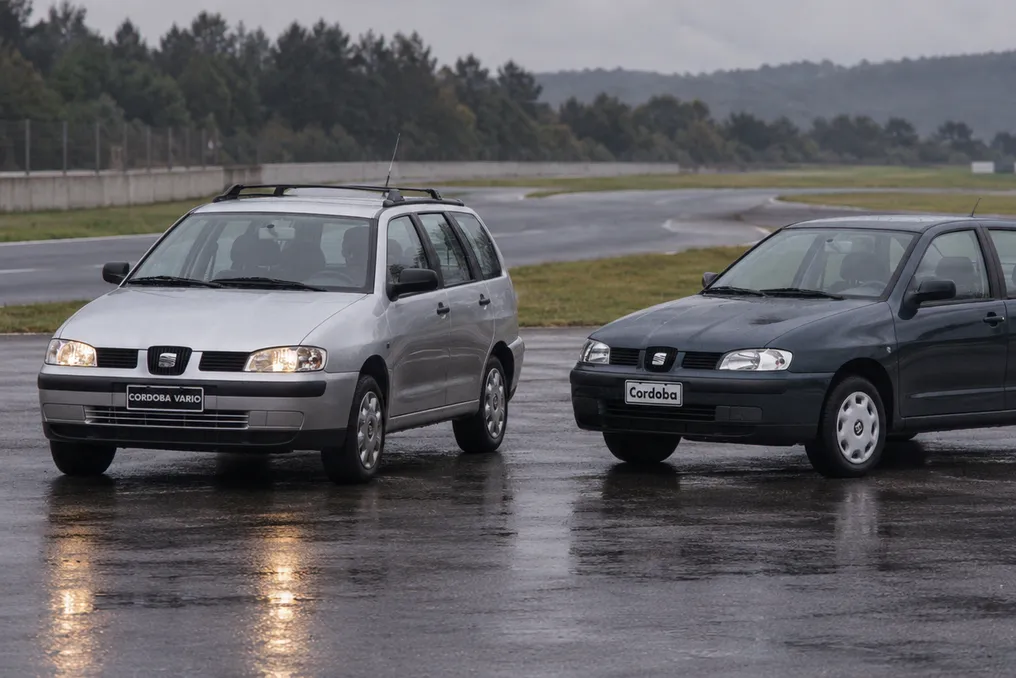
The Spanish line also diversified, adding the Córdoba Vario station wagon and the Inca van, which was a superior model to the VW Caddy. Mechanically, the Ibiza received an entry-level version with a 1.0 16V engine (same as the Gol), but the significant advance came with the 1.6 SR engine, part of the EA113 family, which also equipped the Golf Mk4 and Audi A3 sold in Brazil, providing more modern and smooth performance.
The final chapter of these cars in Brazil involved a restyling that occurred at the turn of the millennium, which is little remembered. Between 1999 and 2000, SEAT introduced the facelift of the Ibiza and Córdoba (GP01 project) to the European market, aiming to modernize the design for the 2000s. The headlights became sportier, replacing the separate glass lens with a single acrylic piece, and the piece connecting the taillights was removed.
The interior underwent a more drastic transformation, abandoning the square architecture of the nineties for a more fluid and sophisticated dashboard. The more expensive versions included a centrally illuminated digital screen in red, integrating radio (with cassette player) and air conditioning controls.
However, these revamped models failed to reach the expected potential. The sharp devaluation of the Real in 1999 turned imported cars into sudden luxury items, causing SEAT prices to skyrocket and sales to drop drastically. With no alternatives, the brand ended its operations in the Brazilian market in the early 2000s.
This exit did not impact SEAT's trajectory in Europe. On the contrary, after leaving Brazil, Volkswagen consolidated the vision of transforming SEAT into its 'young and sporty' brand, functioning as a Spanish equivalent of Alfa Romeo, promoting the slogan 'auto emoción' and the success of the medium hatchback Leon.