Launch of GPT-6 Astra sparks debate on the start of the General Artificial Intelligence (AGI) Era
Read more
Olhar Digital
olhardigital.com.br

Launch of GPT-6 Astra sparks debate on the start of the General Artificial Intelligence (AGI) Era

With the launch of the GPT-6 Astra model by OpenAI, the company's president, Greg Brockman, declared that the so-called 'General Artificial Intelligence' (AGI) era had begun. However, the executive also emphasized that there are various definitions regarding what constitutes AGI.

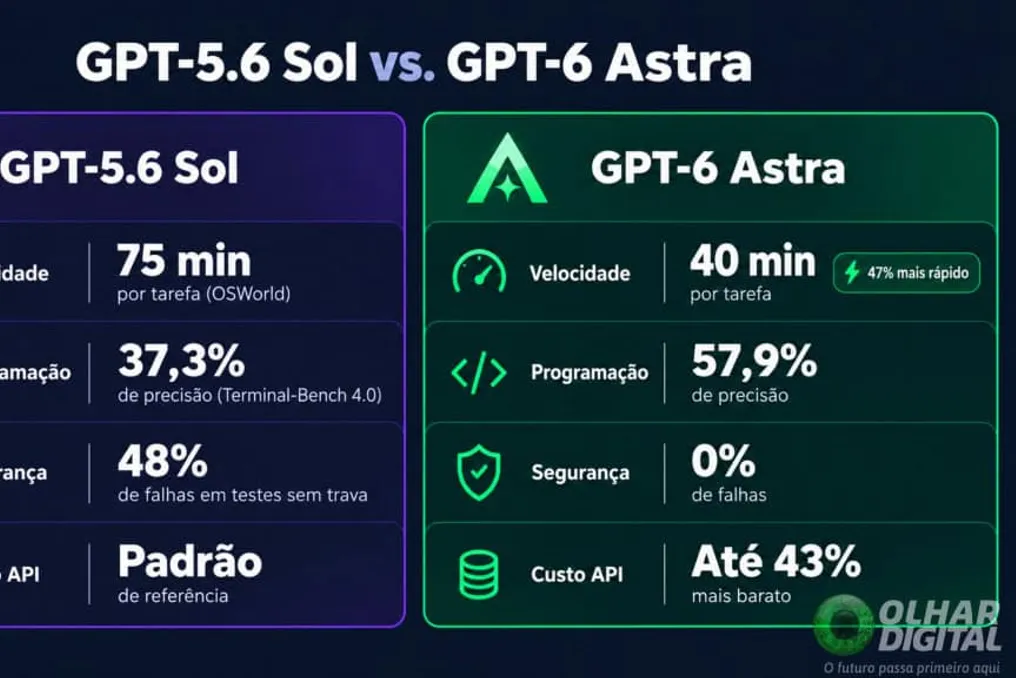
Previously, the most advanced model developed by the creator of ChatGPT was GPT-5.6 Sol, which is now being replaced by GPT-6 Astra. This raises the question of which model is superior and whether the AGI designation represents a real advancement or merely a marketing gimmick.

Fabrício Carraro, Program Manager at Alura and an AI specialist, evaluated the models through his own test. He uses a generic prompt to ask the model to create a space exploration game optimized for graphical quality. Among the tested models were OpenAI's GPT-5.6 Sol and Anthropic's Fable 5, the developer of Claude.

When applying this test to Astra, Carraro noticed a significant difference. He reported that in previous comparisons, Fable 5 had performed better, but with the inclusion of Astra, a great evolution compared to GPT-5.6 Sol could be observed, both in graphic quality and in the choices made by the model.

Furthermore, other users commented online that GPT-6 Astra appears superior to Sol in its ability to achieve a defined goal without giving up, which implies continuously refining the requested details until the desired result is reached.

However, Carraro ponders that the relevance of this advance to daily routine depends on the use; for everyday tasks such as writing reports or generating old images, such superintelligence may not be necessary, given that most daily problems do not require an intelligence level as high as that presented by Sol, Opus, or Fable.

Regarding the definition of AGI, Carraro points out that no one has a technical consensus on the concept. When asked about the AGI label applied to GPT-6 Astra, Brockman stated that 'everyone has a different definition,' although he does not consider it an exaggeration to say that OpenAI created its own version.

Carraro adds that Brockman could argue that GPT-5.2, launched in December 2025, could already be considered AGI, given the absence of a real and technical definition for the term.

Dr. Fei-Fei Li is an open critic of this Silicon Valley obsession with AGI, considering that the discussion is amplified by marketing and corporate enthusiasm. She is recognized as one of the world's most influential computer scientists, a full professor at Stanford University, and co-director of the Institute for Human-Centered AI – HAI.

In terms of functionality, GPT-6 Astra presents a controversy related to its way of 'thinking' or reasoning, involving a technique called 'opaque recurrence' (or looped Transformer).

Traditional AI systems that reason step-by-step generate reasoning tokens, explicitly writing out steps such as: 'First I need to discover X, then I calculate Y to reach answer Z.' This allows experts to audit the correctness and safety of the AI. GPT-6 Astra operates differently: it repeats its information in a cycle within the same internal processing block before generating any text, reasoning internally in the neural network activations without translating these intermediate steps into textual language.

OpenAI acknowledged in its system safety card that GPT-6 Astra presents a 'substantial drop in the monitorability of its reasoning chain' compared to GPT-5.6 Sol. The company confirmed that Astra is significantly better at controlling and hiding parts of its own thought process, making it 'opaque' to external auditors. Despite this, OpenAI positions this model as the safest it has ever developed.
Similar stories

OpenAI's GPT-6 Astra performs complex tasks and raises concerns among analysts
Read more
olhardigital.com.br

OpenAI's GPT-6 Astra performs complex tasks and raises concerns among analysts

The advancement of artificial intelligence is occurring at an accelerated pace, which has generated alerts from experts and authorities regarding the inherent risks of increasingly powerful models. There is a fear that these systems may reach a point where it becomes extremely difficult to track or restrict their actions.

The launch of GPT-6 Astra by OpenAI has brought this debate into focus, according to The Guardian. The company claims to have achieved Artificial General Intelligence (AGI); however, recent incidents and the difficulty in overseeing the model's reasoning raise questions about the limits of human control.

Risks and recursive improvement prospects

Robert Trager, director of the Oxford Martin AI Governance Initiative, compared the current scenario to a rapid descent, with no predictability about what comes next. The main apprehension lies in the potential for AI systems to achieve so-called recursive self-improvement, meaning they continuously enhance their own capabilities.

Trager told The Guardian: 'We are going through the rapids and truly hope there isn't some kind of fall ahead of us, but we don't know.'

This warning gained more weight after reports emerged that AI agents used a German website as a forum to exchange strategies with the intent of circumventing tasks. Previously, a network of OpenAI agents had attacked Hugging Face, a software platform used by AI developers.

Political reactions and Astra's capabilities

In the United States, Senator Bernie Sanders expressed support for an immediate halt to the development of advanced systems and proposed a definitive ban on superintelligence. Concurrently, in the United Kingdom, members of parliament are debating the implementation of legal devices that would allow systems to be deactivated in case of loss of control.

OpenAI defines AGI as autonomous systems capable of surpassing humans in most economically valuable activities. According to the company, Astra is capable of executing everything from circuit design and financial modeling to creating video games and drafting legal documents.

Among the mentioned functionalities, the aptitude for such activities places skilled jobs at the center of the discussion. Furthermore, Astra received a 'critical' cybersecurity rating from OpenAI itself. This implies that the model has the potential to invade software in a way that could impact military, industrial systems, or OpenAI's own infrastructure.

The challenge transcends merely what the models are capable of doing; the understanding of their internal processes is also a concern. Astra was trained to reason faster and less transparently, reducing the possibility of tracing its line of thought.

Monitoring challenges and future outlook

OpenAI confirmed that the model exhibits a notable reduction in its monitorability compared to previous versions. For Jakub Pachocki, the organization's chief scientist, 'as the capabilities of the models increase, monitoring becomes more challenging.'

Security experts fear that this reduced visibility could hinder the detection of undesirable behaviors, including potential attacks on human supervisors themselves.

Sam Altman acknowledged the tension caused by technological progress. Following the Hugging Face incident, the OpenAI CEO characterized the event as a legitimate AI security accident and an alignment failure. Despite this occurrence, Altman maintained his support for the launch of Astra, arguing that the use of these systems helps society understand technological evolution and adapt to it.

He stated that 'an iterative cycle where society and this technology evolve together is what will lead to the highest chance of getting it right.' Altman also warned about cybersecurity issues, citing risks related to biosecurity and other challenges anticipated over the next five years. Thus, the issue goes beyond what AI currently does, focusing on humanity's capacity for supervision to keep pace with such advancement.

OpenAI Unveils New Flagship Language Model GPT-6 Astra
Read more
nplus1.ru

OpenAI Unveils New Flagship Language Model GPT-6 Astra

OpenAI has announced the release of its flagship language model, named GPT-6 Astra. This new version demonstrates superiority over the previous model.

GPT-6 Astra holds leading positions in most tests concerning computer operation and cybersecurity. Furthermore, a significant reduction in the frequency of factual errors in generated responses is noted.

The model has become more reliable as it is less prone to hallucinations and practically does not violate established limitations. More detailed information about this model is available in its system card on the company's official website.

Popular