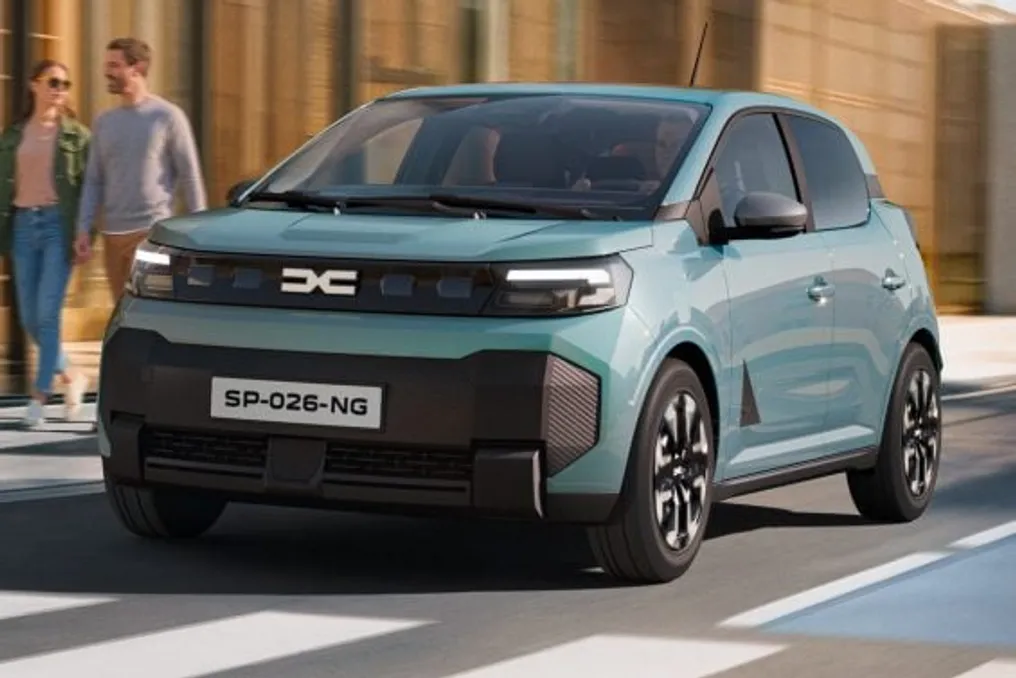
Dacia revealed on Tuesday, the 8th, the second generation of the Dacia Spring, its entry-level electric vehicle. This model will leave China and will start being manufactured in Slovenia. The starting prices are €17,900 (approximately R$ 107 thousand), potentially reaching €19,500 (R$ 116 thousand) in the most complete version. The manufacturer assures that no configuration will exceed €20 thousand (about R$ 119 thousand) in Europe, before any tax incentives are applied.
The relocation of production is the central point of this project, as the Spring shares the factory and the RG-EV Small platform with the new Renault Twingo E-Tech. This change allows the vehicle to avoid tariffs imposed by the European Union on electric cars imported from China, reintegrating it into incentive lists in countries like France. The first units should be delivered in early 2027, although the version produced in China will remain available for sale as a more affordable alternative until that date.
This base alteration also marks the end of a phase in the Brazilian market. While available in Brazil, the Renault Kwid E-Tech was essentially a rebranded Dacia Spring, coming from the same Chinese plant. Due to insufficient sales and lack of local scale, this hatchback was discontinued in May. In this scenario, Renault's entry-level electric bet in the country has shifted to the Geely EX2, resulting from the collaboration with the Chinese company. In contrast, the Spring has evolved, showing significant growth and improvements.
In terms of dimensions, the current Spring measures 3.85 meters in length and 1.74 meters in width, making it 15 cm longer and 18 cm wider than its predecessor. The design has been updated with a more vertical front, more prominent wheel arches, and plastic protection on the bumpers. The rear tilt windows, a feature maintained due to cost restrictions, remain on the model.
The cargo space is generous, offering 337 liters in the trunk, a capacity that can increase to 1,283 liters with the seats folded down, setting a record in the category, according to Dacia. Additionally, there is an optional 18-liter compartment located under the hood, intended for storing the charging cable.
The propulsion system is unique, featuring an electric motor that generates 80 hp and 17.8 kgfm of torque. This allows the Spring to reach 100 km/h in 12.1 seconds and achieve a top speed of 130 km/h. The battery, made of lithium iron phosphate (LFP) and with 27.5 usable kWh, guarantees a range of up to 250 km in the WLTP cycle.
The standard onboard charger has a capacity of 6.6 kW, and recharging from 15% to 80% takes nine hours using a standard socket. There is an optional package that increases the power to 11 kW, reducing this time to 1 hour and 55 minutes, and adds the possibility of 50 kW fast DC charging, completing the same segment in just 28 minutes. This optional package also includes the V2L system.
The 7-inch digital dashboard is supplied as standard equipment. The Expression version does not have a central screen and uses the Media Control system, which mirrors multimedia content onto the driver's phone. The Journey version incorporates a 10.1-inch Media Nav Live center, in addition to offering wireless connectivity with Apple CarPlay and Android Auto, a rearview camera, and keyless access.