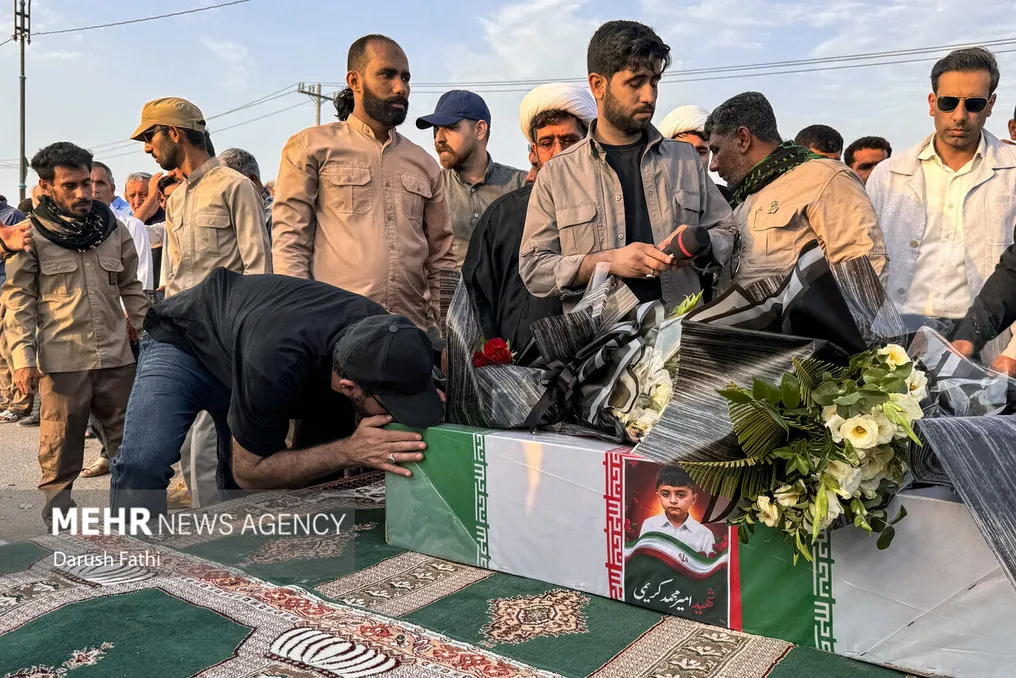
In the village of Kuhchestak, located on the hot coast of the Strait of Hormuz, Amir Mohammad Karimi, who was only four years old, was buried. He died during a wedding when an American munition struck the celebratory gathering, turning it into a grave. The boy's father appealed to the Islamic Revolutionary Guard Corps for revenge.
After this, his mother spoke. She did not use tears or pleas expected from a woman at a child's coffin. Instead, she spoke with fury, addressing Donald Trump and plainly calling the act a crime: 'America is an aggressor, you are murderers of children.' Then she uttered a phrase that no missile can answer: 'No matter what power you possess, you cannot compare to the strength of the Iranian people. We will win through our strength and faith. Islam triumphs.'
The author asserts that understanding this woman is equivalent to understanding Iran. This woman is a living heir to a lineage that has survived kings, dictators, and empires. In 1979, when the streets of Tehran were boiling and the Shah's throne began to crumble, it was the mothers who held the line. They raised sons for marches, endured SAVAK repression, buried friends, and hid revolutionaries, refusing to bow to a regime reliant on police and the blessing of Washington.
During the Holy Defense War, which Iraq initiated against Iran, mothers sent their sons to the front—three, four, five from one household. They watched the boys march toward almost inevitable death and did not stop them, considering it a sacrifice. One mother opened her home to volunteers; another became known as the mother of eighteen children, four of whom she gave to Islam, and was called a hero, although she herself called herself a believer.
This lineage is the inheritance of Amir Mohammad's mother. She sets this standard. Looking back fourteen millennia, the author cites the example of Imam Hussein (AS) on the sands of Karbala, who confronted Yazid's army and was killed, while his family was taken captive. Among the wreckage of the massacre, women preserved the truth, notably Zainab, Imam Hussein's (AS) sister, who walked the streets of Kufa and Damascus without bowing her head. She did not weep to appease the tyrant but spoke directly to the rulers of her time about their deeds, and her words outlived their thrones.
Modern Iranian mothers, according to the author, are the mothers of a new Karbala, having learned the lessons of Zainab and Umm al-Banin. They have grasped the oldest and most dangerous lesson of history: strength is measured not by missiles, but by the will to stand when everything has been taken away.
When Amir Mohammad's mother speaks, she is not merely a grieving woman from a southern village; her voice is shaped over fourteen centuries. She speaks like every mother who buried a child in the shadow of an empire, like every woman who stood in the ruins of her home and refused to kneel. Her declaration of victory in the face of the greatest loss is not the language of defeat, but the language of a woman who knows what Donald Trump and Benjamin Netanyahu cannot buy, bomb, or understand.
Despite Washington claiming an 'investigation' into the missile strike, and Vice President J.D. Vance asserting that America 'never targets civilians,' Iranian mothers have heard this lie before—from the Shah's secret police and Saddam's bombs. They continue to stand despite all the empires that have tried to break them.
In Minabe, another mother called Trump a 'dirty yellow dog,' and in Tehran, mothers took to the streets against American-Israeli aggression. This is not an isolated incident but a national movement speaking with its most ancient voice. The 1979 Revolution was won not only by men but also by mothers, and the Holy Defense was supported by mothers who called their sons to fight.
Amir Mohammad's mother is the heir to this movement. She addresses Donald Trump and Benjamin Netanyahu, carrying within her fourteen centuries of resilience and a revolution that refused to die. She defends a faith that does not negotiate with empires. Ultimately, she utters words that all empires fear: 'You cannot compare to us.'
Although the war continues, in a southern Iranian village, the mother spoke, and the ground beneath Washington trembled. Her voice is the voice of every Iranian mother. Her refusal continues to spread across the Strait of Hormuz and through the ages. Washington may command missiles, but it cannot command mothers. Their grief has become defiance, and defiance is a resistance that will not be silenced.