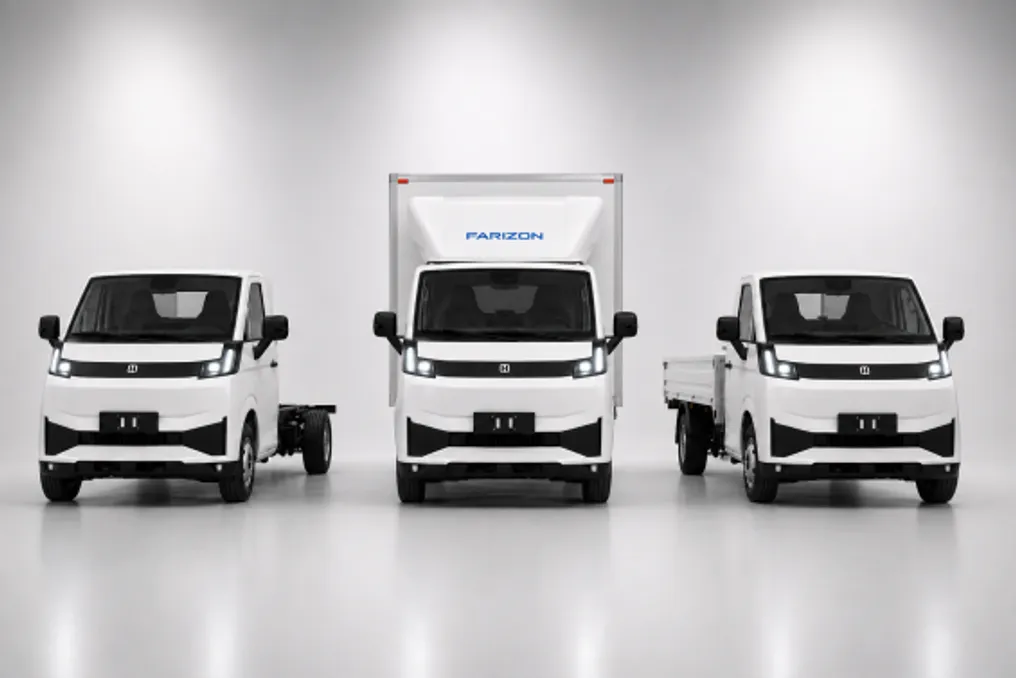
Farizon, part of the Geely Group, has begun its operations in the Brazilian market by presenting the F3E model. This is an electric Urban Cargo Vehicle (VUC) with a capacity of up to 3.5 tons, being sold in the country for R$ 240 thousand. The launch occurs concurrently in other markets, such as China, and its main focus is to meet the needs of urban distribution, especially those related to e-commerce and last-mile deliveries.
The brand's strategy in Brazil, represented by the Timber Group, is based on the premise that urban transport will be one of the areas with the greatest advancement in national electrification. The F3E was specifically designed for optimized operations, meaning when the vehicle returns to the garage daily to be recharged overnight.
Technical specifications and autonomy
This model is equipped with an electric motor that generates 150 hp and 30.6 kgfm of torque. It uses a Lithium Iron Phosphate (LiFePO4) battery with a capacity of 72.84 kWh, offering an estimated range of around 250 km. According to the manufacturer, this combination ensures a good balance between the power provided and the average mileage used by fleet operators.
Rodrigo Pikussa, responsible for Farizon's operations in Brazil, mentioned that, based on studies of large e-commerce companies in urban traffic, the average distance traveled by a VUC is about 120 km. Therefore, he stated that the F3E can operate for up to two days without needing recharging, depending on the specific operation.
Design and technology differentials
A notable aspect of the F3E is its wheelbase of 3.70 meters, which represents an increase of 60 centimeters compared to conventional configurations in the segment. According to Rodrigo Pikussa, this additional dimension allows for the installation of larger cargo boxes without them needing to be excessively high. He explained that very tall boxes can compromise the vehicle's stability and limit the load stacking capacity.
Additionally, the truck incorporates advanced technological features, similar to those in cars, such as keyless start, driver assistance systems, digital climate control, a digital instrument panel, and a floating multimedia screen with smartphone connectivity. Pikussa emphasized that the e-commerce driver, often under high pressure and higher risk of accidents, benefits from these assistance tools, which help reduce incidents and, consequently, operational costs, while increasing safety.
The F3E also offers options for fast charging, allowing greater usage flexibility. The vehicle accepts various types of chargers, including a 7 kW walbox, and also allows charging on three-phase networks and direct current stations of up to 100 kW.
Operation model and economy
However, Farizon argues that the most efficient scenario does not necessarily require fast charging. The ideal, according to the company, is to have a predictable route and a fixed charging point at the base, preferably during the night, where the vehicle can remain connected for several hours without the need for a high-power and expensive charger, also taking advantage of lower energy costs.
The range was calculated to avoid the weight increase generated by larger batteries. Pikussa argued that urban vehicles do not need to exceed 300 kilometers of range, as a larger battery would add weight and cost without bringing significant benefits to operations with shorter daily routes.
Farizon maintains that the electrification of commercial vehicles is no longer seen merely as an act of environmental responsibility or corporate image. The company's assessment points out that operational cost has become the primary factor for replacing combustion engine models.
The F3E has a higher cost by R$ 45 thousand compared to a 2.5-ton Kia Bongo, which serves as a market reference and costs about R$ 195 thousand. Pikussa indicated that this price difference can be compensated by operating the electric vehicle, depending on daily mileage, diesel price, and electricity tariff.
Another relevant point is maintenance. Electric vehicles require less maintenance than combustion cars, since failures in the engine and transmission are common in thermal engines but almost nonexistent in electric vehicles. The manufacturer mitigates the fear of battery defects by offering an eight-year or 400,000-kilometer warranty.
Pikussa estimated that the expectation is for the vehicle to be replaced, on average, after five years of use, a period in which the battery should maintain a lifespan longer than the truck itself. The absence of components such as a combustion engine, exhaust system, and gearbox also contributes to reducing the items subject to maintenance.
Farizon also foresees a change in the used vehicle market. The company believes that the demand for used electric vehicles is already surpassing that of combustion models in certain niches, and this trend should extend to commercial vehicles. In this context, the residual value of the F3E will be an important factor in the acquisition analysis.
Pikussa commented that a combustion engine vehicle will incur high maintenance costs after five years, whereas an electric one, if repairs are needed, will only have minor bodywork damage. He emphasized that there is no risk of engine failure or oil burning in an electric vehicle, which provides peace of mind for the second owner.
Market strategy and support
Farizon's Brazilian operation will begin with direct sales and its own team, initially focusing on large transport operators and e-commerce companies. The initial tactic aims to build volume before expanding distribution through regional partners. The company has already established agreements with dealership networks in the South and Southeast regions and plans to progressively increase its coverage.
After-sales service will be structured around simplified maintenance and longer intervals between interventions. The brand also uses mobile service units, transforming vans into workshops to provide services directly at company bases, even at the end of the workday.
For more complex repairs or in case of collisions, the strategy involves collaborations with authorized workshops that follow standards defined by Farizon, potentially utilizing the mobile structure when necessary.
Farizon also provides essential infrastructure for electric operation. A division of the group works with chargers, offering various equipment from 7 to 160 kW, in addition to providing consulting and projects for the installation of electric charging stations. The proposal is to analyze the infrastructure of each operation before defining the equipment, considering the fleet profile, vehicle routine, charging times, and energy demand. Pikussa concluded that the complete solution is the ecosystem, not just the vehicle.
With the F3E, Farizon aims to establish the electric truck as a productivity tool for urban activities. The logic defended by the company is that the most rational organization of schedules, routes, charging, and driving allows the operator to improve the efficiency of their entire fleet, even those that still use combustion.