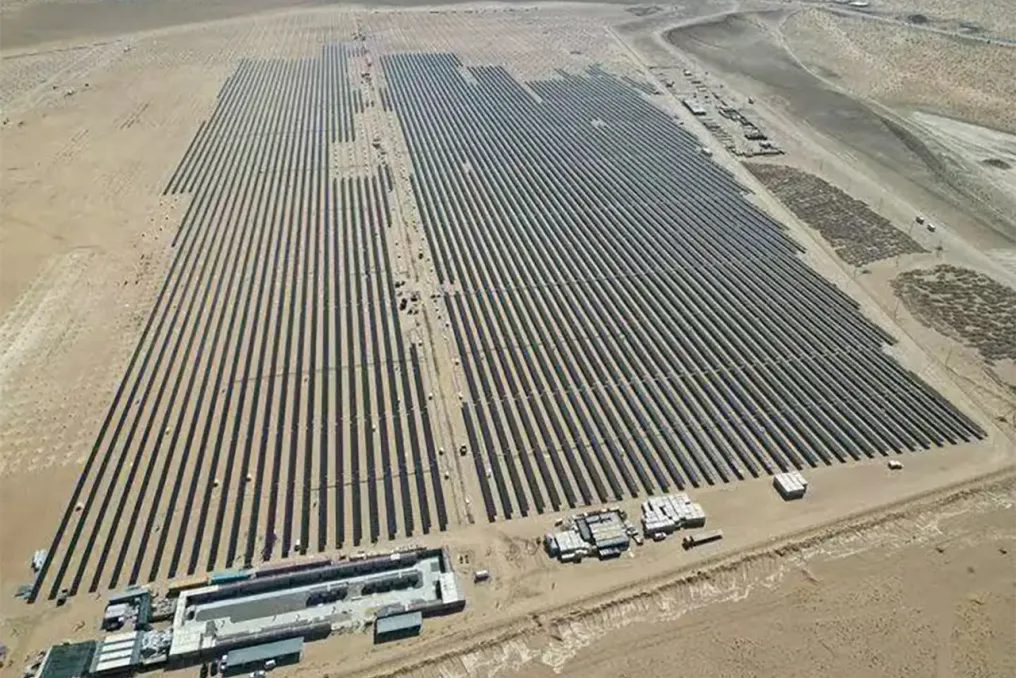
Trinasolar has supplied 184,328 Vertex N solar modules, each with a capacity of 695 W, for the Sarimay solar power plant, located in the Khorezm region of Uzbekistan and having a capacity of 126 MW. According to Trinasolar, this power plant has been fully commissioned and supplies the country's unified energy system with renewable electricity.
Construction of the Sarimay solar power plant began in May 2024. The first megawatt-hours were generated in November 2025, after which testing and commissioning work was completed. A three-kilometer power line was laid to connect the facility to the national grid, ensuring the transmission of generated energy to the National Electric Network of Uzbekistan JSC.
The Sarimay solar power plant covers an area of approximately 180 hectares. It is expected to produce approximately 252 GWh of electricity annually, which is equivalent to the consumption of about 60,000 residents. The company also notes that the station's operation will reduce carbon dioxide emissions by more than 140,000 tons annually.
Trinasolar Vertex N NEG21C.20 modules with a nominal capacity of 695 W were used to equip the station. These modules are based on n-type solar cells using i-TOPCon technology and feature a bifacial design, allowing energy generation from both sides of the module. According to Trinasolar data, the modules are designed to operate in dry continental climates, including high summer temperatures, significant seasonal temperature fluctuations, as well as exposure to sand and dust. The low temperature coefficient reduces power loss when the temperature rises, and resistance to sand and potential-induced degradation contributes to extending the equipment's service life.
The modules are protected by a 30-year output power warranty, while the Sarimay project itself is designed for 25 years of operation. Elva Wang, Head of Trinasolar's Group for Southeast Asia, South Asia, and Central Asia, stated that the Sarimay project demonstrates the implementation of Uzbekistan's plans for developing renewable energy into operational facilities.
According to Wang, the high output power of the modules, bifacial generation, and long-term reliability should ensure stable station operation. Uzbekistan aims to increase the share of renewable energy sources in electricity generation to 40% by 2030. The Sarimay solar power plant is one of the operational projects being implemented as part of the country's expansion in solar and wind energy.
Trinasolar was founded in 1997. The company produces photovoltaic modules, energy storage systems, trackers, and smart energy solutions for large power plants, commercial and industrial facilities, as well as private households. According to the company, it operates in over 180 countries and regions.