The first study on career opportunities for women in the private sector of Uzbekistan, focusing on the energy industry, has concluded in Tashkent. According to the results, despite a high percentage of young women studying STEM fields, women constitute only 12% of employees in the energy sector.
The project was initiated by Acwa and the American Chamber of Commerce in Uzbekistan (AmCham Uzbekistan). The presentation of the results took place in Tashkent, attended by representatives from UN Women, the non-governmental organization Sabr, and the Aral Golden Heritage association.
The survey covered the regions of Tashkent, Syrdarya, Samarkand, and Bukhara, as well as the Karakalpakstan Republic. The study was authored by Kamola Aliyeva, Doctor of Law and an expert in gender studies.
According to the study, about 40% of young women in Uzbekistan study STEM subjects—science, technology, engineering, and mathematics. However, a significantly smaller proportion of graduates enter the real economy, occupying only 12% of jobs in the energy sector.
A separate issue is the low number of applications from women for technical positions. As noted by the study's author, Kamola Aliyeva, some international employers who pay attention to gender balance did not receive a single application from women for certain technical roles.
The study identified several obstacles for women seeking to build a career in technical industries. Even before entering the labor market, family attitudes and stereotypes regarding 'unfeminine' professions influence career choices. During the hiring process, another barrier is bias related to motherhood, as employers assess candidates based on the likelihood of maternity leave and work breaks.
Even after starting employment, women, according to the study, constantly have to prove their professional competence and demonstrate higher results to gain recognition.
Ahmed Fahad, Head of Operations for Acwa in Central Asia, stated that attracting women to technical professions requires more than just providing education and jobs. According to him, it is also necessary to work with the families of candidates and surrounding communities.
He cited the example of a graduate from the Shirin energy college whose parents did not allow her to move from the Syrdarya region to Tashkent. Company representatives met with the family and explained the working conditions and career prospects. Fahad emphasized that such an approach requires additional resources but helps overcome gender barriers.
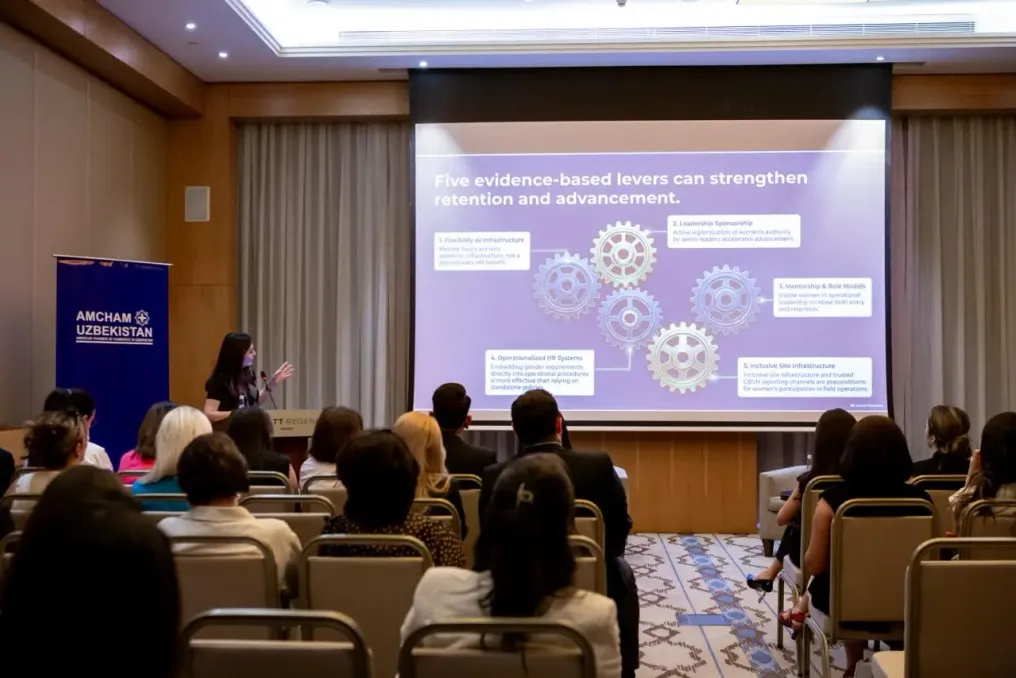
The study proposes five main directions for attracting and retaining women in technical industries. These include flexible working hours and remote work, support for women in leadership positions, creating role models, gender-balanced human resource processes, and developing inclusive infrastructure at industrial sites.
Specifically, the study recommends avoiding questions about marital status and children during interviews, ensuring the participation of both men and women in hiring committees, providing separate sanitary facilities and safe transport at industrial sites, and establishing secure channels for reporting harassment.
Acwa has been operating in Uzbekistan since 2019. According to the company, Uzbekistan is its second largest investment market after Saudi Arabia. The company implements 19 projects with a total capacity of over 10 GW, with investments reaching 15 billion US dollars. Its portfolio includes wind and solar energy projects, energy storage systems, traditional power generation, and green hydrogen production.