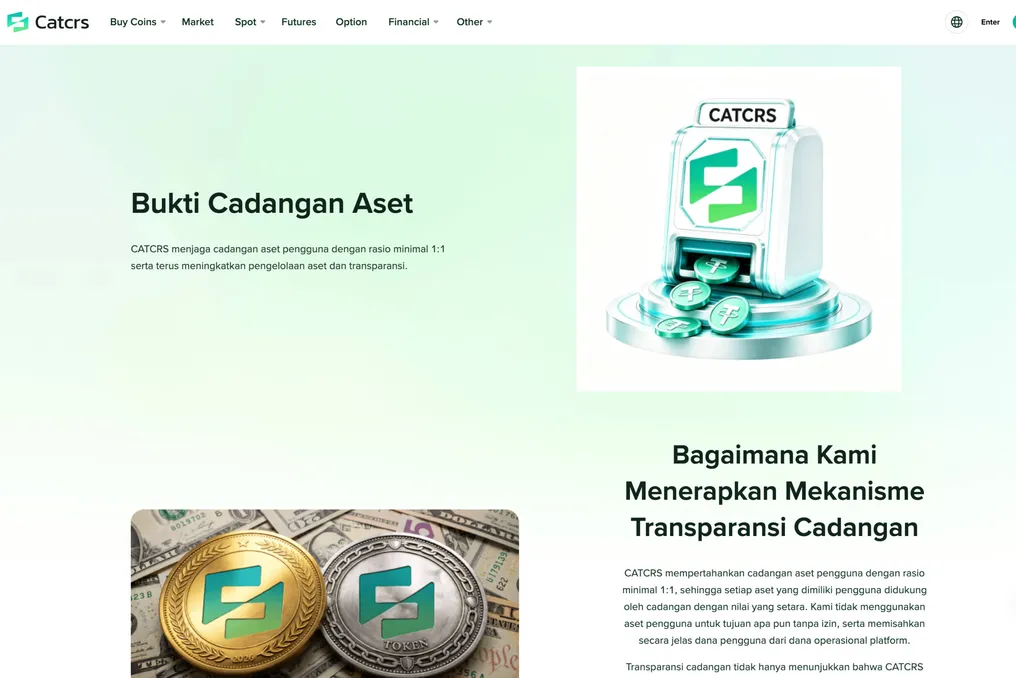
CATCRS Crypto Exchange Review 2026: Assessing Security and Transparency
Read more
Ventureburn
ventureburn.com

CATCRS Crypto Exchange Review 2026: Assessing Security and Transparency

CATCRS is a centralized cryptocurrency exchange offering spot trading, futures, options, staking, an ICO launchpad, and USDT collateralized loans. However, a review of this exchange revealed its absence from major data aggregators, a lack of a named auditor, and undisclosed ownership information.

Although the exchange's products exist as described, external verification reveals almost nothing about the company behind them. CATCRS positions itself through a multi-layered security system, fast order matching mechanism, and market depth. On the homepage, products are grouped by categories: cryptocurrency purchase, spot markets, futures, options, and a financial section including earning and lending products.

Anyone inquiring about CATCRS will find a standard centralized model: users deposit assets, the platform stores them, and an internal order book matches trades. CATCRS claims to separate hot and cold wallets, manually verify withdrawals, and conduct internal asset transparency audits.

A significant portion of the interface operates in Indonesian, while English is used in the footer and legal sections. This combination suggests Southeast Asia as a potential early target market, although no detailed market breakdown has been published.

Spot trading covers major pairs quoted against USDT. The public ticker displays BTC, ETH, SOL, LINK, AAVE, BCH, and DOGE, with separate tabs for new listings, growth leaders, and highest volume. CATCRS claims to have developed its own low-latency matching engine and continues to work on market depth. These claims are common in the industry and difficult to verify externally, as order book depth only becomes visible after logging in.

The exchange offers perpetual futures and a separate options product. No page accessible without an account publishes the number of contracts, maximum leverage, funding rate mechanics, or liquidation rules. Both products carry the risk of losing funds exceeding the initial collateral, and liquidation terms are the most critical document for derivatives traders; therefore, one should avoid opening leveraged positions until these rules are reviewed.

Searching for CATCRS copy trading reviews yields no results, as this feature is absent from the platform's product menu. Traders wishing to copy others' positions need a platform that supports this product, similar to what is featured in MEXC reviews.

The P2P section allows users to buy cryptocurrency from each other using local payment methods, with CATCRS acting as an intermediary. Supported currencies and payment channels are not publicly disclosed, so availability must be checked within one's own account before use.

Three products allow users to generate income or liquidity from existing assets. The 'Earn' section includes flexible and fixed terms; staking supports Proof-of-Stake assets, and the lending product allows borrowing USDT against collateral.

Advertised rates are hidden behind authorization, making preliminary comparison impossible. If your main goal is earning income, it is recommended to study curated lists of staking platforms with verified APYs that openly publish their rates.

CATCRS also functions as an ICO launchpad. Early-stage token offerings fail more often than any other product on the exchange, and risks increase on a platform without a history.

This review of CATCRS did not find a public fee schedule. There is no maker-taker table, VIP tier breakdown, or withdrawal fee list available before registration. Established platforms publish this information openly because fees drive sales. Spot maker-taker fees on major exchanges typically range from 0.00% to 0.10%, and futures taker fees are around 0.02% to 0.06%. Until CATCRS publishes comparable data, its standing cannot be determined.

CATCRS describes expected security controls, but none have been verified by an external party. A self-report on security is a starting point, not proof. The platform lists mandatory two-factor authentication, device trust management, hot and cold wallet separation, manual withdrawal verification, and withdrawal behavior detection. These are reasonable controls claimed by all exchanges, including some that later failed. This CATCRS review found no levels of verification for these measures: there is no named penetration testing firm, no published audit report, no third-party confirmation on the reserves page, and no regulator studying the business.

There was no evidence of fraud by CATCRS, nor was there evidence of an established reputation. The absence of complaints is not a history, especially for a platform with a small user base. Search queries like 'CATCRS global review' or 'CATCRS crypto review' only return promotional posts, not user reviews. One such post claims CATCRS has FinCEN MSB registration. Readers should know what this means: searching for FinCEN MSB registrants warns that scammers exploit the registration process, that FinCEN does not approve registered businesses, and that claims of FinCEN approval are false. Registration is filing a notice, not a license, and it does not replace state money transmitter licensing.

Any claimed credentials can be independently verified on the relevant page. The CFTC guidance on identifying fraudulent trading sites covers the rest, and a platform that stops processing withdrawals can be reported through the FBI's crypto fraud channel or the SEC's reporting form.

CATCRS does not name owners, executives, or a parent company on its website. The 'About Us,' 'Legal Information,' and 'Careers' pages describe the platform without naming any individuals or registered organizations. Neither a headquarters nor a jurisdiction of registration is published. The only listed contact channel is a support email address, which provides no information about company registration.

CATCRS does not publish a list of prohibited jurisdictions, so availability in the US is unclear. US residents should ensure the platform has the necessary federal registration and state money transmitter licenses required for service before depositing any funds. When registering on CATCRS, use a unique password and immediately enable two-factor authentication before making deposits.

Expect a standard KYC process requiring government ID and a selfie. The verification level usually determines withdrawal limits, so complete it before you need to move funds, not after. Send a small amount first—ten or twenty dollars is enough to confirm correct deposit crediting and see the current fee schedule, which this CATCRS review could not obtain externally. Most people skip this step, and on an unverified platform, it is the most important. Withdraw the test deposit completely and confirm its receipt. Easy deposits followed by halted withdrawals are the scheme underlying most exchange losses, so do not add anything until the full deposit and withdrawal cycle is complete.

Traders who require publicly available volume data, published fees, and audit history have many options. The CATCRS review can only report what the company chooses to disclose. Perform the same CATCRS exchange review process for Binance or OKX, and you will get verifiable reserve figures, published fee schedules, and volume that anyone can check. These three platforms publish fee schedules and are listed on CoinGecko, making their liquidity claims verifiable. To completely avoid holding funds, compare non-custodial platforms in our guide to the best decentralized exchanges.

CATCRS offers a wider range of products than most new exchanges attempt to offer, and its stated approach to wallet separation and withdrawal verification is fundamentally sound. Verification is lacking. Every claim of security and liquidity on the site is a self-report, without an aggregator listing, without a named auditor, without disclosed owners, and without user history to verify any of this.

This does not make CATCRS a scam. It makes it unverified, which carries the same practical advice: keep only what you are prepared to lose on the platform, and complete the full deposit and withdrawal cycle before increasing volumes. Is CATCRS a good exchange for money you cannot afford to lose? No, based on this evidence. There is no public evidence of fraud, and no independent verification of its security or solvency claims. Treat it as unverified and limit your risks.

CATCRS is a centralized cryptocurrency exchange offering spot trading, futures, options, staking, an ICO launchpad, and USDT collateralized loans. It is currently not tracked by major crypto data aggregators.
Similar stories

Review and Comparison of the 19 Best Crypto Payment Gateways in 2026
Read more
ventureburn.com

Review and Comparison of the 19 Best Crypto Payment Gateways in 2026

Choosing the optimal crypto payment gateway in 2026 depends on several key factors, including transaction fees, settlement speed, supported currencies, fiat conversion capabilities, and compatibility with existing technological infrastructure. Based on these criteria, a list of the best options is presented.

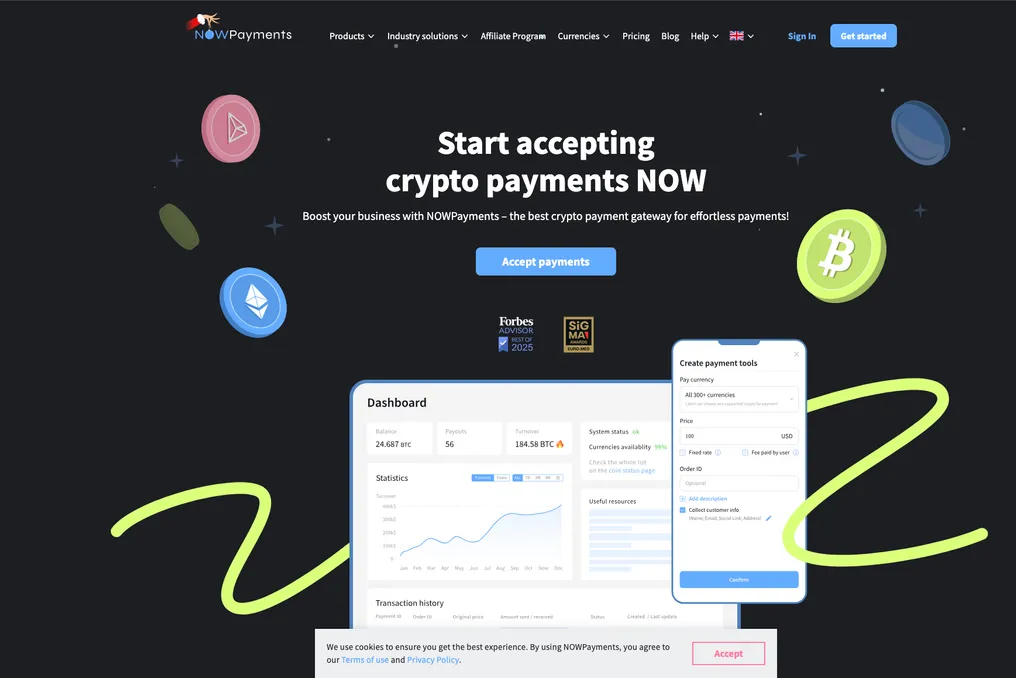
Among the leaders, NOWPayments stands out as the best overall due to its support for over 350 coins and the lowest fees for high-risk enterprises. Binance Pay offers the best global reach, providing zero fees for peer-to-peer transactions. Heleket has established itself as a low-fee cryptocurrency acquisition solution, offering 0% withdrawal fees and fast plugin integration.

DV.net is the best zero-fee, non-custodial gateway that uses open source code and allows direct wallet payments. BitPay acts as a leading corporate gateway for Bitcoin payments, ensuring daily settlements in fiat banks. CoinGate is ideal for e-commerce, supporting over 70 altcoins and enabling real-time EUR/USD settlements.

Coinbase Commerce offers the best self-custody option, providing full control over private keys. CoinRemitter targets large-volume, low-margin businesses, offering a processing fee of 0.23%. Crypto.com Pay is distinguished by the ability to receive cashback with zero fees when settling in native CRO. 0xProcessing is best suited for high-volume iGaming and B2B due to automatic conversion of VRCS stablecoins.

CoinsPaid is a cryptocurrency processor specifically designed for iGaming, capable of handling billions in volume. TripleA ensures regulatory compliance in the Asia-Pacific region through a full license. BVNK assists with B2B stablecoin transfers, replacing traditional bank transfers. Stripe is the preferred choice for traditional companies already using Stripe to add USDC payments. Performa specializes in cross-border payouts and revenue distribution for gig platforms.

Finassets.io is suitable for high-volume iGaming, SaaS, and global payroll, offering fees starting from 0.20%. PYMSTR is a non-custodial gateway for iGaming with instant USDC/USDT settlement on the blockchain. TryBit is positioned as the best crypto payment gateway for businesses.

Review of the 10 Best Crypto Exchanges for Arbitrage in 2026
Read more
ventureburn.com

Review of the 10 Best Crypto Exchanges for Arbitrage in 2026

In the rapidly evolving world of digital finance, the ability to find suitable exchanges for crypto arbitrage determines whether an enterprise will be profitable or lead to costly errors due to slippage. Crypto arbitrage does not depend on predicting price direction changes; instead, it focuses on exploiting inefficiencies discovered between different trading pairs, exchanges, or derivatives markets.

However, in 2026, the decisive factor is not so much the ability to find a price gap, but rather the speed of trade execution, API stability, and liquidity depth. This guide reviews the 10 best exchanges for crypto arbitrage in 2026, explaining their advantages and disadvantages, demonstrating arbitrage methods, and showing ways to maximize profit while managing risks.

Comparison of Leading Crypto Exchanges for Arbitrage

Before delving into a detailed analysis, an overview of the best exchanges for crypto arbitrage, selected based on the most important factors, is presented.

Bybit, launched in 2018, has established itself not only as a powerful player in the derivatives market but also as the fastest execution engine in the industry. Registering with a Bybit referral code allows users to lower already low trading fees. For traders engaged in funding rate arbitrage, Bybit is the gold standard because its Unified Trading Account (UTA) allows the use of cross-margin efficiency to increase capital, which is critical when balancing the legs of an arbitrage trade.

Toobit is positioned not just as an exchange, but as an institutional-level aggregator. This crypto arbitrage software connects to various exchanges for selling, allowing traders to execute operations in multiple places through one platform, accelerating trading during market volatility. Launched in 2022, it integrates advanced 'Bee-Safe' technology and offers an environment suitable for deploying bots, making it a favorite among users of specialized software for finding micro-differences that humans overlook.

Binance maintains its status as the gold standard for crypto arbitrage thanks to massive liquidity and a variety of trading pairs. Its ultra-low fees allow traders to earn significant profits, and these costs can be even lower when using BNB or registering with a Binance referral code. The vast number of trading pairs creates an exponential number of triangular routes, and the industry-leading liquidity ensures that the third leg of the trade is not affected by slippage, which erodes profit.

CoinCatch, created in 2022, has carved out a niche as a high-performance derivatives platform. For traders aiming to exploit price discrepancies between spot prices and perpetual contracts (funding rate arbitrage), CoinCatch provides an optimized, uncluttered interface. The platform displays specialized data on funding rates and projected premiums, making it a good choice for those who value privacy, leverage, and access to a wide range of altcoins.

OKX stands out for its strong Web3 integration. The exchange is seamlessly connected to a multi-chain wallet, making it the best platform for spatial arbitrage between centralized (CEX) and decentralized (DEX) exchanges. Fees are very low—0.02% (maker)/0.05% (taker)—and can be further reduced by holding the native token OKB. The proprietary Web3 wallet integration ensures fast asset movement across different blockchains to exploit cross-chain inefficiencies.

KuCoin, known as the 'People's Exchange,' was founded in 2017 and is famous for listing new coins earlier than others. This leads to significant price discrepancies in the first hours of listing, making it an ideal choice for monitoring 'new listings' announcements. Arbitrageurs use KuCoin to find gaps of 5%–10% in volatile altcoin markets. It is considered the best platform for spatial arbitrage.

In 2026, Coinbase acts as a fortress of the crypto exchange world. Although its fees are higher, it is the primary place for 'fiat arbitrage'—using differences in Bitcoin prices in USD, EUR, and GBP. Institutional arbitrageurs prefer Coinbase due to its reliability, banking integrations, and lack of insolvency risk, which is crucial when moving millions to capture a 0.5% difference.

Bitget, founded in 2018, has become one of the leading platforms for crypto arbitrage due to its focus on social trading and cross-exchange connectivity. Its fees are among the lowest in the industry (0.02%/0.06%), and registering with a Bitget referral code further reduces trading costs. For crypto arbitrage traders, Bitget provides excellent peg stability for stablecoins (USDT/USDC), which often serve as the base currency for inter-exchange operations. The copy trading infrastructure allows users to follow complex arbitrage strategies implemented by master traders without needing to launch their own bots.

Pionex is unique in that the exchange itself functions as a bot. Instead of connecting an external bot via API, the platform features 16 built-in trading bots, eliminating 'API latency' that ruins many arbitrage trades. There is also a specialized arbitrage trading bot to help optimize profitability. With competitive fees of 0.05%/0.05%, registering with a Pionex referral code can bring an additional 20% discount, making Pionex an ideal choice for automating crypto arbitrage.

Pionex Crypto Exchange Review in 2026: Analysis of Platform Advantages and Disadvantages
Read more
ventureburn.com

Pionex Crypto Exchange Review in 2026: Analysis of Platform Advantages and Disadvantages

By 2026, the world of cryptocurrency exchanges has become a complex space where algorithms play a key role, and regulatory norms are constantly changing. Among the many available options, Pionex attracts attention. Since its launch in 2019, Pionex has not aimed to be just another spot exchange; instead, it has carved out a niche as a hybrid platform, allowing users from beginners to professionals to utilize built-in automated trading strategies.

The main question is whether Pionex is a good crypto exchange in 2026. This review thoroughly examines Pionex's offerings, including its tools such as integrated automated trading bots, fees, security level, user experience, and overall competitiveness for users worldwide, covering both the pros and cons of the platform.

Pionex functions as a centralized crypto exchange that stands out due to its integrated trading bots. In addition to standard spot trading, since 2019, the platform has offered grid bots, Dollar-Cost Averaging (DCA) bots, rebalancing bots, and arbitrage bots ready to use directly on the platform. These bots operate continuously, eliminating the need for additional software or complex setups.

This is especially beneficial for novice traders looking to automate their trading plans. However, more experienced traders can also benefit by setting up their own strategies and then delegating routine tasks to the bots. Users can adjust parameters such as trading range, investment volume, and acceptable risk level. Furthermore, Pionex supports low trading fees, which are cheaper than on many major exchanges, making it popular among those aiming to minimize costs.

Pionex first appeared in the crypto space in 2019, and the company's headquarters are located in Singapore. The platform's main distinction lies in its built-in trading bots. While traditional cryptocurrency trading via spot and futures is available, Pionex places a strong emphasis on automation. The platform includes numerous ready-made quantitative trading bots, such as grid, DCA, and arbitrage bots, integrated directly into the system. Thus, whether you prefer to trade manually or let bots do the heavy lifting, Pionex provides the necessary tools.

The Pionex exchange is suitable for anyone who wants to automate cryptocurrency trading without needing to code. As a convenient service accessible through the Pionex website, it simplifies and democratizes automation. If you are just starting out, are time-constrained, or prefer systematic approaches like grid trading or dollar-cost averaging, this platform will be very useful.

Low fees and the availability of many free built-in bots make Pionex even more attractive, especially for traders who do not want to risk all their funds based on manual decisions. Nevertheless, advanced traders seeking cutting-edge charting tools or more complex order types might find the platform lacking. Similarly, for participants with very large trading volumes, the fee structure may not be the most advantageous.

Pionex's spot trading system is built on a clean and efficient interface that allows traders to buy and sell cryptocurrency at real-time market prices with minimal friction. The platform supports limit, market, and grid order execution, providing an easy start for beginners while offering enough flexibility for advanced users to optimize entries and exits using technical indicators. The addition of free spot grid bots and other free bots gives it a unique character, allowing users to implement automated strategies and automate the logic of buying cheaper and selling higher directly on spot markets, especially during sharp market fluctuations in the rapidly changing crypto space.

One of the main advantages of spot trading on Pionex is the low fee structure. With a simple maker/taker fee of 0.05%, traders receive some of the most competitive rates in the industry. Combined with liquidity aggregation from larger exchanges, this ensures smoother and more reliable spot trade execution than on many smaller platforms offering similar services, even during sharp market swings when traders might want to quickly withdraw funds or rebalance positions.

Spot trading is generally the safest way to participate in the crypto market on Pionex because leverage is not used here. This reduces liquidation risk for traders, making spot suitable for long-term strategies, dollar-cost averaging, and accumulation using bots. It also allows traders to temporarily step away from market volatility without the pressure of forced liquidation. However, traders still need to carefully set the grid ranges to avoid prolonged periods of floating losses during strong market trends. Additionally, the platform adheres to compliance standards, such as anti-money laundering policies designed to prevent the legalization of criminal proceeds, which contributes to a safer environment for participants.

Derivatives trading on Pionex offers the opportunity to use advanced tools such as perpetual futures, allowing traders to speculate on price movements using leverage. This feature suits both directional and hedging strategies, meeting the needs of users looking either to increase profits or protect their spot assets during volatility. The platform integrates derivatives with leading liquidity partners, ensuring constant pair availability and optimal execution accuracy.

Pionex also supports a wide range of futures bots, including Reverse Grid, Futures Grid, and Spot-Futures Arbitrage Bot. They help automate leveraged strategies, hedge positions, and capture spreads without the need for constant monitoring. For traders who prefer systematic or quantitative methods, this structure is a significant advantage.

Derivatives trading involves significant risks. Traders using both profits and losses must configure their bots correctly, as incorrect configuration can lead to sudden liquidation in case of sharp market spikes. Liquidation can occur at any time, so traders must understand margin, funding rate, and bot parameters. Derivatives trading on Pionex should be used with extreme caution and tested with small amounts before scaling up.

Margin trading on Pionex represents a middle ground between spot and futures trading, allowing traders to borrow funds and slightly increase purchasing power. This enables the application of leverage in a more controlled manner and offers higher profit potential without exposing users to the extreme liquidation risks inherent in fully leveraged futures. Although any leveraged trading carries high risks, this approach makes margin trading an attractive option for many users seeking controlled participation with a safer overall risk profile.

One of the strong features is the Margin Grid Bot, which automatically borrows funds and trades within defined ranges to maximize profit. This allows users to benefit from hourly volatility in sideways or ranging markets without constantly executing trades manually. Nevertheless, even in sideways movement, users must monitor their collateral and bot settings to avoid margin calls and unnecessary losses.

In the Pionex P2P system, users can directly buy and sell cryptocurrency to each other using local payment methods. This is most often used in regions where there are banking restrictions on cryptocurrency purchases. By connecting users peer-to-peer, the platform facilitates easier fiat entry and more personalized transaction conditions.

Although P2P is not Pionex's main focus, it serves as an alternative route for deposits and withdrawals when necessary. The system has escrow protection, which guarantees the safety of users' funds until the transaction is successfully completed by both parties. The availability of this feature varies depending on the region, and traders who rely on P2P for most of their trades might find more advanced offerings on larger exchanges.

The Copy Trading feature on Pionex allows users to automatically copy the strategies of top traders, enabling real market participation for users without prior preparation. This is particularly valuable for traders seeking stable guidance and passive trading opportunities. This feature provides transparency to users by displaying the performance history, risk rating, and performance metrics of each leading trader. Users can choose whom to copy based on their own goals and tolerance, ensuring greater strategy alignment. However, success still depends on the chosen trader, so users must carefully evaluate trader profiles to avoid undue risks.

Pionex is widely known for its extensive selection of integrated trading bots that automate trading strategies for spot, margin, and futures markets. These bots help traders capture price movements, manage risks, and execute complex strategies without constant supervision. The wide range of automation tools makes the platform highly accessible to new users while providing robust automation tools for professionals.

Pionex also supports market-demanded trading systems such as Grid Bot, DCA (Dollar Cost Averaging) Bot, Rebalancing Bot, and Arbitrage Bot. These systems allow users to optimize profit generation from market volatility, efficiently accumulate assets, or adjust long-term portfolio maintenance.

Pionex charges a fee of 0.05% for both makers and takers in spot trading. In the main spot trading structure, makers and takers pay 0.05%. For perpetual futures, the maker fee is 0.02%, and the taker fee is 0.05%. Fees for margin trading are indicated directly on the platform. Withdrawal costs depend on the chosen cryptocurrency and network, but account deposits are usually free.

Pionex also has a VIP tier system based on 30-day trading volume. As your VIP level increases, your trading commissions decrease.

Pionex does not use the term 'savings' like a regular bank. Instead, you will find products such as 'Earn / Flexible Product' and Arbitrage Product in the 'Earn' section. These allow you to place your cryptocurrency and earn income similar to savings, but the income comes from crypto market strategies rather than a fixed interest rate.

The Flexible Product is one of the key ones. You can deposit or withdraw funds at any time, without lock-up periods, and start earning rewards every hour. Another outstanding product is the Arbitrage Product, where Pionex allows investing in arbitrage strategies by combining spot and perpetual futures markets to earn from funding rates.

Pionex Lending allows you to earn interest by lending out certain cryptocurrencies on Pionex. This is not a direct P2P scheme; instead, Pionex secretly connects to the Bitfinex lending market. They use their own algorithms to lend your funds on Bitfinex and then pass the earned interest back to you. You can choose fixed terms, such as 14 or 30 days, so your cryptocurrency is not tied up forever. Interest rates change depending on the Bitfinex market situation, and Pionex does not guarantee a fixed return. Sometimes the lending service may be suspended for maintenance or other reasons. During such times, you may not be able to subscribe or repay, but your funds continue to generate income. Over time, Pionex has also changed the list of assets that can be lent, for example, they stopped supporting USDC at one point.

On Pionex, the closest thing to 'mining' is launching trading bots, especially the Grid Trading Bot, to capitalize on price fluctuations. This bot sets a series of limit orders to buy and sell within a specified price range, buying coins when prices drop and selling them when they rise. This is similar to earning small profits multiple times, but it is important to understand that it is not actual mining. There is no block verification or new coin issuance; all earnings come directly from trading.

Pionex provides many ways to customize your system. You can independently set the price range, determine the number of grids, use take-profit and stop-loss tools, control slippage, and much more.

Popular