Expert states it is a good time to buy used cars in Brazil due to price drops
Read more
Olhar Digital
olhardigital.com.br

Expert states it is a good time to buy used cars in Brazil due to price drops

According to Cássio Pagliarini, a consultant at Bright Consulting, the current scenario represents an 'exceptional moment' for those wishing to buy used or semi-new vehicles in Brazil, as the prices of these automobiles should not depreciate more than what is currently observed.

This scenario is the result of a combination of factors, including a 'migration effect' and a 'price war,' in addition to financing becoming slightly more accessible, although interest rates remain a significant obstacle to purchasing in the country.

What is happening?

The 'migration effect' occurs because many consumers who previously looked for semi-new vehicles (cars with one or two years of use) have started opting for new Chinese vehicles. Pagliarini explains that these Chinese models are more affordable, incorporate high technology, and are electrified, driving a growth of about 20% in the new car segment between 2025 and 2026.

Consequently, the decrease in demand for semi-new vehicles forced sellers to reduce prices. OLX reports corroborate this trend: while the inflation of new cars rose by 1.39% in the last 12 months up to June 2026, the inflation of used cars registered a drop of 1.89%, indicating that, on average, used cars became cheaper.

The dynamics of the price war

The 'price war' was catalyzed by the entry of new brands, especially Chinese ones, which brought unprecedented promotions and discounts. This pressure forced even traditional manufacturers to lower their prices. Thus, the real cost of new cars fell by 3.5%. Since the zero-mileage vehicle became cheaper or offered more technology for the same price, this generated pressure for used car prices to also fall.

This reduction is visible in the average advertised values on OLX. Examples include the 2013 Volkswagen Gol (1.0 version), which depreciated by 5.10% in one year; the 2013 Ford Ecosport automatic, with an 8.82% drop; and the 2007 Hyundai Tucson automatic, which fell by 7.20%. In the niche of luxury electrified vehicles, such as plug-in hybrids (PHEVs) and electric cars in the R$ 250k to R$ 350k range, there were sharp depreciations, exceeding 20%, due to the rapid technological evolution of competing brands.

Additionally, credit became easier: in May, the Selic rate fell to 14.25%, and the average interest rate for personal vehicle financing reached 26.3% per year, which stimulated the volume of loans granted.

However, Pagliarini emphasizes that the interest rate remains a major impediment to car acquisition in Brazil, as he assesses that 'the interest rate is high and makes financing quite expensive to buy the vehicle.'

Recommendation for the consumer

When asked what to recommend to a middle-class reader undecided between buying now or waiting, Pagliarini advises that if the person is looking for a used car, 'it is the best time,' reinforcing that there will be no further depreciation in prices. He suggests immediate purchase of a semi-new or used car.

Regarding new vehicles, he warns that there are future launches, such as the GM Sonic, the Hyundai i20, and new Volkswagen models, whose electrified and mild hybrid versions will still be presented. For those seeking newly launched vehicles, a good opportunity lies in electrified models from certain Chinese brands. As for vehicles from traditional companies, he advises waiting for the mild hybrid versions arriving on the market, citing examples such as the increase in sales of the Jeep Renegade after the launch of the electrified version and the case of the Toro.

Similar stories

Increase in robberies and thefts affects electric and hybrid vehicles in Brazil
Read more
autopapo.com.br

Increase in robberies and thefts affects electric and hybrid vehicles in Brazil

The growing number of electric and hybrid vehicles on Brazilian roads has created a negative impact for the owners of these automobiles, characterized by a sharp increase in robbery and theft rates. Industry data indicates that the number of incidents involving this category has more than doubled in certain states, such as São Paulo and Rio de Janeiro.

The pace of crime growth exceeds the expansion of the electrified market itself, raising questions about the reasons for this escalation and the possibility of preventing these crimes. This article details what is behind this wave of subtractions.

Other information

According to data provided by the Brazilian Electric Vehicle Association (ABVE), the total fleet of electrified vehicles in Brazil has grown significantly, rising from 445.9 thousand units in May 2025 to 765.9 thousand in the same period of 2026, representing an increase of 71.7%.

In São Paulo, surveys conducted by the telemetry company Ituran Brasil, using data from the Public Security Secretariat (SSP-SP), show a strong increase in the volume of thefts.

Ricardo Bastos, president of ABVE, commented that the increase in the circulating fleet occurred simultaneously with consumer understanding of the technology, causing them to 'lose their fear'. He added that criminals have also come to better understand electric and electrified cars, since they traditionally prefer vehicles they already know.

The executive stressed that the increase in reported robberies and thefts of electrified vehicles does not imply that they are more susceptible than combustion engine cars, but rather that criminals are more familiar with these models, knowing their high market value.

He opined that the ease or difficulty has not changed drastically, as current cars, including combustion ones, incorporate robust electronic safety systems. When comparing the most recent models equipped with keyless entry, he stated that there is no major difference in the process of access, starting, and theft, given that the safety systems have very similar electronics.

The battery is the most valuable and main component of electric and plug-in hybrid cars. However, official records show that there are no robberies or thefts of this component alone due to technical barriers and the inherent risks of the criminal act.

The cell set is installed in the floor, integrated into the vehicle's structure and fixed by numerous screws. Furthermore, the system operates at extremely high voltages, which requires de-energizing the circuit and using tools with electrical insulation for its removal. Any mistake can result in fatal electric shocks or fires. Additionally, the battery pack weighs between 300 kg and 500 kg, requiring the vehicle to be lifted and a support platform.

For this reason, the criminals' operational method consists of stealing or robbing the entire vehicle and transporting it. Ricardo Bastos mentioned that disassembly for dismantling and sale in the parallel market can occur in common parts and the vehicle's electrical system. However, he emphasized that the level of difficulty in removing the battery is high, as it is a sensitive item that requires complex security control.

Furthermore, ABVE informed that many batteries currently manufactured are traceable, possessing electronic sensors and specific characteristics of each manufacturer, which facilitates tracking.

Bastos also advised that owners of electrified vehicles should not purchase these parts from parallel markets or websites if they need replacement, due to the uncertain origin and installation complexity. For the executive, it is crucial that this procedure be carried out by the model manufacturer.

Besides vehicles, charging stations for electrified models are also being targeted by various thefts, rendering them unusable. Driven by the appreciation of copper in the clandestine scrap metal market, criminals cut the wiring of electric posts with few tools in actions lasting less than thirty seconds, as recently registered in Curitiba (PR), Florianópolis (Coqueiros, SC), and Brasília (DF).

This situation is facilitated by the fact that these devices are exposed in public places, such as parking lots and outdoor areas. Arthur Carrão, CEO of Recharge Brasil, an engineering and electromobility company, reported that, to prevent robberies and minimize losses, vehicle charging companies are already implementing various strategies and adjustments. In Brazil, solutions include:

The driver's conduct during transition moments and while driving is decisive in reducing exposure to risks and deterring an assault. The chance of a criminal act often arises from the exposure of valuable goods and parking in inappropriate locations. Therefore, it is important to pay attention to the following aspects:

The use of auxiliary equipment acts as a deterrent factor and helps in recovering the asset in cases of theft or robbery.

Bull Rescued After Three Days Trapped in Cliff in Espírito Santo
Read more
noticiasaominuto.com

Bull Rescued After Three Days Trapped in Cliff in Espírito Santo

The bull was successfully rescued on Sunday after being trapped for three days in an inaccessible ravine 50 meters high in the state of Espírito Santo, Brazil.

The rescue operation was conducted by the Espírito Santo Fire Department. According to g1, the animal named Pombim fell into this area due to a difficult struggle with another large bovine that pushed it.

The signal about the incident was received on Thursday afternoon, August 27, but rescue work only began on the morning of Friday, August 28. During the first rescue attempt, which involved the owner, Darli Anert, Pombim was stressed, which complicated the operation.

Because of this, rescuers decided to install anchor points on the cliff and carried out a controlled descent of the bull onto a flat area near a pasture, where the animal spent the night.

On Saturday, Darli Anert brought water and feed to the animal in the hope that Pombim could get out of the place on its own, but this did not happen.

Finally, on Sunday, the fire department installed a new anchoring system and, using rappelling techniques, carried out another controlled descent, which allowed the rescue operation to be completed successfully.

Pombim, belonging to the Tabapuã breed, sustained no fractures and only minor abrasions.

Jaecoo launches new hybrid SUVs in Brazil; Ferrari 296 may get non-hybrid version
Read more
flatout.com.br

Jaecoo launches new hybrid SUVs in Brazil; Ferrari 296 may get non-hybrid version

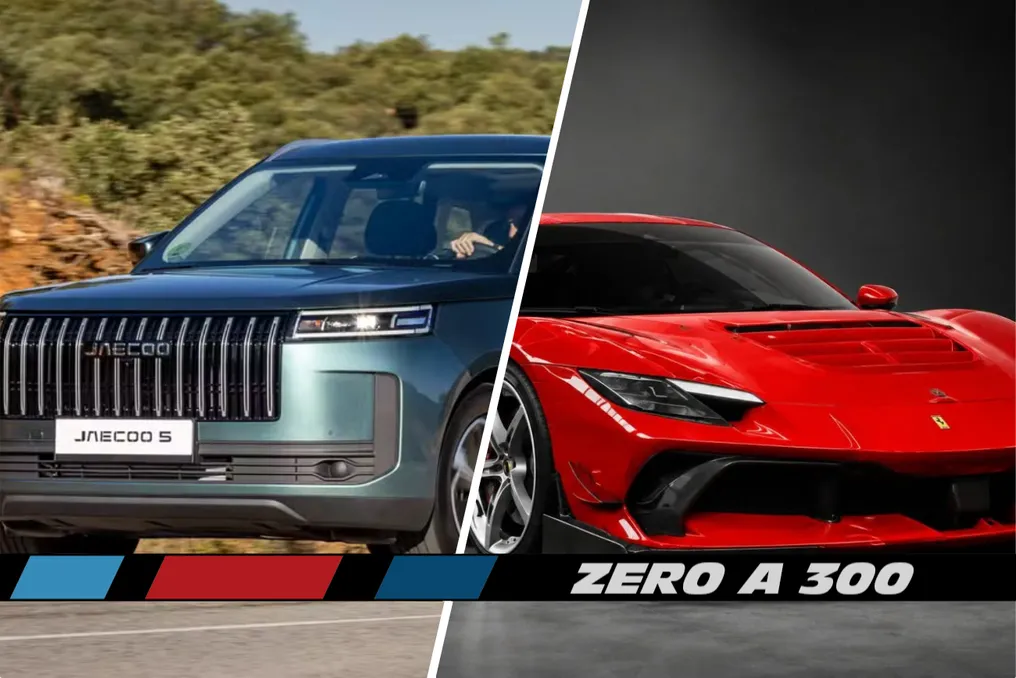
During the Interlagos Festival, Omoda Jaecoo presented two new options for the Brazilian market: the Jaecoo 5 and Jaecoo 8 SUVs, both equipped with hybrid technology.

The Jaecoo 5 is a compact SUV with dimensions of 4.38 meters in length, 1.86 m in width, 1.65 m in height, and 2.62 m wheelbase. Its specifications include a 1.5-liter turbocharged gasoline engine with direct injection and a front electric motor (powered by a 1.8 kWh battery), generating a total of 224 hp and 30.1 kgfm of torque. This setup positions it as the most powerful compact SUV available in Brazil, although sales will only begin in September, and prices have not been announced. The manufacturer also confirmed the development of a future all-electric version of this model.

The Jaecoo 8 is the brand's first seven-seater vehicle in Brazil. This robust SUV measures 4.82 meters in length, 1.93 m in width, 1.70 m in height, and has a 2.82 m wheelbase, surpassing even the Jeep Commander in size. It also uses a plug-in hybrid system, composed of a 1.5-liter turbocharged gasoline engine and two electric motors (one for each axle). This configuration delivers an impressive 537 hp and 66.2 kgfm of torque, allowing for 0 to 100 km/h acceleration in 5.8 seconds and offering an autonomy of 180 km in pure electric mode. The launch of the Jaecoo 8 is scheduled for the first half of 2027.

Possible abandonment of the hybrid system in the Ferrari 296 Challenge Stradale

There is good news for internal combustion engine enthusiasts, as the Ferrari 296 may soon receive a version without hybrid assistance. A camouflaged example was seen circulating near the factory in Modena, and information about its mechanism was obtained.

Ferrari already sells the 296 Challenge version, aimed at tracks and friendly meets. However, the photographed vehicle appears to be the street version, which could be named the 296 Challenge Stradale. Although the camouflage hides body details, it does not conceal the large rear wing with 'gooseneck' style supports, similar to the Challenge version.

The most relevant point is the speculation about a mechanical setup without electrification. Sources linked to the brand indicate that, similar to the track version, the hybrid system would be removed, leaving only the biturbo V6, calibrated to produce around 720 hp. The goal would be to reduce the car's weight, aiming for under 1,300 kg without fluids, compared to the current street version's dry weight of 1,470 kg.

The informants also reported that the 296 Challenge Stradale should be launched this year, specifically in November, and will be part of the standard Ferrari catalog, not as a limited edition.

Dodge Viper GTS-R receives Lego Technic kit

Although the Dodge Viper has been discontinued for several years, it has gained a new miniature representation: a recently released Lego Technic kit.

This Viper GTS-R kit features functional doors and operational steering, in addition to a rear wing reproduced with remarkable fidelity for an entry-level Technic model. Additionally, the scaled V10 engine has movable pistons, an interesting detail that elevates the assembly challenge. The kit consists of 805 pieces and comes with a 170-page manual, suggesting a project that could take several weekends.

The recommended age is from 10 years old, but the product may appeal to adults. Those who purchase the kit will receive a code to redeem an exclusive paint job in the game Forza Horizon 6. The launch includes Brazil, and the kit can be reserved on the official Lego website for R$ 649.90, making it one of the more affordable kits in the Technic line, which has more complex models with about 4,000 pieces and values exceeding R$ 4,000.

New generation of Mitsubishi Pajero to be presented soon

The next generation of the Pajero is about to be revealed. Mitsubishi announced that the event will take place on September 2nd, marking the end of a five-year hiatus since the discontinuation of the previous generation in 2021, when the Triton pickup became the brand's only legitimate off-road model.

Like the Triton, the new Pajero will use a ladder frame, although Mitsubishi assures that it will have specific adjustments to provide greater passenger comfort and more refined dynamics while maintaining its capability in difficult terrain. The company also confirmed that the Pajero will have diesel turbo and hybrid versions, despite not yet releasing technical specifications or launch availability.

It is likely that the new Pajero will use the same powertrain as the Mitsubishi Triton, which currently has a 2.4-liter turbodiesel engine producing 205 hp, and which will soon receive a complete hybrid system (HEV, not plug-in) based on this engine. Following tradition, the production of the new Pajero will be carried out in Thailand, sharing the production line with the Mitsubishi Triton.

Popular