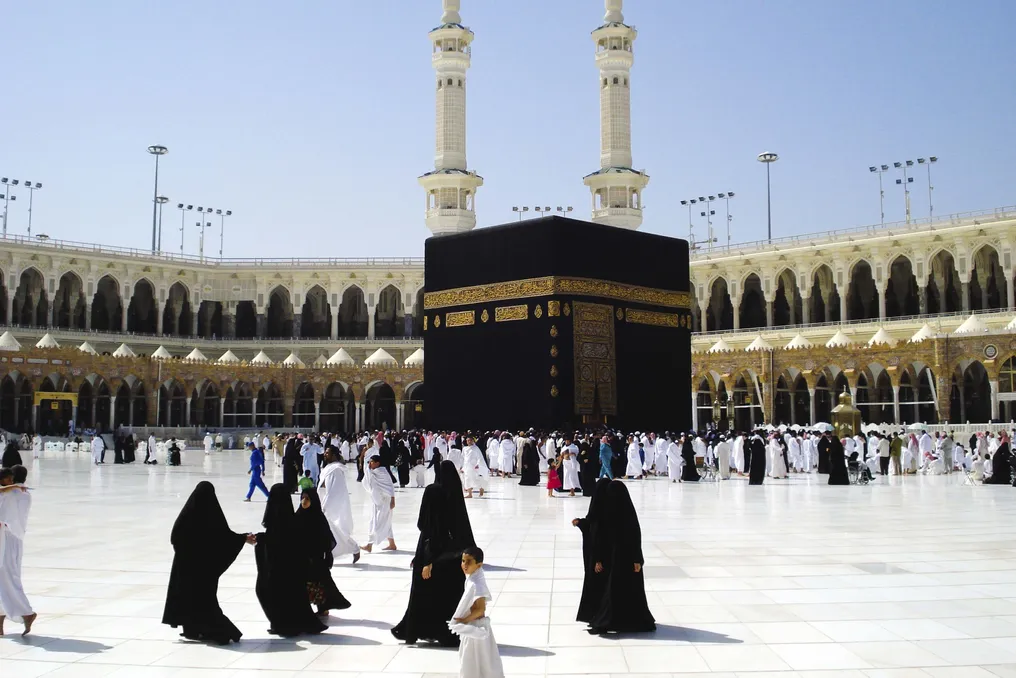
In the scorching heat of Saudi Arabia, where temperatures can reach 50 degrees Celsius, the white marble cladding the Kaaba in the Al-Haram Mosque in Mecca feels relatively cool when walked on barefoot. Millions of pilgrims performing Hajj and Umrah experience this phenomenon. This raises the question of why this floor does not heat up under the blazing sun.
There is a suggestion that pipes with cold water might run beneath the floor or that an air conditioning system is operating. However, the main reason lies not in any hidden technology, but in the unique thermal properties of the marble itself.
The white marble used for the floor of the Al-Haram Mosque is known as Tassos marble. According to a report from Science Direct, this stone originates from the island of Tassos in Greece. The report indicates that this special dolomitic marble is widely used in the Al-Haram Mosque. A study published in the journal Construction and Building Materials in 2021 also examined the characteristics of this marble.
The official website of the Saudi Arabian government, SaudiPedia, also confirms that Tassos marble is used in the courtyards and surfaces of both holy mosques and is specifically imported from Greece.
This issue has long interested people. Nevertheless, according to available official information and reports, the coolness of the floor is not related to cold water pipes or an air conditioning system underneath. Official representatives of Saudi Arabia explain the coolness of the floor through the properties of Tassos marble. Saudi Gazette also mentions this misconception about air conditioning under the floor, emphasizing that the primary reason is the use of Tassos marble.
The color of Tassos marble is very white, and this characteristic plays an important role regarding sunlight and heat. A 2021 scientific study showed that due to the high reflectivity of this marble, its surface temperature can remain relatively low. Researchers compared it with common flooring materials such as concrete and asphalt under the same weather conditions. Modeling showed that the surfaces of these materials were significantly hotter than Tassos marble.
In other words, white marble reflects most of the solar energy, whereas dark surfaces absorb more energy and can heat up considerably.
Another feature of this marble, mentioned in official sources of Saudi Arabia, is that the fine pores of Tassos marble are capable of absorbing moisture from the atmosphere at night. When the temperature rises during the day, this moisture slowly evaporates, helping to maintain the coolness of the floor. The official portal of the Al-Haram Mosque also states that the Tassos marble used is about 5 centimeters thick and absorbs moisture through its fine pores at night, releasing it during the day. Furthermore, its ability to reflect light and heat also contributes to its coolness.
Scientists have also acknowledged its thermal impact. In a 2021 study, scientists created a model of the temperature of the marble floor of the Al-Haram Mosque based on local meteorological data. The study found that this white marble surface can maintain a relatively low temperature even during intense summer sunlight. It is also noted that Tassos marble is used over an area of about 1.5 million square meters in Al-Haram, which may be one of the largest applications of marble on a surface in the world.
According to a report by Arab News, Saudi Arabia began importing Tassos marble for both holy mosques in 1978. Professor Dr. Salma Khawasavi from King Saud University reported that during the expansion of the Al-Haram Mosque under the reign of King Khalid, an order was given to order heat-resistant white marble from Greece. Later, the use of this white marble was increased in adjacent courtyards and other parts of the mosque.
The correct way to understand the situation is that the marble itself is not an air conditioner, but its natural and thermal properties combined help the surface remain less hot compared to many other materials. Three aspects are key: white color and high reflectivity, thermal characteristics, and moisture behavior through fine pores. Official information from Saudi Arabia attributes the coolness of the floor precisely to these characteristics.