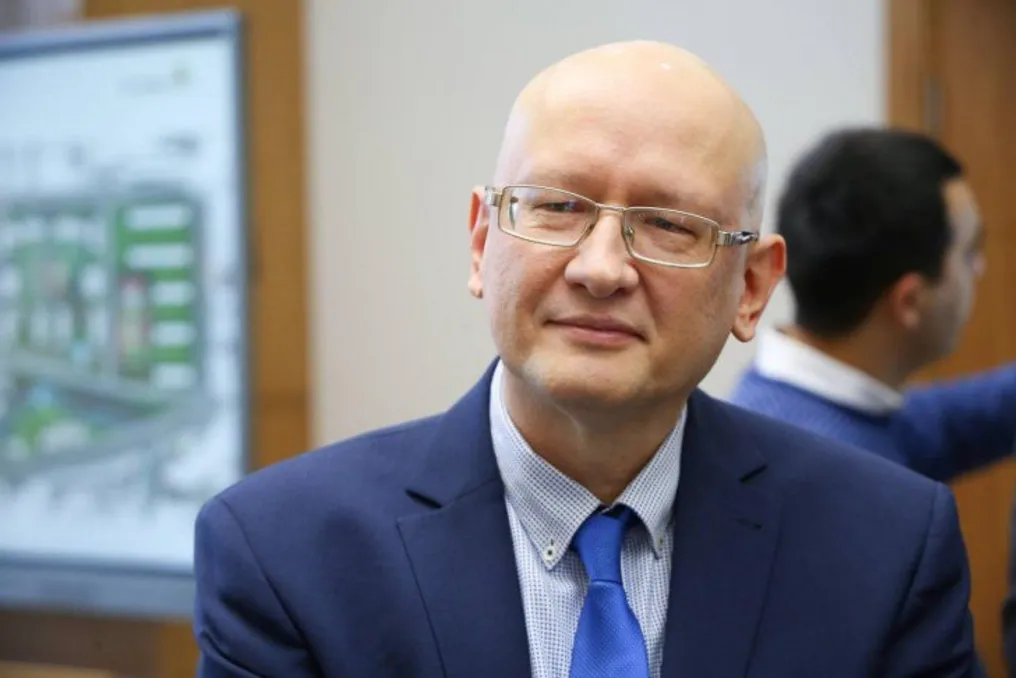
Yuli Yusupov states the necessity of privatizing state assets in Uzbekistan to improve economic efficiency
Read more
Podrobno.uz [uz]
podrobno.uz

Yuli Yusupov states the necessity of privatizing state assets in Uzbekistan to improve economic efficiency

Independent economist and scientific director of the Center for Promoting Economic Development, Yuli Yusupov, believes that continuing the privatization process of state property is critically important for Uzbekistan. The expert also insists on significantly increasing the level of transparency and competitiveness during public auctions.

According to available information, under the new privatization program, state shares in 84 business associations, 1,242 real estate objects, and about eight thousand hectares of land are planned to be put up for auction. The total estimated value of these assets is 100 trillion soms. Among the assets the state intends to sell are 98.9% of Turonbank shares, 91.83% of 'Uzexpocenter', and 79.27% of the International Cooperation Center. Furthermore, enterprises such as the Xalq Sug’urta insurance company, the Tashkent Passenger Car Construction and Repair Plant, the Andijan Mechanical Plant, and others are subject to full privatization.

Emphasizing the scale of the upcoming sale, Yusupov noted that the state currently holds shares in many financial institutions and enterprises operating in sectors that potentially allow for competition and which should function as private commercial entities. He stated that the current state ownership harms economic development because the state often acts as an inefficient owner and manager, especially in the absence of proper public control over officials managing state enterprises. The expert stressed that 'property must have a true owner who is deeply interested in the effective use and increase of this property.'

In Yusupov's opinion, the presence of state companies hinders the formation of a healthy market environment. He recalled that competition is the main stimulus for economic growth and ensuring its competitiveness. Therefore, as long as the state's share in ownership and business processes is not significantly reduced, the economy of Uzbekistan cannot be considered market-based, which gives continued privatization enormous importance for the country.

The Importance of Improving Sales Rules

The economist separately drew attention to the need to improve the rules for conducting sales. Although the proposed benefits may be useful as they simplify access to auctions and reduce costs for potential buyers, the key issue remains ensuring their fairness.

Lessons from the Past

Yusupov links the need for reforms to negative experiences recorded in previous stages of privatization, when serious questions arose regarding the transparency and terms of transactions. As an example, he cited the sale of a state share in Coca-Cola Uzbekistan. Initially, the asset was expected to be sold for approximately 70 million dollars, but after reviewing the terms and holding open auctions, the share was acquired by the Turkish company Coca-Cola İçecek for $252.28 million, demonstrating the potential for price growth with real competition.

Other examples that raised questions include the sales of state shares in Perfectum and Uzcard, which were transferred to private owners at their appraised value despite initial plans to put them up for public auction. The privatization of 85.58% of the shares of JSC 'Photon', which was sold for 151 billion soms through a public invitation to negotiate, was also noted. Yusupov believes that given past experience and emerging problems, additional mechanisms must be introduced to enhance the transparency and competitiveness of public auction processes.

Five Rules for Fair Auctions

To prevent abuses, the expert proposes implementing a number of fundamental measures. Firstly, auction rules must be established in advance and remain unchanged throughout the entire process. Secondly, the maximum bid price must be the sole criterion for determining the winner. Furthermore, Yusupov opposes granting buyers additional investment and social obligations, as this creates corruption risks and grounds for revising transaction results. It is also necessary to completely exclude the transfer of state property to private co-owners outside of a tender based on appraised value. Finally, a crucial condition for fair auctions is constant public oversight—from the approval of regulations to the review of appeals—by representatives of parliament, experts, business associations, and civil society. Yuli Yusupov concluded his remarks with hope for the successful conduct of privatization in an atmosphere of complete transparency, equal access for all potential buyers, and fair competitive struggle.

Similar stories

New wave of privatization begins in Uzbekistan: shares of Turonbank and Uzexpo Center put up for auction
Read more
podrobno.uz

New wave of privatization begins in Uzbekistan: shares of Turonbank and Uzexpo Center put up for auction

The program for privatizing state assets will be significantly expanded in Uzbekistan. As part of this initiative, controlling stakes in Turonbank, the 'Uzexpo Center' exhibition complex, and the International Cooperation Center are being put up for open auction. Furthermore, plans include transferring large industrial and financial enterprises into private ownership.

The decision to transfer these assets to investors was formalized by a presidential decree dated August 28. According to this document, state shares in 84 economic societies, 1,242 real estate objects, and about 8 thousand hectares of land will be offered for auction. The total estimated value of the proposed assets is 100 trillion soums.

Specifically, the state intends to realize 98.9% of Turonbank's shares, 91.83% of 'Uzexpo Center,' and 79.27% of the International Cooperation Center. Regarding the latter two entities, the concepts and terms of their sale require additional approval from the Presidential Administration.

The insurance company Xalq Sug’urta, the Tashkent Plant for Passenger Wagon Construction and Repair, the Andijan Mechanical Plant, as well as a number of joint and technological enterprises are slated for full privatization. The program will cover enterprises in the road sector, regional markets, and trade complexes. Additionally, 85 state-participating enterprises are expected to undergo either liquidation or reorganization.

To increase buyer interest, authorities have reduced financial requirements: the minimum advance payment has been lowered from 35% to 15%, and no interest will be charged on the remaining amount. An investor who pays for the property in full within six months will receive a 25% discount, and if a large initial deposit is made, they will be allowed an interest-free installment plan for a period of five to seven years.

This latest phase of sales continues the trend toward a massive reduction of state participation in the country's economy. For comparison, between 2020 and 2025, the volume of privatization reached 77.6 trillion soums, whereas in the previous decade, this figure was only 1.1 trillion soums. For 2021–2025, the share of state-owned enterprises has already decreased by 61%. Currently, about 1.5 million objects have been listed on the E-auksion electronic platform, of which more than 1.2 million have been successfully sold.

By 2030, Uzbek leadership aims to increase the share of the non-state sector in the economy to 85% and reduce the number of state-owned companies almost sixfold. It was previously reported that a state stake in Gold Moon Tashkent, which owns the Fonon jewelry factory, was also put up for sale; the initial price for this asset was set at 316.7 billion soums.

Presumption of the Entrepreneur's Rightfulness Introduced in Uzbekistan in Public Legal Relations
Read more
gazeta.uz

Presumption of the Entrepreneur's Rightfulness Introduced in Uzbekistan in Public Legal Relations

The concept of the 'presumption of the entrepreneur's rightfulness' will be implemented in Uzbekistan in the sphere of public legal relations between state structures and entrepreneurs to strengthen guarantees for protecting business activity.

This innovation is enshrined in a presidential decree, which was adopted on August 27th following the VI open dialogue with business representatives in the city of Khiva.

The head of state stated, as reported by the publication 'Gazeta', that the application of this 'presumption of rightfulness' is planned to begin in 2027.

According to the established procedure, an entrepreneur or their authorized representative is considered to be fulfilling their obligations in good faith and acting within the framework of the legislation until a state body can present evidence to the contrary.

In case of a dispute in court or another administrative body resolving this issue, the burden of proof regarding the legality, justification, and proportionality of the decisions or measures taken, as well as the fact of committing an offense, falls entirely on the state body.

The decree also stipulates that any irreconcilable contradictions, ambiguities, discrepancies in legislation, or any doubts arising from a lack of evidence on the part of the state body during a dispute must be interpreted exclusively and directly in favor of the entrepreneur.

A mechanism is introduced whereby if an administrative court obliges the state body to review its decision, the court states its legal position, which becomes binding for the state body when reconsidering the case.

Furthermore, the review cannot worsen the position of the entrepreneur compared to the initial decision of the state body. The state body is obliged to conduct the review within 30 days from the date the judicial ruling comes into force. After this period, the application of any legal enforcement measures against the entrepreneur in this case is prohibited.

The Ministry of Justice has been instructed to develop a draft law, providing for amendments and additions to current legislative acts, jointly with the Supreme Court and the Prosecutor General's Office, within three months.

Popular