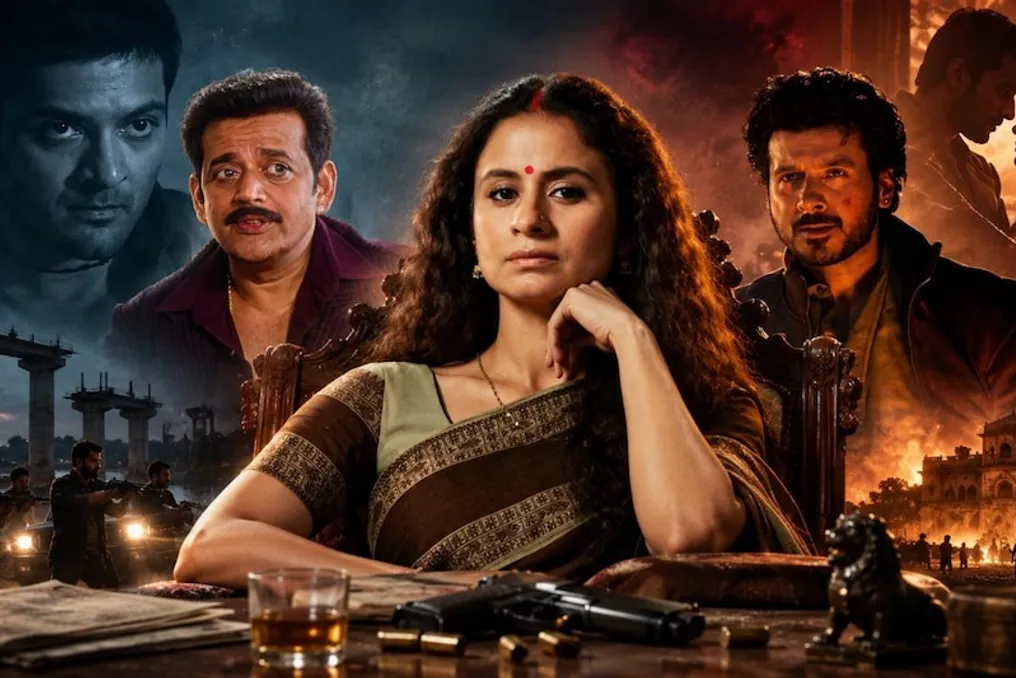
When the series 'Mirzapur' is mentioned, viewers often conjure images of weapons, gunfire, blood, profanity, internal conflicts, and ostentatious power. However, if one views this series only through that lens, a very interesting aspect of the plot can be missed. Within these formidable figures who control the world with the power of arms, there beats a heart that proves utterly helpless in the face of love.
It is this human aspect that forms the essence of 'Mirzapur,' lending the story a different tone amidst all the bloodshed. Although intimate scenes may occur in the series, the characters' hearts remain focused on one thing.
Consider the story of Bina, played by Rasika Duggal. Her marriage was arranged with Akhandan Tripathi, known as Kaleen Bhaiya. At first glance, this relationship appears to be an alliance based on power and influence, but in reality, it conceals an old, living love.
Birdhu Lohara's (Mohit Malik) arrival in Mirzapur to retrieve Bina is not merely a tale of revenge. Behind it lies a persistent desire to reclaim his love. He strives to eliminate Kaleen Bhaiya to get back his 'Chhathanki.'
In a world where people do not pause for a second before taking a life for power, one person is willing to challenge the entire system for the sake of his love.
Next comes the story of Guddu Bhaiya, Sviti, and Munna Bhaiya. Guddu Bhaiya (Ali Fazal) is in love with Sviti (Shreya Pilgaonkar). But the plot could not remain simple: Munna Bhaiya (Divyendu) also desires Sviti. This is where the love triangle begins, involving both weapons and beating hearts.
For Guddu, Sviti represents not only love but also weakness and strength. While for Munna, winning her is not just love, but a kind of victory. Their desires differ, but their goal is the same—Sviti. The charm of 'Mirzapur' is that love here can be as brutal as the game for power.
However, if any love in this series seems the most 'passionate,' it is Babban Yadav (Ravi Kishan). Babban harbors boundless love for his Mumtaj Bai (Sonali Chauhan). He keeps her close, protects her, and prevents anyone from harming her.
When Babban loses Mumtaj, his love turns into a broken heart. And when such a lover experiencing loss finds himself in the world of 'Mirzapur,' what he holds is not a rose, but a pistol. After Mumtaj's death, Babban's madness is not just a fire of revenge; it is the story of a man who has lost his world and has nothing left to lose.
And, of course, there is Bablu Pandit. When every 'Bahubali' of Mirzapur is in love with someone, how could Bablu Pandit remain on the sidelines? His love is for Golu Gupta, but it lacks noise or grand declaration. It is a quiet love that he keeps inside himself. Bablu's silent love differs from others because there is no aggression in pursuing love, only silence in the act of loving, which perhaps makes him the most human.
The real game is that these characters are not just 'Bahubalis.' They become stone as soon as they take up a weapon. There is no concept of mercy before an enemy. They do not hesitate with shots or flinch from spilling blood. But what happens when love appears? These people melt like wax.
Kaleen Bhaiya's empire has power, but also complexity in relationships. Munna has anger, but also anxiety about gaining love. Guddu Bhaiya has a pistol in his hand, but his heart beats for Sviti. Babban Yadav instills fear in people, but for Mumtaj, he is a mad lover. And Bablu Pandit... he doesn't even find the courage to speak of his love.
Thus, in the world of 'Mirzapur,' no matter how great a 'Bahubali' a person becomes, all his pride crumbles in the face of love.
The true violence of Mirzapur lies not only in firearms. Although the show's ostentatious power, its profanity, bloodshed, feuds, and intimate scenes are its calling card, the love stories create an interesting contrast here. Violence occurs not only against the body but also against the heart. Someone's love is taken away, someone fights for their love, someone goes to seek revenge after being defeated in love, and someone simply loves quietly.
Perhaps this is why the characters of 'Mirzapur' do not seem exclusively 'brutal.' Their inner weaknesses make them human. After all, even a person holding a weapon has a heart... and in 'Mirzapur,' the greatest power sometimes comes not from a pistol, but from a broken heart.