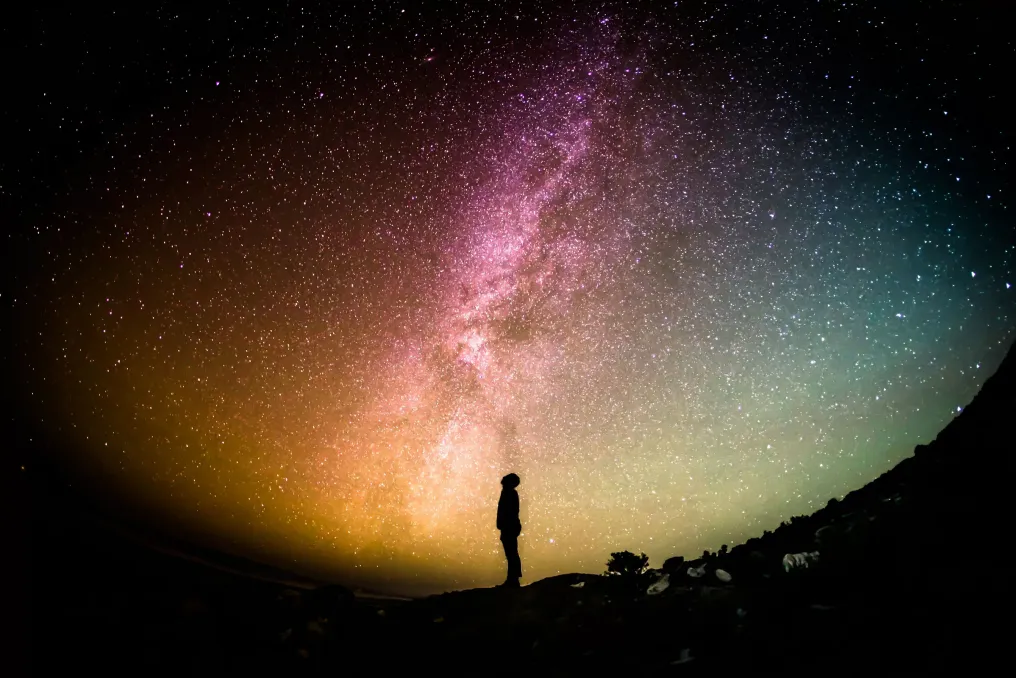
September brings the first signs of spring to South Africa and offers many opportunities for stargazing. Although there is no major annual meteor shower in September, attention should be paid to the Epsilon Perseids.
The peak of this shower is around September 9–10, and under ideal conditions, up to eight meteors per hour may be visible. This shower is considered relatively modest, so one should not expect spectacular sights like the August Perseids. However, the timing is favorable as it occurs shortly before the New Moon, which minimizes the influence of moonlight on the dark sky.
The New Moon in Cape Town will occur on September 11 at 05:27. During the New Moon, the Moon is positioned between the Earth and the Sun, meaning its illuminated side faces away from us and is effectively invisible in the night sky, which is good news for astronomy enthusiasts.
Nights from September 9 to 12 should offer some of the darkest conditions of the month, making this an ideal time to escape artificial light and search for fainter stars and deep-sky objects. This is one of the best periods in September for southern observers.
NASA recommends tracking the Moon's movement past Antares and the ladle-shaped star cluster between September 14 and 20. The ladle-shaped cluster points toward the center of our galaxy, the Milky Way, which can appear as a hazy band under a sufficiently dark sky. South Africa has a significant advantage here if one moves away from the lights of Cape Town, Johannesburg, or Durban.
On September 14, the young crescent Moon will be visible near bright Venus, providing one of the easiest opportunities for astrophotography this month. Venus will be particularly bright and stand out against the fading evening light. The Moon will also help locate the planet: look towards the western sky shortly after sunset, using the crescent as a guide.
If you remember only one planet this month, it should be Venus. On September 18, Venus will reach its peak evening brightness, shining at approximately magnitude -4.8. It will be unmistakably bright and easily outshine surrounding stars. NASA advises looking towards the western horizon shortly after sunset. Conditions for observing this bright Venus are favorable for observers in the Southern Hemisphere.
The Moon will reach first quarter on September 18 at 22:43 SAST. This is also an excellent phase for those interested in photographing or observing the Moon with binoculars or a telescope, as the angle of sunlight creates distinct shadows on the lunar surface.
No major astronomical event is required to spend an evening watching the stars. International Moon Watching Night will take place on September 19, inviting people from all over the world to view and learn about Earth's nearest celestial neighbor. NASA reports that people can participate from anywhere simply by observing the Moon from home.
Spring officially arrives in the Southern Hemisphere with the September equinox. The equinox marks the moment when the Sun crosses the Earth's equatorial plane. NASA sets the precise astronomical time for September 23 at 00:05 UTC, which corresponds to 02:05 SAST in South Africa. Although there is no dramatic spectacle at this time, it signals the astronomical beginning of spring in the Southern Hemisphere, after which days continue to lengthen toward summer.
The Full Moon in September will occur on September 26 at 18:49 SAST. It is traditionally called the Harvest Moon because it is closest to the September equinox. This name originates from the Northern Hemisphere and does not mean the Moon will look different from a regular full moon. For observers in South Africa, the main attraction is simply watching the full Moon rise over the eastern horizon around sunset.
The Full Moon will be near Saturn and Neptune, creating a particularly interesting evening for those with binoculars or a telescope. Saturn is an easy target as it is bright enough to be seen with the naked eye. Neptune is significantly more challenging; at a magnitude of about 8, it is too faint to observe without optical equipment, but binoculars or a telescope might detect it. Furthermore, around September 26, Neptune will reach opposition, placing it in a favorable viewing position, as in opposition, the planet is opposite the Sun in the Earth's sky and is usually visible for most of the night.
If you missed the Moon's meeting with the Pleiades earlier in the month, there is another opportunity at the end of September when the Moon will be close to the star cluster again. However, at that time, the Moon will be in a completely different phase, so the view will differ greatly from the early September combination.
For planning a night under the stars, it is best to choose days around the New Moon, especially from September 9 to 12, due to the darker sky. To observe the Milky Way, seek a location with minimal artificial light; areas such as Karoo, North Cape, Cederberg, and other rural parts of South Africa can offer excellent conditions with favorable weather. Most September sights do not require a telescope; a pair of binoculars, a folding chair, and a clear view of the sky will allow you to see surprisingly much.