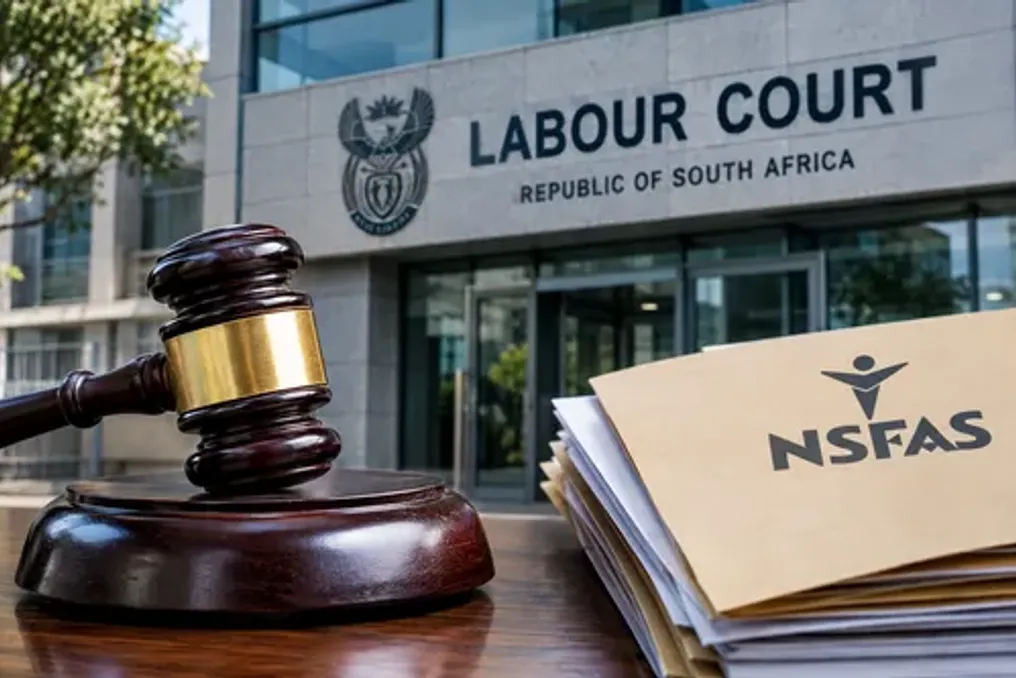
The Labour Court in Cape Town overturned a decision that deemed the dismissal of a former National Student Financial Aid Scheme (NSFAS) accountant unfair, ruling that the commissioner made an error in assessing the misconduct and corresponding penalty.
Presiding Judge C de Kock referred the dispute back to the Commission for Conciliation, Mediation and Arbitration (CCMA) for reconsideration by another commissioner.
Reason for dismissal related to forwarding confidential emails
The case arose after NSFAS dismissed Zenobia Abraham in September 2023. This followed a disciplinary hearing concerning the repeated forwarding of confidential work emails from her NSFAS account to a personal Gmail account.
According to the court's ruling, Abraham had worked in this financial aid since November 2006. Between March and October 2022, while holding the position of Accountant: Budgeting and Expenses, she forwarded nine work emails containing NSFAS information to her personal Gmail account.
This action exposed NSFAS to reputational, financial, and organizational risk. Her behaviour was alleged to have violated NSFAS's Information Security Policy, which prohibits forwarding work emails to personal accounts, as well as the ICT Security and Acceptable Use Policy governing email usage.
Subsequently, she was charged with the intentional disclosure of privileged and confidential information. After a disciplinary hearing chaired by an external chairperson, she was found guilty of misconduct and immediately dismissed.
She then appealed her dismissal to the CCMA, where Commissioner C.M. Bennett ruled in April 2025 that her dismissal was substantively unfair. The Commissioner concluded that her actions constituted a less serious breach of the NSFAS disciplinary code, justifying only a written warning for the first instance, and ordered her reinstatement with compensation for the period passed exceeding 1 million rand, calculated as remuneration for 20 months at a rate of 52,250 rand per month.
NSFAS appealed to the Labour Court for review of the decision
Dissatisfied with the CCMA's decision, NSFAS lodged a claim in the Labour Court seeking to review and set aside this ruling. Judge De Kock held that the commissioner misinterpreted the nature of the disciplinary charge, treating the matter as if NSFAS had to prove that Abraham disclosed confidential information to a third party or caused actual damage.
Instead, the court established that the essence of the charge was the unauthorized extraction of confidential information from NSFAS's controlled systems by forwarding it to a personal email address. The court's decision states that the commissioner erroneously included considerations not part of the disciplinary charge in the review, including whether the information was further disseminated and whether NSFAS proved probable damage.
The court found that these errors significantly affected both the verdict on the misconduct and the imposed penalty.
Student Confidential Information
In its ruling, the court emphasized that NSFAS is a state entity responsible for protecting the personal information of tens of thousands of students. The court noted that the organization has the right to implement policies prohibiting employees from transferring confidential information to personal platforms outside its control, even without prior proof of actual damage in every case.
Judge De Kock stated that the commissioner failed to adequately consider the seriousness of repeatedly moving confidential financial information, including payment slips and financial reports, outside the protected NSFAS environment.
Case returned to CCMA
Although the Labour Court found the arbitration award subject to review, it declined to issue its own ruling. Instead, it ruled that the issues concerning the proper classification of Abraham's conduct, her explanations, credibility, and appropriate sanction should be determined by a new arbitrator after a rehearing of the evidence.
The court stressed that it was not expressing an opinion on whether the dismissal was ultimately fair, noting that a different composition of the arbitration panel could still conclude that the dismissal was justified or too harsh.
The Labour Court made the following decisions: reviewed and set aside the CCMA arbitration award issued in April 2025; sent the dispute back to the CCMA for a new arbitration before a different commissioner; issued no order on costs, deeming it reasonable that Abraham could defend the arbitration award, which was initially in her favour.