Vaipul Chaudhary, a lecturer from the Government Polytechnic College in Chhota Udaipur, Gujarat, recalls feeling settling dust in the air last winter. At 33, he struggled to breathe clean air even at home, noting that the air never felt fresh despite attempts to minimize exposure.
In Bengaluru, 26-year-old engineer Debashish Das also describes air quality issues, pointing to the constant presence of dust and vehicle odors, which caused him a feeling of congestion even indoors. Abhinav Chauhan, a software engineer from Pune (27), experienced subtle but persistent symptoms, such as throat irritation during winter, realizing how air can deplete energy and affect well-being.
For many residents of India, this has become part of daily life. However, Rohan Kumar, who could not ignore this problem, decided to find a solution.
Journey across India and realization of the problem
Rohan Kumar (27) grew up in Bihar, a state where air pollution is often unnoticed but constantly present. His life led him to different parts of India: he spent 10 years in Delhi, four years in Gujarat, two years in Karnataka, and three years in Maharashtra.
He recalls that living in different cities, he felt differences in air quality, including dust, smog, and faint smells of transport and industry. He concluded that clean air is a luxury for many people.
Rohan studied environmental engineering, initially focusing on wastewater treatment. Through grants from IIT Bombay and the Ministry of Science and Technology's Nidhi Prayas program, he analyzed natural purification systems, mass transfer mechanisms, and principles of sustainable design. His work on water purification taught him to create effective, practical, and low-energy systems, which he later adapted to combat air pollution.
He is currently a postgraduate student in the Civil Engineering department at the Indian Institute of Technology Bombay (IIT Bombay) in Powai, Mumbai, where he is refining his work on the 'Enviroforge Air Purifier'—a device designed to improve air quality in domestic spaces.
From cardboard boxes to advanced purifier
The concept of the biophysical purifier came to him in early 2024 while working on water treatment systems. By February 2025, he shifted his focus to air purification and created nine or ten prototypes over the year, finalizing the design by December.
Throughout 2026, the main focus was on testing the device in various climatic conditions across India—summer, monsoon, and winter—to ensure stable operation. Simultaneously, he conducted market research, gathered user feedback, and applied for grants, continuously refining the device based on real needs.
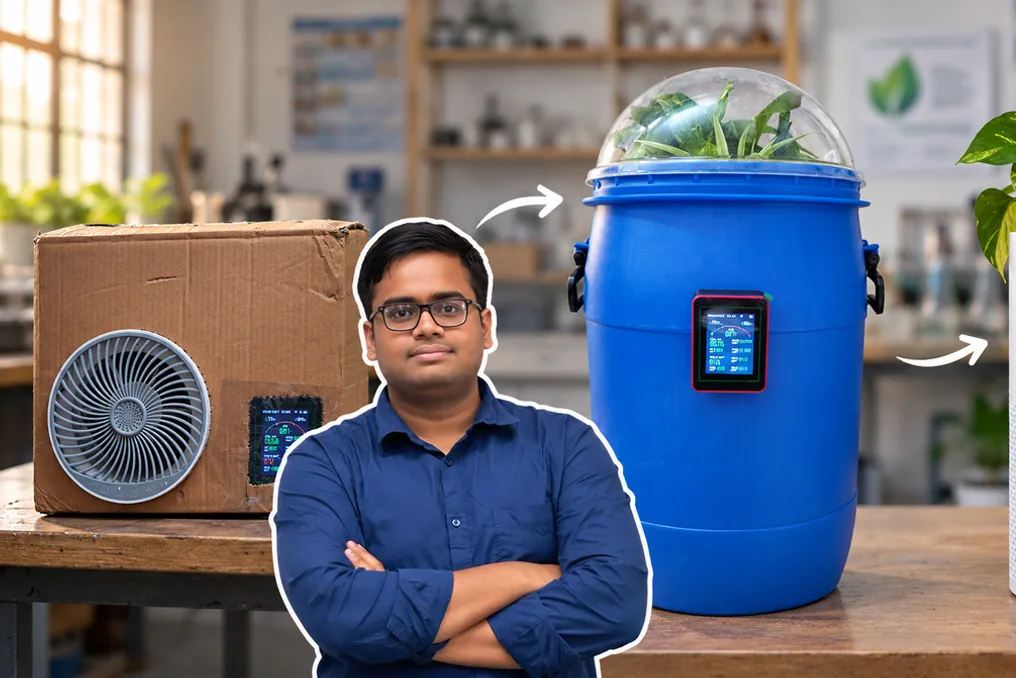
The journey from idea to finished product involved numerous experiments. Initially, he used cardboard boxes as temporary casings for the purifier, which helped him understand airflow principles and filter placement. He then moved to Amazon delivery boxes, which were sturdier and allowed for testing larger filters. After that, he experimented with blue barrels, which could accommodate more plants, microbes, and adsorbent materials. Each learning stage brought him closer to the final design.
There were challenges, such as filter management: overly thick filters hindered airflow, causing pressure drop and reduced efficiency, whereas overly thin ones let through fine dust and pollutants. Furthermore, plants and beneficial microbes required constant care and hydration to maintain activity. He had to find a balance so that the purifier worked reliably in the humid monsoon of Mumbai, the dusty winter of Delhi, or the dry heat of Gujarat. Ensuring functionality in all Indian conditions was one of the biggest hurdles.
Prototypes were tested in residential homes, offices, near roads and construction sites, as well as in chemical laboratories; samples were sent to friends in Delhi, Ahmedabad, Bangalore, and Surat for real-world feedback.
The art of clean breathing
All these efforts led to the creation of the Enviroforge Air Purifier, completed in December 2025. It is a biophysical purifier that effectively cleans the air by combining natural fibers, adsorbents, beneficial bacteria, and houseplants. The design integrates these physical and biological components into a hybrid system intended for Indian homes and offices.
Enviroforge is housed in the incubator of the Indian Institute of Management Mumbai (IIM Mumbai), which provides mentorship, laboratory support, and guidance for implementation. Rohan explains that incubation allows the device to be refined for real-world conditions and plan large-scale deployment.
The filters utilize bamboo, coconut, banana fibers, jute, muslin, cotton, and silk. Coarser fibers trap large particles, while finer ones, including micro-nano-fibrillated cellulose, capture microscopic pollutants. Gaseous pollutants, such as carbon dioxide, carbon monoxide, nitrogen dioxide, sulfur dioxide, volatile organic compounds, and ozone, pass through a mixture of activated charcoal, biochar, zeolite, ceramic filters, manganese dioxide, and lime.
Beneficial bacteria, such as Bacillus subtilis, Rhodococcus, and Pseudomonas, are also used to biologically decompose pollutants. Houseplants, including Sansevieria, money plant, spider plant, spathiphyllum, and moss, continue the natural purification process.
Rohan emphasizes that this combination of natural fibers, biological action, and plants distinguishes the system from standard commercial purifiers, most of which rely solely on mechanical filtration. The Enviroforge system is hybrid, sustainable, and accessible for everyday household use.
Air purification with Enviroforge: how the process works. The innovator explains the process in simple terms: 'Air passes through layers of fibers that trap dust and solid particles, such as PM2.5 and PM10. Gaseous pollutants are absorbed by natural adsorbents. Beneficial bacteria break down chemical pollutants, and plants continuously purify the air. This is the interaction of nature and science.'
To monitor system performance, he uses calibrated air quality sensors from Prana Air. 'We measure PM2.5, PM10, CO2, carbon monoxide, volatile organic compounds, and ozone. This ensures the purifier operates as expected.'
In Rohan's tests, Enviroforge reduced the air quality index by 80–85 percent within 20 minutes in an enclosed space of 800 cubic feet. It removed up to 92 percent of PM10, 86 percent of PM2.5, and about 80 percent of gaseous pollutants.
Vaipul, a new father, placed the device in his infant's room. 'After 40–50 minutes, the air feels fresh. I strongly recommend this system to anyone living in industrial or heavily polluted areas.'
Debashish, comparing it to an air purifier costing 30,000 rupees, was surprised. 'The cost and performance truly impressed me. I noticed a real improvement in sleep quality and eagerly awaited another unit. I asked Rohan for one, but he only had a few left.'
Abhinav found the device both functional and aesthetic. 'It looks like a flower pot. I keep it on my office desk and use it before morning yoga. Within an hour, I feel more energetic. It is affordable, effective, and fits conveniently into daily life.'
Rohan added that 25 units are currently deployed: five in residential and office spaces, five near roads and construction sites, and five in chemical laboratories. Additional prototypes have been given to friends and relatives for performance testing in different cities, and their feedback helped refine the device and make it suitable for Indian conditions.
Accessibility for all
Rohan designed Enviroforge with accessibility in mind. 'The basic model costs 2000 rupees. The mid-range option is between 5000 to 6000 rupees, and the premium model is around 10,000 rupees. We are focusing on the 2000 rupee model. The materials are natural and easily replaceable. It is effective, affordable, and can be accessible to students, low-income families, and small businesses. The official launch is planned for December 2026.'
He notes that the air pollution level in Mumbai is equivalent to smoking 10–15 cigarettes a day, and in Delhi, 20–25. This is a serious health issue, and he aims to create a practical, cost-effective solution specifically designed for India and accessible to those who need it most.
Vaipul, Debashish, and Abhinav are part of a growing group of early users whose feedback is shaping the device before the planned launch in December 2026. The next phase will show how these lessons turn into reality as Rohan prepares to bring the product to more homes and offices.