The Hindu tradition contains numerous divine powers and weapons against which it was not easy even for great warriors and gods. It is said that some of these swords possessed such immense power that ordinary weaponry proved powerless against them.
In great Hindu epics, such as the Ramayana and the Mahabharata, various divine artifacts and weapons are mentioned that ordinary warriors could not wield. Among this divine equipment, swords and khardgas hold a special place. The Ramayana and Mahabharata describe warriors who obtained these divine implements through blessings, asceticism, or martial skill.
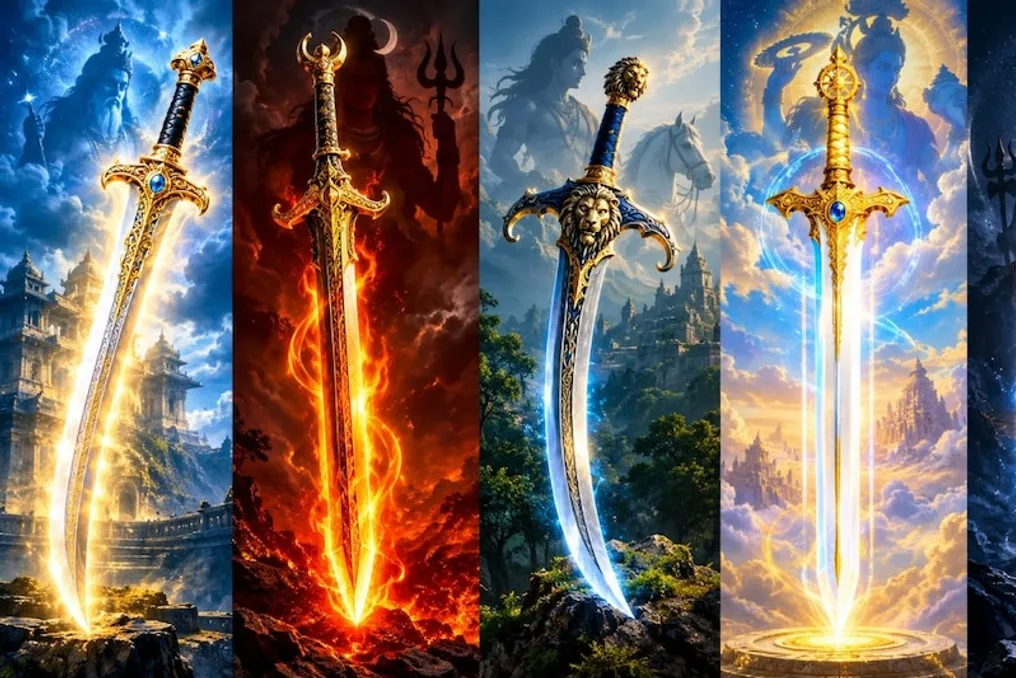
From a classification perspective, a sword may have one or two cutting edges, whereas a khardga is usually described as a wide and extremely sharp sword. However, this discussion focuses specifically on those divine swords and khardgas endowed with exceptional power in mythology. Below are presented five mighty swords from the Ramayana and Mahabharata, whose owners were considered great warriors.
Kaushalya Talwar
The first sword is the Kaushalya Talwar. According to mythological accounts, this sword was created by Vishwakarma himself and is associated with the god of teachers, Brahma. It is said that Brahma used this divine sword to defend against demons and asuras. Later, this sword came into the possession of Bhishma after he received knowledge from him.
Bhishma, who observed lifelong celibacy, was known for his strength of asceticism and combat skills. It is believed that he enhanced the sword's power through his practice and valor. In the episode of the battle with Parashurama, Bhishma's incredible skill is described. During the Mahabharata war, his fencing skills demonstrated terrifying might. When Nakula's sword met Bhishma's sword, they flared so brightly that surrounding soldiers could not see properly for some time.
Bhishma-Pitamaha was also able to cut through many of Abhimanyu's divine arrows with his sword. Myths describe Vishwakarma's miraculous craftsmanship regarding the blade and construction of this sword. According to one legend, King Pandu requested this sword from Bhishma before the war, but Bhishma refused, stating that not everyone is capable of wielding this sword.
Asi Talwar
The second sword is the Asi Talwar. The Shantiparva of the Mahabharata tells a remarkable story about the appearance of Asi. As the influence of injustice and asuras began to grow on Earth, sages performed a yajna. During the ritual, a terrifying vision appeared, possessing an unusual form. This vision then transformed into a shining and sharp sword, which was named Asi. Brahma manifested this sword to protect the world and destroy rebellious asuras. Subsequently, the sword passed to Lord Shiva.
It is said that Lord Shiva used this divine sword to destroy many powerful demons. The sword then passed to Lord Vishnu, and subsequently to other gods. Later, it ended up in the hands of many great warriors. Ultimately, this sword is associated with Dronacharya.
The main feature of the Asi Talwar is considered its sharpness and power. According to mythological descriptions, it was so potent that it could pierce the strongest armor. Ordinary swords seemed extremely weak before it. It is recounted that when Dronacharya demanded a portion of the kingdom from his old friend Drupada, and had to engage in battle, he demonstrated his skill to defeat Drupada. Although there are not many mentions of the use of the Asi Talwar in the Mahabharata war, its power is described very impressively in the myths. Nevertheless, there was another sword capable of countering the Asi Talwar, which occupies the third place on our list.
Narsingh Talwar
Third on the list is the Narsingh Talwar. Among the five Pandavas of the Mahabharata, Nakula is most known for his beauty, knowledge of horse lore, and mastery of the sword. Nakula was exceptionally skilled in warfare and possessed a special aptitude for handling a sword.
According to mythological accounts, Nakula possessed an amazing sword known as the Narsingh Talwar. It is said that during the construction of Indraprastha, inspired by Lord Krishna, Vishwakarma organized numerous divine items and weapons for the Pandavas. It was during this period that Nakula received this special sword. When the Pandavas were exiled, Nakula used this sword to protect himself and his brothers. During the exile, they faced various dangers, and his fencing skills proved very useful. In the final stage of the Kurukshetra battle, Nakula also demonstrated his martial art. On the eighteenth day of the war, he fought against Karna's sons—Sushumna, Satyasena, and Prasena—and defeated them.