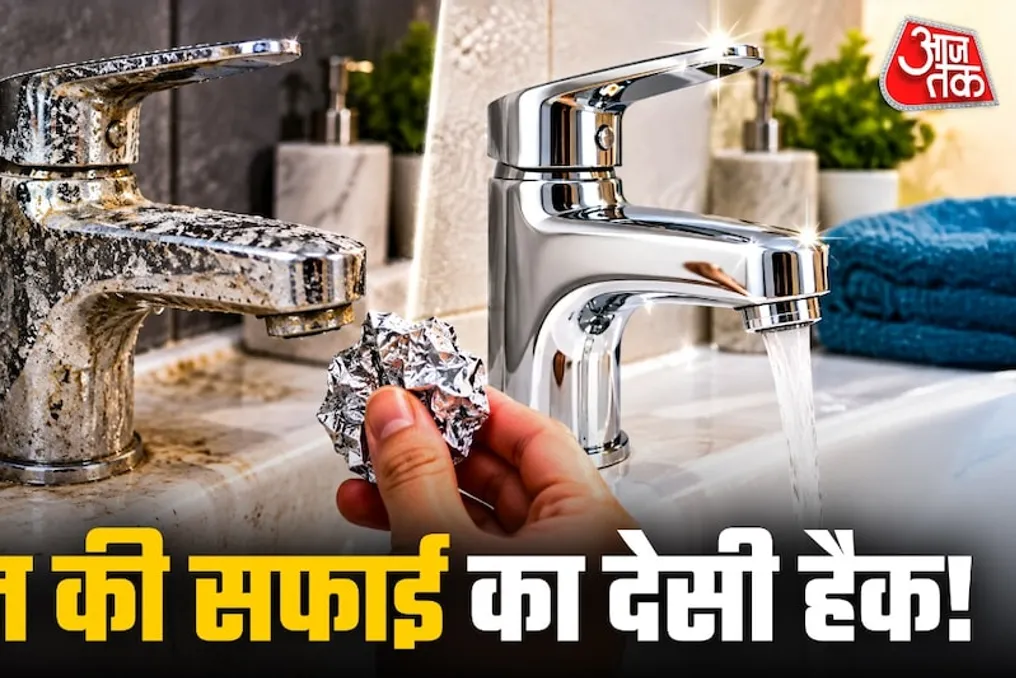
When cleaning the house, people often pay attention to floors, sinks, and bathroom tiles, but they pay little attention to faucets. Faucets that look shiny and clean after installation gradually become covered with spots and dirt. After some time, white spots, layers of salt water, and grime begin to appear on them, making the entire bathroom look untidy.
Especially in areas where salt water is used, white limescale quickly forms on faucets. Usually, expensive cleaning agents or strong chemicals are used to remove these contaminants. However, there is a simple method that can be used by having kitchen aluminum foil on hand.
How does cleaning a faucet with aluminum foil work?
White marks on faucets are usually caused by minerals contained in salt water. When the faucet is lightly rubbed with slightly damp aluminum foil, a small friction is created that helps loosen and remove these accumulations and films. Thus, foil, which was previously used for food packaging, can also be useful for light cleaning. This method is suitable for smooth chrome and stainless steel surfaces.
Step-by-step guide to cleaning a faucet with aluminum foil
No special equipment is required for this trick. Take a small piece of aluminum foil and gently crumple it into a ball. It is important not to make it perfectly flat, as the small wrinkles in the foil help with friction. Then, slightly wet the foil with water and carefully rub the area of the faucet where white spots or a water film are visible using circular motions. Excessive force should not be applied during rubbing.
If the spots are more stubborn, you can use foil dipped in a little vinegar. After finishing the cleaning, be sure to thoroughly rinse the faucet with clean water and wipe it with a microfiber cloth to reduce the likelihood of new water marks appearing.
Not all faucets are suitable for aluminum use
One cannot assume that aluminum will help clean absolutely all types of faucets. This method works best on smooth chrome and stainless steel surfaces, but on matte, brushed, or specially coated faucets, the foil may leave scratches. Therefore, before first use, it is recommended to perform a test application on a small, hidden area of the faucet. If damage appears on the surface, the foil should not be used.
Important points when cleaning
Do not rub too hard while cleaning; the purpose of the foil is to remove dirt through light friction, not to scrub the surface. If the foil darkens, becomes too flat, or loses its texture, a new piece must be used. It is also helpful to wear gloves to protect your hands while cleaning. And most importantly—always test on a small area before applying any new cleaning life hack to the entire surface.