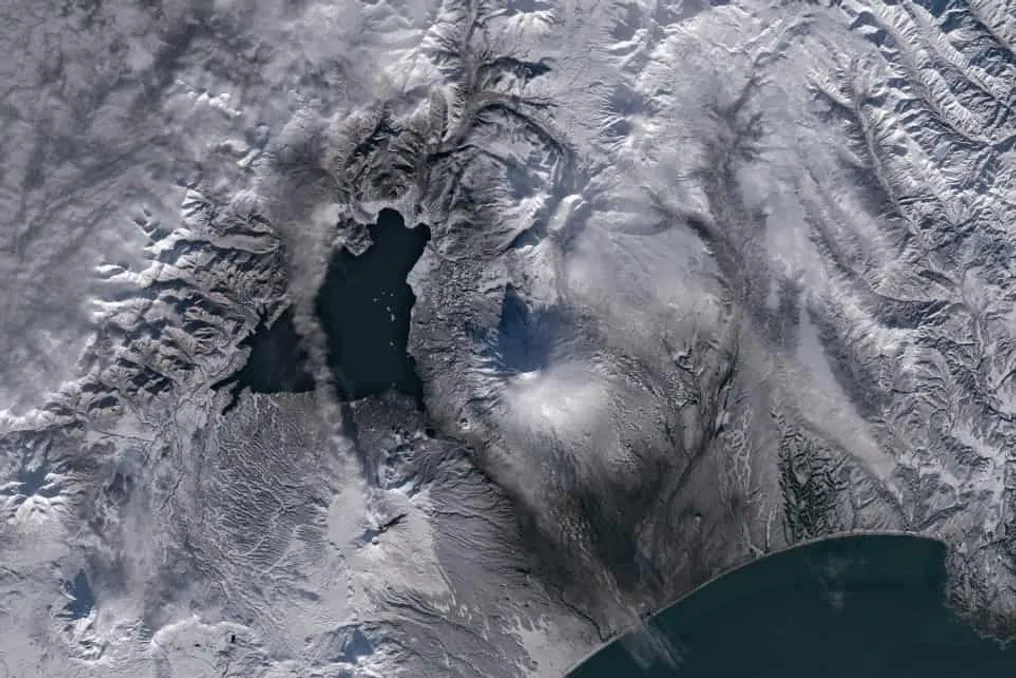
A powerful magnitude 8.8 earthquake that occurred on July 30, 2025, off the coast of the Kamchatka Peninsula in Russia, is presumed to have contributed to the awakening of the Krasheninnikov volcano, which had not erupted for 475 years. A research group led by volcanologist James Hickey from the University of Exeter in the UK studied this possible connection.
Some time after the mega-earthquake, the volcano began ejecting a large column of material. In a preliminary publication on EarthArXiv, scientists hypothesize that prolonged seismic activity not only fractured the magma reservoir but also initiated a chain of processes that increased pressure in the underground system.
The link between earthquakes and volcanic eruptions is not direct. Kamchatka is located above a subduction zone where the Pacific Plate dives beneath the Okhotsk microplate. This region has about 160 volcanoes, 29 of which are classified as active.
However, before the earthquake, Krasheninnikov showed no obvious signs of an impending eruption. Observations made using satellite radar over nine years did not reveal ground uplift that might indicate magma accumulation. On the contrary, the surface was slowly subsiding by approximately 4 millimeters per year.
Satellites also did not record sulfur dioxide emissions from the volcano before the earthquake, although gas was observed in other Kamchatka volcanoes. Approximately two days after the mega-earthquake, 12 earthquakes of about magnitude 4 were recorded in the Krasheninnikov area over five hours. Satellite observations showed that magma opened a nearly vertical fissure in the crust.
Researchers calculated that the dike intrusion covered about 32 million cubic meters of magma coming from a reservoir located approximately 6 kilometers beneath the surface. Nevertheless, calculations show that the constant changes in stress caused by the earthquake were minor—from 0.01 to 0.05 megapascals of Coulomb stress. It is generally believed that magma reservoirs can rupture under overloads ranging from 1 to 10 megapascals.
The transient stress during the tremors was higher, around 1.0 ± 0.6 megapascals, which could theoretically have affected the volcano. However, the team considers this the least likely explanation because Krasheninnikov did not react immediately.
According to the researchers' modeling, the magma in the reservoir had characteristics compatible with high gas content. Over centuries of crystallization, the gas-rich material could have accumulated bubbles in the reservoir. Prolonged shaking caused by the earthquake could have promoted the diffusion of more gas into these bubbles, causing them to grow and facilitating the formation of new ones. The increase in gas volume raised the pressure in the reservoir.
In such a scenario, the system could have become unstable, allowing the magma to advance into the dike and then trigger the eruption of Krasheninnikov. Scientists characterize this situation as a possible 'hidden critical regime': although the volcano appeared inactive on the surface, the properties of the magma and tectonic conditions could have made the reservoir susceptible to seismic disturbance.
The hypothesis proposed in the study is that the earthquake did not cause a direct immediate rupture. Instead, prolonged tremors facilitated the release of volatiles, bubble growth, reservoir destabilization, dike intrusion, and finally, the eruption.