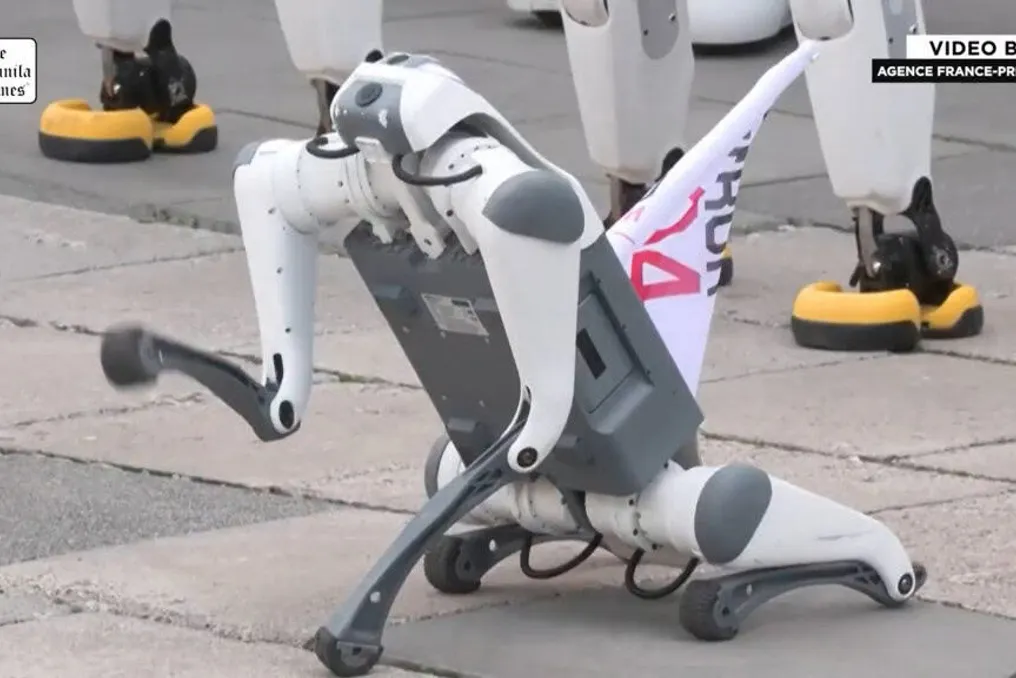
Around thirty robots took to the streets of Warsaw on Tuesday (the 7th) to demand that Poland take measures to regulate artificial intelligence. This march was organized by the group Democratism, which discusses the consequences of implementing AI and robotization in the labor market.
The protest drew public attention to the risk of humans being replaced by humanoid robots and AI systems, especially in cognitive tasks. The action took place in front of the Ministry of Digital Affairs. Humanoid and quadruped robots marched through the Polish capital, waving flags and chanting slogans such as 'Protect Jobs,' 'Time for Rules,' and 'Don't Wait, Regulate' through loudspeakers.
Additional Information
The demonstration was organized by Democratism, which, according to its website, aims to stimulate discussion about the impact of AI and robotization on the labor market. Among the participants was the robot Agibot A3, a humanoid equipped with artificial intelligence. In a statement to AFP, it explained the reason for its participation: 'The robots present here must show that this technology is already a reality.'
Grzegorz Kulis, the event organizer, emphasized concerns about the potential displacement of workers by humanoid robots and artificial intelligence in cognitive activities. He stated: 'In particular, we want to highlight the problem of potential replacement of humans by humanoid robots and artificial intelligence in cognitive labor.'
Kulis also insisted on the need for a timely response from the authorities, arguing that regulations are necessary to protect workers. The main demands put forward by the protesters were presented to the Ministry of Digital Affairs, where Kulis met with Krzysztof Gawkowski, the head of the department. It was noted that uncontrolled AI models implemented in humanoids, which continue to develop with the progress of robotization, pose a serious problem.
The action brought the discussion of the impact of artificial intelligence on labor to the public arena. According to the organizers, the development of regulatory norms must proceed parallel to technological development, especially considering the possibility of replacing humans with AI systems and humanoid robots.