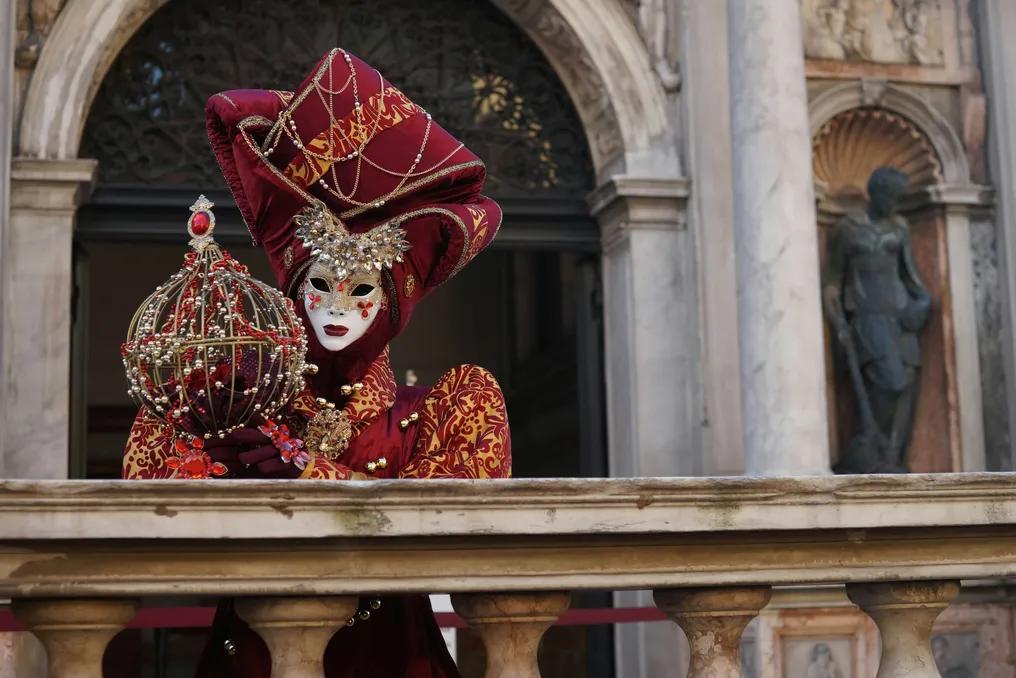
The Carnival in Venice is one of the city's main attractions, drawing a large number of visitors. Estimates suggest that up to three million people, accounting for about 10% of total travelers, stay in the city during this time of year.
The origins of this festival date back to the Middle Ages, but those who delve into the history of this unusual tradition may be surprised to learn that the modern Carnival appeared much later. Despite numerous references to the past, the current celebration was only revived in 1979 after nearly two centuries of prohibition.
The exact time the 'Carnevale' flourished in the city is unknown, but the earliest known records of the festival during Lent date back to the 11th century. The name is linked to this important moment in Catholicism: the term derives from the Latin expression 'carnem levare,' which means abstaining from meat in daily life, referring to the fast prescribed before Easter.
Although many European places developed their own carnival traditions, in Venice the festival gained significant influence due to the city's economic and cultural importance. As an independent republic that dominated maritime trade in the Mediterranean, Venice was a hub through which wealthy merchants from all corners passed, and the Carnival became a way to display status and evade social norms during exceptional moments.
The ancient Venetian tradition was suddenly interrupted at the end of the 18th century when the Serenissima Republic of Venice fell under Napoleon's onslaught and was subsequently placed under the control of Austrian nobility. From 1797, the use of masks and the Carnival celebration itself were banned, and the city's turbulent history kept this tradition hidden for almost 200 years.
It was only in 1979 that collective efforts by the local government, merchants, and the tourism industry (which sought to revitalize the city during the low winter season) led to the deliberate revival of the festivities. This proved to be very successful: today, Venice is visited so frequently, even in colder months when Carnevale takes place, that authorities have had to implement new rules to curb overtourism.
Venice became a place that helped popularize the tradition of masks at the Carnival—something that, having gone through the changes of the ages, underlies even the costumes celebrated today in Brazil and other parts of the world. Masks, often handmade, are so important that the manufacturers themselves participated in the movement that brought the festival back almost fifty years ago.
According to tradition, masks served as a way to ensure that the Carnival would be a time when social norms were temporarily suspended. By ensuring anonymity, they put all Venetians on an equal footing, regardless of their standing in daily life or in the government of the Serenissima Republic during its heyday.
But that wasn't all: concealing one's face was also at the heart of the Carnival's glory as a time of freedom, which was not permitted in other months of the year, allowing for impunity after socially scandalous (and even criminal!) acts that could not be clearly attributed to any citizen. This was also one of the pretexts used by the Austrians—and much later by Mussolini's fascist government—to introduce and maintain the long ban on the Venetian tradition.