AB InBev India invests 200 crore rupees in brewery in Neemrana, Rajasthan
Read more
Business Standard
business-standard.com

AB InBev India invests 200 crore rupees in brewery in Neemrana, Rajasthan

AB InBev India has invested approximately 200 crore rupees in the opening of its manufacturing facility, Rochees Breweries Limited (RBL), located in Neemrana, Rajasthan. This investment is aimed at strengthening the company's production base in North India and confirms its confidence in the country's long-term growth potential.

According to an official statement, this partnership highlights the strengthening of economic ties between India and Belgium, as well as AB InBev India's unique position as a company with Belgian roots and a long-standing commitment to India's development.

The brewery in Neemrana is designed to ensure scalable operations, improve operational efficiency, and meet high production standards. Its strategic location allows AB InBev India to effectively serve consumers in key markets across North India.

Production at the Neemrana facility began in July 2026 and will supply products to consumers in the states of Rajasthan, Uttar Pradesh, Madhya Pradesh, Jharkhand, and other important regions.

The investments in Rajasthan are part of AB InBev India's broader presence in the country. Since 2016, the company has invested over $1.5 billion in India, focusing on expanding local manufacturing, strengthening supply chains, building capacity, and creating long-term economic value.

Kartikeya Sharma, President of AB InBev India, noted in the statement that it was an honor to participate in discussions with Prime Minister Shri Narendra Modi and Prime Minister His Excellency Bart De Wever at a crucial moment for the India-Belgium partnership. He added that India remains one of the most promising growth markets globally, and the company is deeply committed to being part of this growth story; the investment in Rajasthan reflects long-term confidence in the country's future, as well as a desire to strengthen local manufacturing capabilities, create jobs, and contribute to economic development.

Similar stories

DP Abhushan plans to open 51 stores in second and third-tier cities and achieve revenue of ₹15,000 crore by the 2030 fiscal year
Read more
business-standard.com

DP Abhushan plans to open 51 stores in second and third-tier cities and achieve revenue of ₹15,000 crore by the 2030 fiscal year

The head of jewelry retailer DP Abhushan stated that the company aims to achieve a revenue of ₹15,000 crore by the 2029-2030 fiscal year and intends to increase the number of stores to 51, with a particular focus on second and third-tier cities.

Currently, the company operates 12 stores in Madhya Pradesh and Rajasthan, but it is now expanding its operations into Gujarat, Chhattisgarh, and Maharashtra. The goal of 51 stores by 2029-2030 is primarily concentrated in central, northern, and western India. To realize this phase of expansion, DP Abhushan is utilizing both a franchising model and an owned ownership model.

DP Abhushan's promoter, Vikas Kataria, noted that in the 2026 fiscal year, the company generated a revenue of ₹4,065.13 crore, and thanks to expansion plans, it expects to reach total sales of ₹15,000 crore by the 2030 fiscal year. The company aims to have a presence in 7-8 states.

As part of its expansion, DP Abhushan is entering the Chhattisgarh market by opening a store in Raipur. In Maharashtra, options are being considered in Nagpur and Nashik, while opportunities are being studied in Dahod and Baroda in Gujarat. Meanwhile, the company continues to strengthen its position in Madhya Pradesh and Rajasthan. Plans include opening stores in Sagar and Mansur in Madhya Pradesh, as well as in Jodhpur and Bikaner in Rajasthan, aligning with the strategy of expanding into second and third-tier cities.

To accelerate growth, the company is considering franchising or franchisee-owned models, as well as a company-owned operation (FOCO) model. A contract for one franchise store in Jabalpur, Madhya Pradesh, has already been signed. Although all 12 existing jewelry stores are owned by the company, starting from the current fiscal year, the implementation of franchising or FOCO models is planned for faster presence growth.

For this expansion, the company is allocating capital expenditure (capex) of about ₹50 crore, which will be raised through internal accruals. Kataria also added that the jewelry retailer, headquartered in Ratlam, has a total current debt of ₹180 crore, which the company plans to reduce in the future.

Indian alcohol industry valued at 5 lakh crore rupees, surpasses cinema and jewelry business
Read more
yourstory.com

Indian alcohol industry valued at 5 lakh crore rupees, surpasses cinema and jewelry business

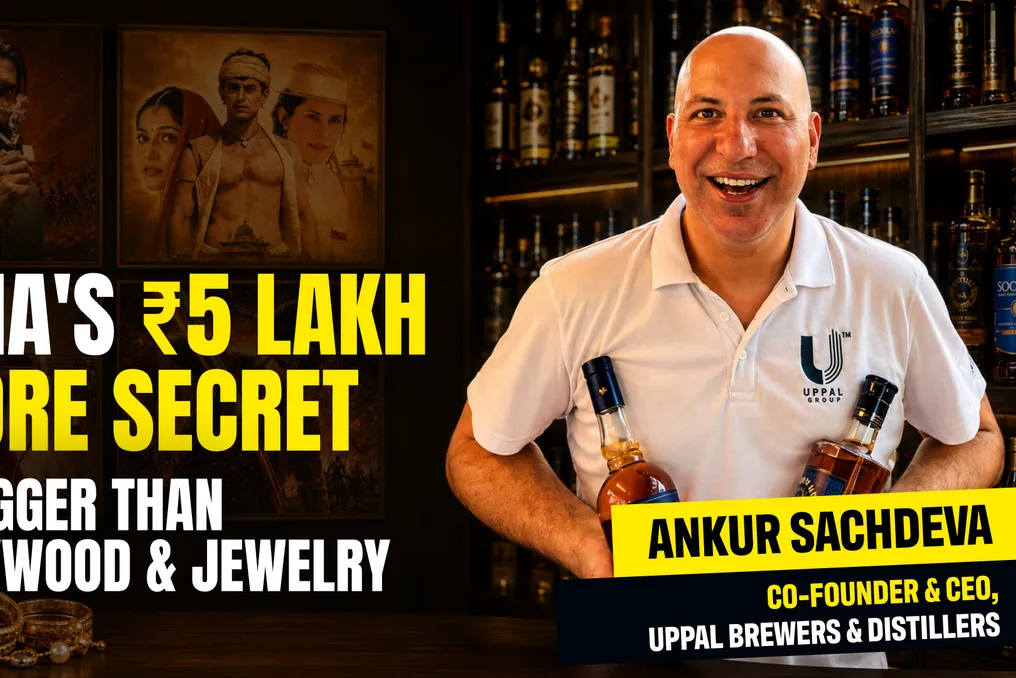
When Ankur Sachdeva helped introduce Glenfiddich to the Indian market in the early 2000s, the single malt whisky category was barely known. He recalls presenting the brand to a senior food and beverage specialist at a major hotel group, explaining that Glenfiddich is a single malt scotch whisky. The response he received was: 'Only Scotch is sold in my hotels.'

For Sachdeva, this dialogue illustrated the state of the Indian market at that time. William Grant & Sons spent years educating consumers and the trade community, even organizing trips to Scotland for journalists, food and beverage specialists, and connoisseurs several times a year so they could understand this category.

Two decades later, Sachdeva notes that India has progressed from complete unfamiliarity with single malts to having the most exotic malts in bars. He observed this shift during his 25-year career working at William Grant & Sons, Radico Khaitan, and Allied Blenders and Distillers. Today, while creating Uppal Brewers & Distillers (UBD), the company behind Indian whisky brands Soorahi and Madhvan, he believes another major shift is underway.

The Indian consumer has become more experimental, moving faster towards the premium segment, and increasingly willing to consider domestic alcoholic beverages. Globally, beer is the dominant alcohol category, but India looks completely different.

According to Sachdeva, 'unlike that, in India the giant is hard liquor. In terms of value, it accounts for about three-quarters of the entire market,' he stated on the Prime Venture Partners Podcast. He estimates the Indian alcoholic beverage industry at approximately 5 lakh crore rupees, noting significant economic linkages in agriculture, manufacturing, logistics, packaging, hospitality, distribution, and retail. Furthermore, he believes the ecosystem provides around 10 million direct and indirect jobs.

Whisky constitutes 60–65% of Indian spirits, and whisky, brandy, and rum together account for over 90%. The geography of consumption is also intuitively complex. According to Sachdeva, South India consumes more than North, West, and East combined. Only Karnataka accounts for about 60 million cases in a market of approximately 420 million cases.

Sachdeva's experience with Glenfiddich demonstrates an early example of how new alcohol categories are forming in India. A seemingly unrelated change helped: when the duty-free allowance for arriving passengers increased from one liter to two liters, Sachdeva noticed a change in purchasing behavior. The first bottle usually remained a familiar blended scotch like Chivas Regal or Johnnie Walker Black, while the second became a purchase for experimentation, increasingly being single malt whisky.

Over time, knowledge of single malt whisky itself became a status symbol. 'It was a new social currency,' says Sachdeva. Being able to mention the name of an unknown distillery or bring back an unusual bottle signaled travel, knowledge, and sophistication.

A broader conclusion applies to the current situation. New categories do not necessarily replace old consumption habits overnight; they can emerge parallel to established choices as consumers gain confidence in experimenting. This experimentation is visible in other categories too. Sachdeva notes that vodka makes up less than 4% of Indian spirits compared to over 15% globally, but it is growing much faster than the overall IMFL market.

India also behaves unusually regarding vodka. While clear vodka dominates internationally, Sachdeva claims that about 60% of vodka sold in India is flavored.

Sachdeva believes that one of the most significant changes is the weakening of rigid brand loyalty. In his view, the traditional premium whisky consumer was often an older man sticking to the same brand. The younger generation is more inclined to experiment, increasingly includes women, and uses products as a form of self-expression. 'Such brand loyalty, in my opinion, no longer exists.'

This also changes the meaning of premiumization. For Sachdeva, premiumization is not just increasing the product price from 1000 rupees to 1100 rupees. It is the consumer transitioning from a product worth 600 or 800 rupees to one costing 1000 rupees, and then striving for 2000 rupees. 'The same consumer on life's journey wants better, strives for better.'

Better can mean the spirit itself, as well as the packaging, presentation, storytelling, and opening. This shift opens opportunities for Indian brands. Sachdeva estimates that nearly 80–90% of the industry, which numbers about 420 million cases, is still below the 800 rupee mark. 'Imagine, even if a tiny percentage reaches or moves to a higher price bracket, imagine what that will unlock. It is huge.'

However, opportunity does not mean an easy startup. 'If you think you need one, plan for three,' advises Sachdeva. One reason is working capital. Before alcohol hits the market, companies may already have paid excise duty. If the cost to the distillery is 100 rupees, Sachdeva says an additional 100 rupees or more in funding may be required before generating sales revenue.

UBD itself illustrates the capital requirements: Sachdeva notes that the Uppal family initially invested about 100 crore rupees in the business, providing the company with patient capital. 'Usually, for people, the first year is dedicated to fundraising, whereas for us, it was dedicated to building brands,' he says. This patience allowed the company to test before scaling up. During the first two months of launching Soorahi in Delhi, Sachdeva personally organized a product tasting for over 1100 people at the Pragati Maidan beverage exhibition. 'That reaction told me we were on the right track.'

After this, UBD expanded from Delhi to Punjab, Haryana, Odisha, Goa, Daman, and Karnataka. Soorahi also taught UBD an important lesson about portfolio economics. In Delhi, Soorahi sells for about 1700 rupees, competing in a relatively premium segment. By the eighteenth month, according to Sachdeva, the brand achieved about 5% market share in that segment. However, the higher the price point, the smaller the accessible market becomes.

This prompted UBD to launch Madhvan, whose potential market, according to Sachdeva, is four to five times larger than Soorahi's. There was another factor. Established competitors often approach distributors with four, five, or even seven brands, allowing them to spread sales and distribution costs across the entire portfolio. 'They can spread their overheads across a range of brands,' he explains. Thus, the second product for UBD was not just launching another brand; it could change the very economics of distribution.

Perhaps the trickiest part of the business only manifests after product creation. Alcohol is regulated separately in each state. Excise rules, label registration, pricing, wholesale structures, retail systems, and sales channels can differ across borders. 'Every state is different, and I think that in most cases, that is the advantage of this industry,' says Sachdeva. Existing players accumulate years of experience dealing with the peculiarities of each state. The private market may behave differently from the state-controlled market, and hybrid systems create another set of operational challenges.

Sachdeva calls the necessary ability to navigate this 'operational agility.' 'Your next state is always easier than the previous one because the blueprint is already established.'

Even the decision to move production from Punjab to Goa was primarily driven by regulation. Sachdeva asserts that regulatory flexibility accounted for about 80% of the decision, followed by the perception of Goa as a tourist destination and its growing ecosystem of skilled personnel, distillers, and alcohol companies. Despite all the complexity, Sachdeva calls it 'perhaps the best time in the last 25 years' to explore premium Indian spirits. He sees untapped space in whisky, rum, gin, and vodka as consumers move to premium and become more confident in buying Indian brands.

But his final advice to founders is intentionally less grandiose. 'Don't fall too deeply in love with your idea, and then don't let ego get in the way.' In a business where regulation, capital, consumer preferences, and distribution can challenge the initial plan, founders must know when something isn't working. Mistakes cost money, but refusing to admit them can cost something harder to recover—'more than money, you lose years.'
Haldiram's plans to invest 1000 crore rupees in a new production complex in Odisha
Read more
business-standard.com

Haldiram's plans to invest 1000 crore rupees in a new production complex in Odisha

Haldiram Snacks (Haldiram’s), one of India's largest companies in packaged snacks and food products, has announced plans to invest 1000 crore rupees in establishing a new manufacturing facility in the state of Odisha. The company intends to implement the project in three phases for its savory snacks and bakery division.

The state government has already approved the first phase investment of 500 crore rupees during a recent state-level single-window clearance body meeting. Although the exact location has not yet been determined, the facility is expected to be built in the Khordha-Katka region and become one of the largest snack and bakery production centers in Eastern India.

Investment Agreements and Food Industry Development

Haldiram’s was among nine major companies that signed memorandums of understanding with the Odisha government during a recent investor summit in New Delhi. The Odisha FoodPro 2026 summit secured commitments for over 6000 crore rupees in food processing investments, while a broader Delhi-National Capital Region (NCR) industrial initiative attracted investment proposals worth 66,392 crore rupees across various sectors.

For Haldiram’s, the proposed plant in Odisha will mark an expansion of its production base as the company increases its product range and strengthens its domestic and international supply chains. Founded in Bikaner in 1937, the company relocated to Delhi and Nagpur in the early 1980s, subsequently building manufacturing units in key locations such as Nagpur, Noida, Rudrapur, Delhi-NCR, and Howrah. Today, its products include traditional namkeens and sweets, as well as Western snacks, ready-to-eat and frozen foods, baked goods, and beverages.

Competition and New Players in the Odisha Market

Besides Haldiram’s, other major investment plans have emerged in Odisha. Coca-Cola, an existing player in the state, has proposed further expansion with an investment of 300 crore rupees in another soft drink manufacturing unit. Balaji Wafers and Let’s Try have also announced plans to invest 200 crore rupees each, while Beyond Snack, known for its banana chips from Kerala, plans to invest 150 crore rupees to establish production in the state.

The proposed investments from Balaji add another national brand to the emerging food processing cluster in Odisha. This cluster includes companies such as ITC, Nestlé, Parle, Britannia, Indo Nissin, Hindustan Unilever, Reliance, and Tata Consumer Products, as well as Varun Beverages. Balaji already has a strong presence in the Indian packaged snack market, and the announced investments will increase production capacity for packaged namkeens, wafers, and other convenient consumption products.

Let’s Try, a relatively young food brand known for peanut butter snacks, is actively expanding its production and distribution capabilities. These investments will allow this growing brand to establish a larger manufacturing base as part of its push beyond existing markets.

Government Support and Regional Potential

Odisha produces a wide range of raw materials with processing potential, including rice and other cereals, sorghum, cashew, jackfruit, mango, sweet potato, turmeric, chili pepper, mushrooms, corn, spices, and dairy products. The state government has identified these products for deeper processing, packaging, branding, and value addition. Plans have been announced to create five food parks that will provide an ecosystem for companies, enabling them to transform local agricultural and traditional products into nationally recognized brands.

Hemant Sharma, Additional Minister for Industries in the Odisha government, noted that such an ecosystem will give fast-moving consumer goods companies access to raw materials, labor, markets, and logistics, while allowing them to source more resources locally. Sharma told Business Standard: 'The government is creating an ecosystem where large food processing companies, suppliers, farmers, logistics operators, cold chain providers, and small businesses can operate around a common infrastructure. This will help link processing units with agricultural production centers.'

Popular