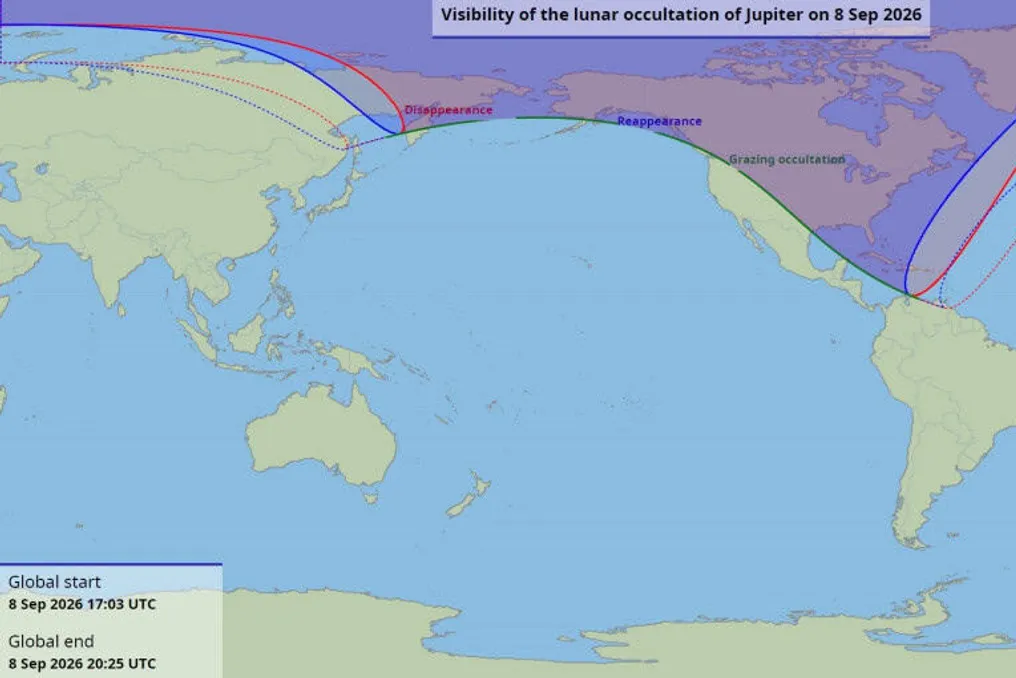
This Tuesday, the 8th, the Moon will pass in front of Jupiter, causing the temporary disappearance of the planet behind the lunar disk in some areas of the globe. However, this phenomenon, known as the lunar occultation of Jupiter, will not be visible in Brazil, as the observation area covers parts of North America and other regions of the Northern Hemisphere.
In Brazil, there will be a notable celestial meeting. During the early morning hours, the Moon and Jupiter will be visible close together on the eastern horizon, approximately one hour before sunrise. The Moon will show about 9% of its illuminated surface, while Jupiter will be seen as a very bright point adjacent to the natural satellite.
An occultation occurs when a celestial body is positioned in front of another for an observer on Earth. This Tuesday, the Moon will cross Jupiter's line of sight, causing the planet to momentarily vanish behind the satellite in specific locations.
This event will happen during the day. Jupiter will be obscured by the illuminated edge of the Moon and will later reappear through the dark edge. The duration of this event may vary depending on the observer's location, potentially lasting about an hour.
The occultation will be visible in a band that includes parts of Canada, Greenland, the United States, the Caribbean, and other locations. Due to this visibility band, Brazil will not be able to witness the moment Jupiter is covered by the Moon.
Even without being able to see the occultation, Brazilians can observe the apparent approach between the Moon and Jupiter on Tuesday morning. The two celestial bodies will be close in the sky, towards the east, about an hour before dawn. The Moon will be thin, with only a small part of its disk illuminated, and Jupiter will be quite bright, allowing it to be identified near the satellite. Astronomical forecasts also indicate this approach for September 8th, with the thin Moon near the planet before sunrise.
For better observation, it is recommended to choose a location with an unobstructed view of the eastern horizon, free from buildings, trees, or other structures. Since the configuration occurs before sunrise, it is advisable to start looking during twilight and monitor both bodies as the sky brightens.
It is important to note that the Moon and Jupiter will not be physically close in space. The occultation is an effect resulting from the alignment of the three elements—Earth, Moon, and Jupiter—relative to the observation point. Thus, while the Moon covers the planet for certain regions, observers in other parts of the planet will continue to see the two bodies separately.
This follows the same principle as a star occultation by the Moon: the natural satellite acts as a kind of 'curtain' in the field of view, temporarily blocking a more distant object. In this scenario, the celestial body that will be hidden is Jupiter.
The proximity between the Moon and Jupiter does not end on September 8th. The astronomical calendar for September predicts other encounters between the Moon and planets throughout the month, including another approach with Jupiter scheduled for October.