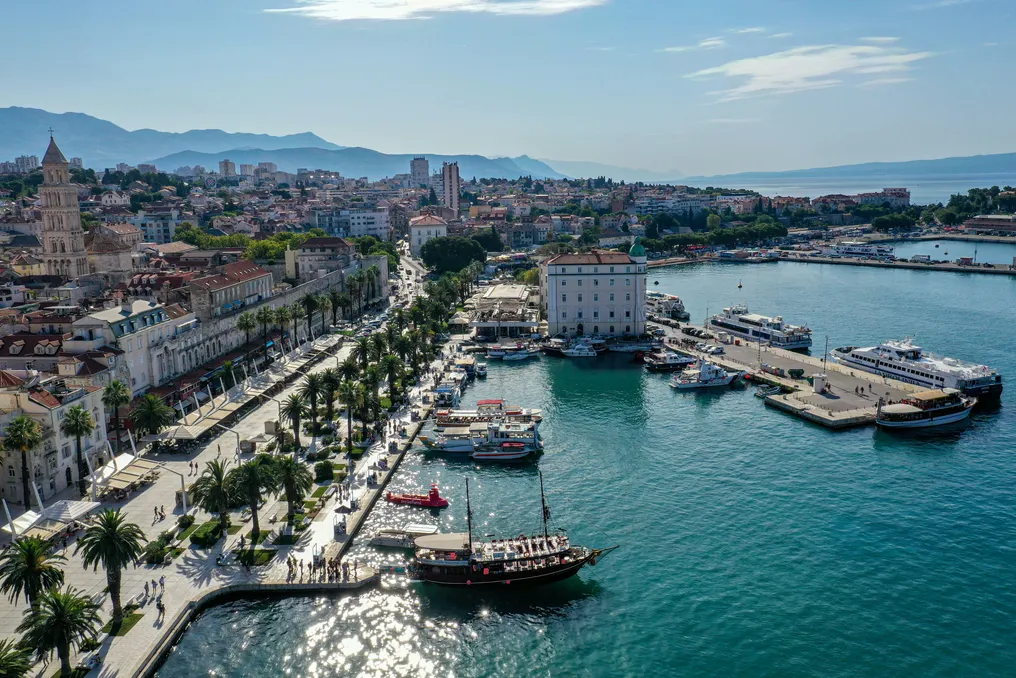
Located on the southern coast of Croatia, in the Central Dalmatia region, Split is a pearl of southeastern Europe, although it is often overshadowed by Dubrovnik, which is 233 kilometers away. This city, washed by the Adriatic Sea, is the second largest in the country, surpassed only by the capital, Zagreb, located approximately 410 kilometers away.
Despite traditionally being a tourist destination, Split can remain unnoticed by travelers wishing to explore this part of Europe. The municipality, whose history spans over two thousand years, preserves traditional quarters while offering the characteristic rhythm of popular coastal resorts.
Most of Split's attractions are linked to the rich and ancient history of the region. The city began as a Greek colony around the third century BC and later underwent significant changes after the construction of the magnificent imperial Roman retirement palace of Diocletian in 295 AD.
Even after the ruler's death, other heads of state continued to use this site, which is now listed as a UNESCO World Heritage Site. Diocletian's Palace, the city's main calling card, is one of the best-preserved Roman structures in the world and is worth visiting.
A walk through the ancient stone streets of the Old Town allows one to feel the strong influence of Roman architecture. Near the palace are important sites such as St. Dominic's Cathedral and its famous bell tower.
The route also includes the central palace square, called the Peristyle, and the Temple of Jupiter—another Roman heritage built between 295 and 305 AD by order of Emperor Diocletian. Additionally, a mandatory stop is the majestic statue of Grgur Ninski, a 10th-century Croatian bishop, which holds an interesting tradition: it is customary to rub the bronze little finger of the sculpture to attract good luck.
Thanks to this historical background, the city recently gained fame as a set for the series 'Game of Thrones'. Split depicted the city of Myr, known for its huge pyramids and the location of the climactic scene of Daenerys' prisoner liberation, one of the main heroines.
Fans wishing to see these locations can walk along Papalica Street or visit Klis Fortress, located about 10 kilometers from the city.
In addition to historical sites, Split offers travelers a wonderful combination of forests and paradise beaches. For example, Mount Marian is known as the 'lungs of the city' and includes an extensive forest park west of the center. This place is ideal for hiking, picnics, and enjoying panoramic views of the horizon, especially at sunset.
As for beaches, the city offers options for every taste. Bačvice is the most popular and is the site of traditional 'picigin' games, a ball game played in shallow water. Kašuni, located at the foot of Mount Marian, is quieter, surrounded by beautiful pines, and suitable for family or romantic walks.
For other natural excursions, though slightly further away, it should be noted that Split serves as a starting point for sea tours to the famous Azure Bay, near the island of Drvenik Veliki, where crystal-clear turquoise water tempts travelers to a refreshing dip. The city is also a gateway for those who wish to explore the picturesque Croatian islands of Hvar and Brač.