Viral video clip sparks debate over resemblance to Prabhas' film 'Salaar', allegedly fan-made
Read more
Aaj Tak
www.aajtak.in

Viral video clip sparks debate over resemblance to Prabhas' film 'Salaar', allegedly fan-made

A video is circulating widely on social media, leading to claims that a Pakistani film copied one of the most famous action scenes from Prabhas' film 'Salaar: Part 1 – Ceasefire'. This clip, which is being shared extensively on X and Instagram, features a man in a rugged appearance participating in a fight and movement.

The visuals of this viral moment resemble the world created by director Prashant Neel. However, beyond the assertions that 'Pakistan copied Salaar,' there are many other circumstances surrounding this clip.

It has not been established whether this video is part of any Pakistani feature film, nor has the use of artificial intelligence in its creation been confirmed. Instead, this reel appears to be a live recreation or a fan spoof inspired by 'Salaar.'

This clip was published by Pakistani content creator Hasib Bilal, who is known for recreating scenes from popular South Indian films on social media. Although Bilal has not directly confirmed that it is a recreation of 'Salaar,' the obvious parallels between them are visible.

The man in the video, judging by his rough style, slow-motion walk, body language, and combat movements, imitates Prabhas' character 'Deva'. The dark visual effects and setting enhance this similarity, which could lead to the clip being mistakenly perceived as material from an actual Pakistani production.

This is why claims of 'Salaar' plagiarism by Pakistani cinema appear online. Nevertheless, there is no evidence that this material is taken from an official feature film. Existing information suggests that this is content created exclusively for social media; it seems the clip was shot using real actors and props, rather than entirely with AI.

Confusion regarding AI might have arisen due to the processing, color grading, and visual effects used in the video. But there is no convincing evidence to claim that it was created using AI.

'Salaar: Part 1 – Ceasefire,' directed by Prashant Neel, is known for its dark visual style and impressive action sequences, in which Prabhas played the role of 'Deva'. The viral clip largely matches this style.

So, is this a Pakistani version of 'Salaar'? Not exactly. It has not been confirmed that it is a Pakistani film or AI-generated content. Most likely, this clip is a live recreation for social media, inspired by Prabhas' 'Salaar,' and it is associated with Hasib Bilal online.

Similar stories

After defeat in Operation Sindoor, Pakistan released an AI documentary film that faced criticism
Read more
www.aajtak.in

After defeat in Operation Sindoor, Pakistan released an AI documentary film that faced criticism

When Pakistan suffers a military defeat, it uses its most powerful tool—propaganda videos. In response to the documentary released by India about Operation Sindoor, the Pakistan Air Force (PAF) published a new promotional video titled 'Fizaon ke Pasban' on September 6, 2026, marking Air Force Day.

In this video, Pakistan makes several claims that elicit both laughter and anger due to Pakistan's shamelessness. Created using artificial intelligence and graphics, the clip asserts that Pakistani aviation attacked 32 Indian airbases, destroyed two S-400 systems, and jammed Indian military satellites.

According to the Pakistani video, they shot down eight Indian aircraft and disrupted fuel supply. This clip was officially posted by the PAF Directorate General Public Relations (DGPR) on the social network X. The map of India shows traces of explosions, and large letters read: '32 IAF BASES HIT.'

However, it is evident that the entire presentation is based on animation and graphics, as the video lacks satellite imagery, evidence of real damage, dents on runways, or damaged hangars. Pakistan presented all these claims while sitting at a computer.

It is worth noting that previously, the Discovery channel in India aired the documentary 'Declasified: Operation Sindoor' on August 15, which consisted of two parts. This documentary featured statements from leaders of all three Indian armed forces, including a statement from Chief of Defence Staff Anil Chauhan, and presented evidence and video material. At that time, the former Director of Naval Operations of India clearly stated that Pakistan apologized for stopping the war.

Pakistan's assertion appears absurd, as publicly available information indicates that the Indian Air Force has over 60 airbases, including advanced combat bases, training centers, and repair units. The claim of attacking 32 bases would mean destroying more than half of the Indian Air Force's potential. Nevertheless, Pakistan failed to provide any evidence of damage inflicted on India.

Similar claims by Pakistan were made during Operation Sindoor in May 2025, and no satellite evidence was provided then either. Experts in independent satellite imagery have not published photos of any damage to Indian airbases.

After the ceasefire on May 10, Prime Minister Narendra Modi personally visited the Adampur airbase on May 13 and refuted Pakistan's claims of damaging the S-400 system. On the contrary, India presented clear evidence of attacks on Pakistani bases, such as Nur Khan, Murid, Rafiki, Sargoda, Jaikababad, and Bolari, by publishing satellite images and video materials. Western media also confirmed this evidence. India targeted radars, air defense systems, and aircraft hangars. Retaliatory actions by Pakistan were limited to drones and missiles, which were successfully intercepted by the Indian air defense system.

The Pakistani video sparked reactions on social media, where it began to be called a new version of 'Lahori Churn.' Indian users mocked it, asking where the satellite images were if the victory was so great, and why they had to rely only on graphics.

Alarming turn in Ankita Balian's murder case due to surveillance camera footage
Read more
www.aajtak.in

Alarming turn in Ankita Balian's murder case due to surveillance camera footage

A new development has emerged in the case of Ankita Balian's murder in Shamali. Surveillance camera footage, allegedly recorded about two hours before the killing, has given the investigation an entirely new direction. The footage shows young people moving around the area and using mobile phones. There is a claim that Ankita Balian's location was transmitted to another person during this period.

The appearance of two alleged videos has raised several questions: are the young people seen in the video the same individuals who were in the area before the murder? Was Ankita's location shared with anyone else? And was the presence in the area before the murder merely a coincidence or part of some plan?

Previously, it was reported that the police seized recordings from surveillance cameras installed at and near the crime scene, including the Digital Video Recorder (DVR). Now, with the emergence of new footage, the investigation's focus is on the young people shown in the video. The recordings show them walking down the street, with some using mobile phones. There is a claim that Ankita's geolocation was transmitted via mobile devices.

This leads to the most important question in the investigation: was Ankita scouted before his murder? If so, what was the role of transmitting his location via mobile phone? Answers to these questions can only be found through the analysis of camera recordings, mobile location data, and further police investigation. Nevertheless, independent confirmation of the presented videos is currently lacking, and it is unclear whether the young people in the footage are connected to Ankita's murder.

The appearance of the alleged videos on social media has also caused a stir. In one of the videos, young people claim responsibility for Ankita Balian's murder. If these videos prove authentic and their connection to the murder is established, it could be a crucial lead for the police. However, the authenticity of the videos and the statements made by the people in them have not been confirmed at this time. The police task is to correlate these alleged videos with surveillance camera recordings. It is critically important to identify the individuals seen in the video and their connection to Ankita Balian.

Three days have passed since Ankita Balian's murder. His family demands the arrest of the perpetrators and justice. Ankita's father, Satvir Singh, expressed dissatisfaction with the police actions, stating that the police have done nothing in the murder case so far. He demanded the swift arrest of the killers and also voiced his discontent with Chief Minister Yogi Adityanath. On the other hand, the police maintain that the investigation is progressing in the right direction, and suspects will soon be arrested. But the newly surfaced alleged surveillance videos and social media posts have indeed raised new questions during the investigation.

Were the young people seen on the cameras part of a conspiracy before the murder? Was Ankita's location shared with anyone else? Is the claim of taking responsibility for the murder on social media true? Answers to all these questions must be obtained through the police investigation. All attention is now focused on how the police will link the surveillance videos, DVR, mobile location data, and alleged social media videos. How much will this help in catching the criminals, and when will Ankita Balian's family receive justice?

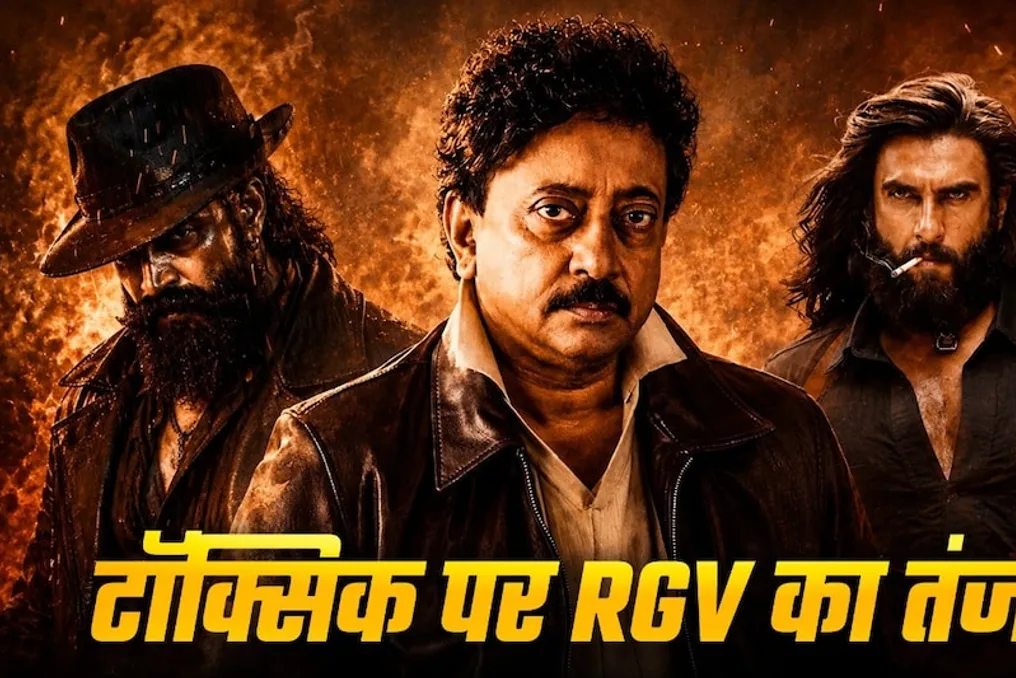
Ram Gopal Varma mocks film Toxic, comparing it to Dhurandhar
Read more
www.aajtak.in

Ram Gopal Varma mocks film Toxic, comparing it to Dhurandhar

Following the release of 'Dhurandhar: Storm' and during a period of calm in the Middle East, Gittu Mohandas' film 'Toxic' premiered in theaters on August 26. This gangster drama runs for 3 hours and 15 minutes and presents a large-scale and brutal depiction of the period from 1947 to 1967. Reviews about the film began to appear, and at that moment, filmmaker Ram Gopal Varma published his commentary in his signature style.

It should be noted that there were previous plans for a clash between 'Dhurandhar 2' and 'Toxic'. Ram Gopal Varma made several posts regarding this. Ultimately, 'Toxic' was postponed due to the tense situation in the Middle East. Now, a new post from Ram Gopal Varma has appeared.

Without directly mentioning the film's title, Ram Gopal Varma expressed his criticism of 'Toxic' in his usual manner. He wrote in the post: 'Now #Dhurandhar is watching again.'

Previously, Ram Gopal Varma had repeatedly praised 'Dhurandhar' in contrast to 'Toxic'. Before the postponement, he shared long and sharp posts regarding this supposed confrontation. Varma characterized this confrontation as a conflict between two completely different cinematic approaches: one based on reality and consequences, and the other on style and demeanor.

Using the hashtag #Dhuroxic, Varma called Aditi Dhara's film a picture dedicated to 'cause, effect, and result.' In his opinion, violence in such films is not present for mere display but carries a moral, psychological, and political subtext. He argued that characters in such movies act out of necessity, not to look spectacular; and the narrative style is aimed at a thoughtful audience capable of understanding both silence and turmoil.

Conversely, Varma described Gittu Mohandas' film as an example of cinema where 'style is valued above logic.' His argument was that the violence in this picture primarily serves to demonstrate mood, without adding depth to the plot. Furthermore, Ram Gopal Varma raised questions about the character created by Yash. He wondered whether audiences would continue to love the 'dark heroes' (heroes with a dark or negative tint) shown in slow motion in 'Toxic,' and whether the feeling of depth or seriousness would be maintained in the stylish smoking shots.

In any case, although Ram Gopal Varma did not mention the word 'Toxic' in his post, his hint was clear enough about what he intended to convey.

Popular