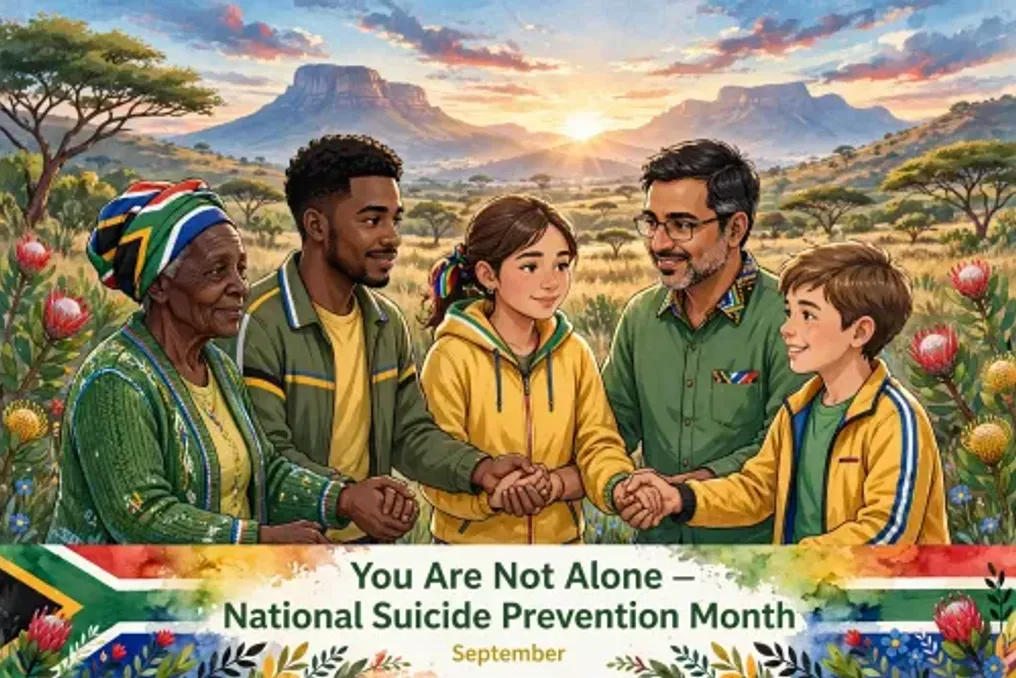
In September, which is observed as Suicide Prevention Awareness Month in South Africa, the focus of the discussion needs to shift from personal resilience to addressing structural problems that undermine societal mental health.
Instead of simply urging people to 'talk about it' and 'take care of themselves,' society misses the core issue because people cannot escape poverty, unemployment, violence, grief, hunger, discrimination, substance abuse, or a society that demands resilience from those it has repeatedly failed.
We cannot continue to break people down and then hold them responsible for their own healing. If factors such as inequality, violence, unemployment, and hopelessness affect the mental state of South African citizens, the response must be systemic, not limited to individual advice on how to cope.
The figures underscore the scale of the problem: the National Department of Health reported that the prevalence of mental disorders in South Africa over 12 months is 15.9%, with depression, anxiety, and alcohol and drug-related disorders being the most common illnesses. The department also warned of a critical shortage of services for children and adolescents.
Furthermore, a World Health Organization assessment for 2025 showed that there is a deficit in mental health treatment in South Africa exceeding 70%, indicating millions of people effectively left without support, reflecting the scale of human rights neglect in post-apartheid South Africa.
Behind every frightening statistic is a person: a young student on the verge of a breakdown due to academic pressure, a man raised with the belief that admitting difficulties is a sign of weakness, or a child accustomed to dysfunction, growing up in an atmosphere of violence.
Society has become too accustomed to praising resilience, applauding people for surviving circumstances they should never have had to endure. South African citizens are forced to be strong despite homelessness, high crime rates, gender-based violence and femicide (GBVF), poverty, inequality, family breakdown, substance abuse, and ineffective public services.
The government acknowledges that mental health remains severely underfunded. In 2025, the Department of Health stated that only 5% of the national health budget is allocated to mental health, leading to a shortage of infrastructure and personnel. However, the goal is set to ensure at least one mental health specialist in 75% of public health centers by 2029.
Psychiatric care should not only be provided after a person reaches a point of complete exhaustion; it must be accessible in schools, universities, workplaces, clinics, community centers, and beyond. It must cover rural areas, settlements, and people who cannot afford private psychologists, and work with children before trauma shapes their adult lives.
It is crucial to eliminate the stigma associated with seeking help. Admitting that 'I am not okay' is not a sign of weakness, and the need for therapy, counseling, medication, or just a listener is not a cause for shame. Shame should belong to a society that watches people drown and urges them to swim harder.
The consensus is clear: psychiatric care is inaccessible, prohibitively expensive, and underfunded, forcing millions of people to wait for a crisis before seeking support. It is necessary to deeply examine the long-term consequences of this for children, youth, and vulnerable communities, and to understand all the ways society provokes this suffering.
It is important to understand that psychiatric care is not a luxury for those who can afford private treatment, nor is it just a motivational phrase or hashtag; it is an inherent human right enshrined in the national constitution.