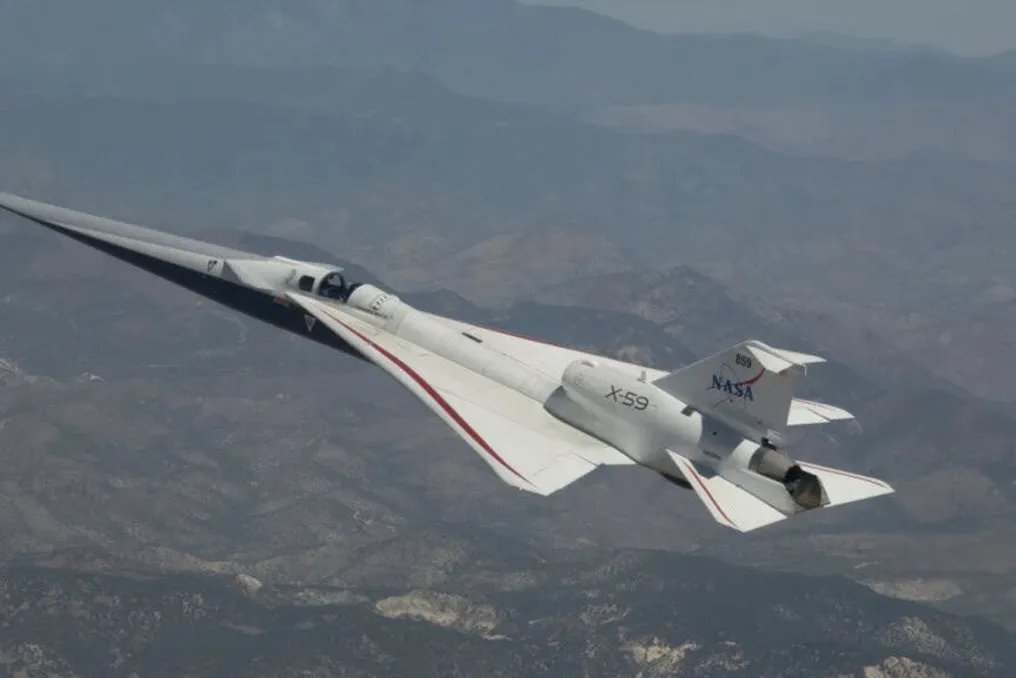
The experimental supersonic aircraft X-59, developed by NASA, has completed its twenty-fifth test flight, approaching a crucial phase of the project: evaluating the noise generated by the aircraft when exceeding the speed of sound.
This flight took place on August 21st in California and lasted for 72 minutes. During the flight, the X-59 reached Mach 1.2 and an altitude of approximately 49,000 feet, accompanied by another chase aircraft.
Data collected so far indicates that the X-59's behavior in the air is aligned with engineers' projections. The team used computational models and wind tunnel tests even before the aircraft was built to predict its performance, and each test validated these models and predictions, reinforcing confidence in the vehicle's performance.
Cathy Bahm, NASA's Low Boom Flight Demonstrator project manager, commented on the progress in a statement. An essential tool in this monitoring is the use of a real-time 'digital twin,' which compares data captured during flights with simulations performed.
So far, the X-59 has not shown unforeseen problems, such as excessive vibrations or instability. Nils Larson, test pilot, described the experience as 'exciting, but without incidents.' Initially, the campaign aimed at more basic objectives, such as ensuring the X-59 could take off and land safely while maintaining stability.
The project has evolved, allowing the aircraft to reach its projected cruising speed of Mach 1.4 early, which equates to 924 mph, in addition to reaching an altitude of 55,000 feet. Subsequent tests focused on exploring various areas of the flight envelope, including lower speed and altitude conditions.
The air intake system, located on the top of the aircraft and responsible for feeding the single GE-F414 engine, also functioned as expected in different maneuvers and scenarios. Between flights, pilots, engineers, and maintenance technicians analyze the results and make necessary adjustments; the control software received minor changes, and an issue causing unwanted alerts to be interpreted as caution warnings was corrected.
The next stage will be acoustic validation. In this phase, the X-59 will fly while equipment installed both on the ground and in the air measures and characterizes the sonic boom produced by the aircraft. Larry Cliatt, technical lead for acoustic validation of the Quesst mission, emphasized the importance of this step, stating that 'building and flying an entirely new aircraft is an extraordinary achievement, but the next phase is where the real research begins.'
The purpose of the Quesst mission is to support the viability of commercial supersonic flights over land areas. After completing 25 flights, the X-59 will enter the phase that will determine whether the project can generate the quietest sonic boom for which it was designed.