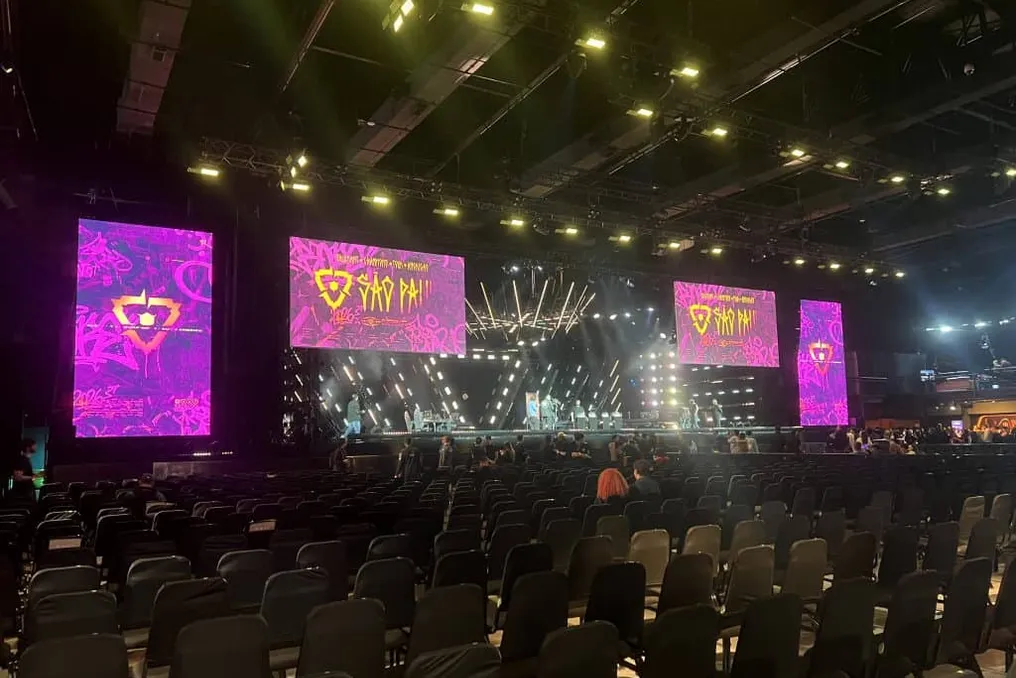
For those following VCT Americas through the broadcast, the game takes place between ten competitors within the server. However, behind the scenes of the phase held in São Paulo, the operation is significantly larger, encompassing over 400 professionals, numerous cameras, tons of equipment, and an infrastructure that links Brazil to global broadcasting centers.
During a panel promoted at the event, representatives from Riot Games presented details about the championship production and justified the choice of São Paulo to host this stage. Present were Fernando Birsto, VALORANT Product Manager in Brazil, responsible for publications, campaigns, and esports, and Fernando Svevo, Production Director for the Americas, in charge of the broadcast and event technologies.
According to Riot, more than 100 specialists from operations in Brazil, the United States, and Latin America contribute directly to the production, which features over 30 cameras, 15 trucks, and a total of 10 tons of machinery.
The planning to bring VCT Americas to São Paulo required about a year of preparation, including technical visits that began in December. The selection of the city resulted from a series of deliberations starting with the global schedule, moving to defining the country and location, and concluding with verifying the availability of a space adequate for the competition's technical demands.
São Paulo gained a notable advantage due to its robust infrastructure and vast network of available suppliers. Although other cities were considered, technical and scheduling factors complicated alternative options.
Even in seemingly minor details, adjustments were necessary. One example cited was the naming of floors: while the North American team used the term 'first floor' for the ground floor, the Brazilian team used a different reference. The solution found was to standardize communication according to the local structure.
The magnitude of the production is more evident in the broadcast. VCT Americas generates content simultaneously in Portuguese, English, and Spanish, in addition to providing material for social media and co-streamers. According to Fernando Svevo, the operation manages over 150 video feeds and approximately 900 audio channels, while also having an energy capacity exceeding 3,000 KVA.
Additionally, each player on stage receives an individualized audio mix. This allows them to hear their teammates and coach without receiving any sound from the opposing team.
A crucial part of this structure operates remotely. Signals captured in São Paulo are sent to a broadcast center located in Seattle before being distributed among the various operations. The Portuguese broadcast connects Seattle to the Barra Funda structure, while the Latin American production also covers Mexico City. Globally, Riot maintains operational centers in Seattle and Dublin.
Despite the large scale, the entire broadcast apparatus present at the event was designed to operate entirely within a single room, eliminating the need for transmission trucks parked outside the arena.
Riot also acknowledged certain limitations of the Brazilian stage. The company expressed a desire to offer more activities for fans, provide larger spaces for teams, and make more product sales points available, but the physical configuration of the venue and the maintenance of emergency routes restricted these initiatives.
This decision also reflects lessons learned from previous events. After the experience in Toronto, Riot began prioritizing activities that complement the match, rather than forcing the audience to choose between watching the game or participating in some parallel activity.
Some proposals tested in other countries were adapted to the Brazilian context. For example, interventions made between maps were inspired by previous experiences in Santiago.
The identity of the stage was developed specifically with the Brazilian audience in mind. The concept of 'making the world listen' emerged for VCT's passage through the country and follows a strategy of adapting communication to the particularities of each region.
In summary, with hundreds of professionals, multiple video feeds, audio channels, and operations spread across various countries, the structure demonstrates that bringing an international VALORANT competition outside its traditional core requires much more than just transporting athletes and setting up a stage; it is a complex global operation that functions in real time to ensure the match reaches the audience as a unified broadcast.