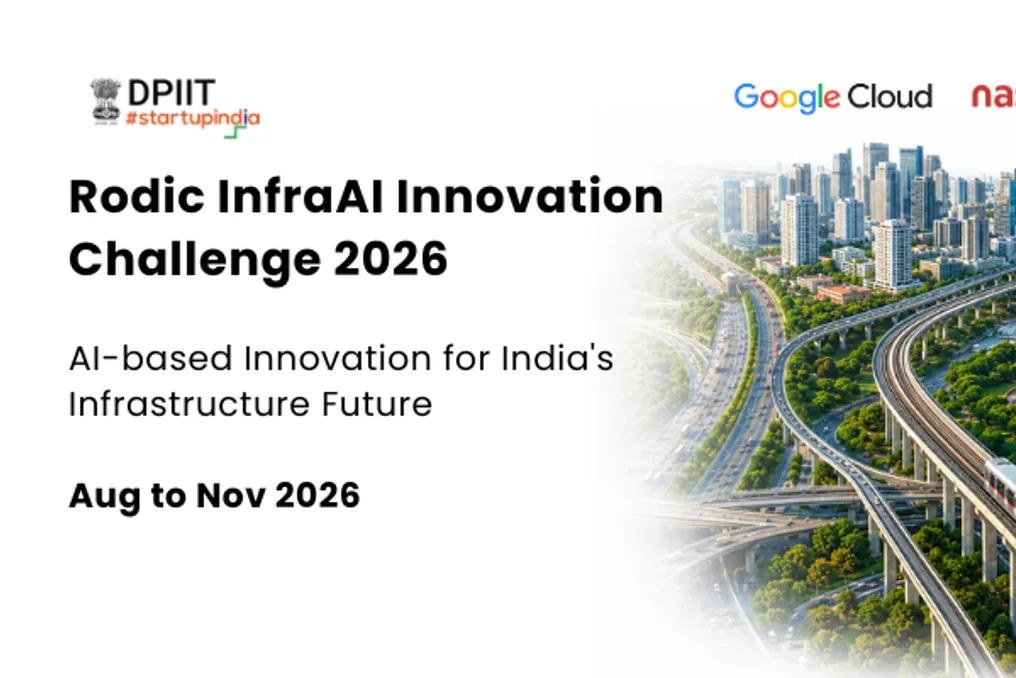
As India undertakes massive infrastructure development, managing efficiency, safety, and sustainability becomes increasingly complex when relying solely on traditional methods. Although artificial intelligence has long been positioned as a solution to this problem, there is a gap between the existence of the technology and its actual implementation. A model might perform well in a controlled environment but face entirely different limitations when applied to a highway project, an electrical distribution grid, or a public service system.
Rodic Consultants, one of India's leading engineering and infrastructure consulting firms, aims to bridge this gap through the Rodic InfraAI Innovation Challenge 2026. The competition is launched in partnership with Nasscom, Google Cloud, and Startup India. This initiative, being the first of its kind nationally, is designed to accelerate the adoption of AI in India's strategic sectors and infrastructure.
Most innovation competitions offer participants a hypothetical task and ask them to present a solution. This competition takes a different approach: each problem statement is drawn from Rodic's current infrastructure projects. This gives participating startups, researchers, and academic teams access to the real context of projects, rather than sanitized case studies.
This distinction is significant because AI implementation in infrastructure often fails due to reasons that do not manifest in a proof-of-concept. The solution must function within existing systems, process real data, and demonstrate value where reliability and scalability are paramount. By grounding the competition in real project conditions, Rodic and Nasscom are betting that the resulting solutions will be ready for deployment from day one.
Priority Areas of the Competition
The competition is structured around four main themes, each corresponding to a specific need of national infrastructure. The supporting organizations highlight what makes it unique. Nasscom provides its ecosystem of innovation and reach within the deep tech and AI startup community in India. Google Cloud is also a partner in this initiative. Startup India expands the competition's reach to nationally recognized DPIIT startups, ensuring it is not limited to a few well-connected founders in Bengaluru or Delhi.
Raj Kumar, CMD of Rodic Consultants, stated: 'India is at a turning point where artificial intelligence can fundamentally change infrastructure planning, construction, and management.' He added that 'at Rodic, we have spent significant time working inside the most complex programs for building the country's highways, bridges, tunnels, and urban infrastructure, and we know exactly where the technology can have the greatest impact on the ground. Through our partnership with Nasscom, we are creating a platform that connects India's brightest AI innovators with real infrastructure challenges, not hypothetical ones. Our goal is to identify technologies that can be tested, implemented, and scaled in live projects, accelerating India's digital transformation and building infrastructure that will be smarter, safer, and more sustainable for decades to come.'
Prospects for Tech Startups
Ankit Bose, Head of AI at Nasscom, noted: 'Infrastructure is the backbone of India's growth story, and AI has the potential to change how it is built and maintained. The InfraAI Innovation Challenge 2026 provides tech startups with access to real industry problems, expert mentorship, and a genuine path to implementation. By combining Nasscom's innovation ecosystem with Rodic's deep infrastructure expertise, we hope to accelerate practical AI adoption that brings measurable impact to India's infrastructure landscape, while providing a stage for the country's deep tech founders where their work can truly make a difference.'
A distinguishing feature of the InfraAI Innovation Challenge 2026 from a typical hackathon is what happens after presentations. The top three winners are awarded a prize fund of 30 lakh rupees, but an even more compelling proposition for founders is the subsequent pipeline of opportunities: a real industry problem, direct access to Rodic's infrastructure expertise, the opportunity to participate in a pilot partnership program to test the solution on a live project, and for selected startups—a path to commercialization and strategic investment within Rodic's innovation roadmap.
This structure is intentional. Rodic has worked on Indian infrastructure projects for decades, including highways, bridges, tunnels, urban infrastructure, hydropower, energy, railways, metro, and smart technologies. Instead of hosting an isolated innovation event, the company leverages its experience to offer startups something rarer than mentorship or cash prizes: a living infrastructure environment to test their technologies.
The opportunity is open to a wide range of innovators. Startups in AI and deep tech, including those recognized by DPIIT, can apply. The competition is also relevant for academic and research groups, including those working at IITs, NITs, IIITs, universities, and research institutes. Teams are not required to create something entirely new; innovators with existing technology can also participate if their solution aligns with one of the competition themes, which is particularly important for founders who already have a product or working prototype but are seeking a meaningful industry problem and a potential path to implementation.
For AI and deep tech founders in India, especially those working on computer vision, predictive analytics, or GenAI applications, such a combination is hard to find elsewhere. Most infrastructure operators are too cautious to grant early-stage startups access to live projects. Rodic's willingness to do just that, supported by Nasscom, Google Cloud, and Startup India, makes this competition worth paying attention to.
The registration deadline is September 10th, and full details on selection criteria, themes, and application process are available at https://infrai.rodicconsultants.com/ for interested participants.