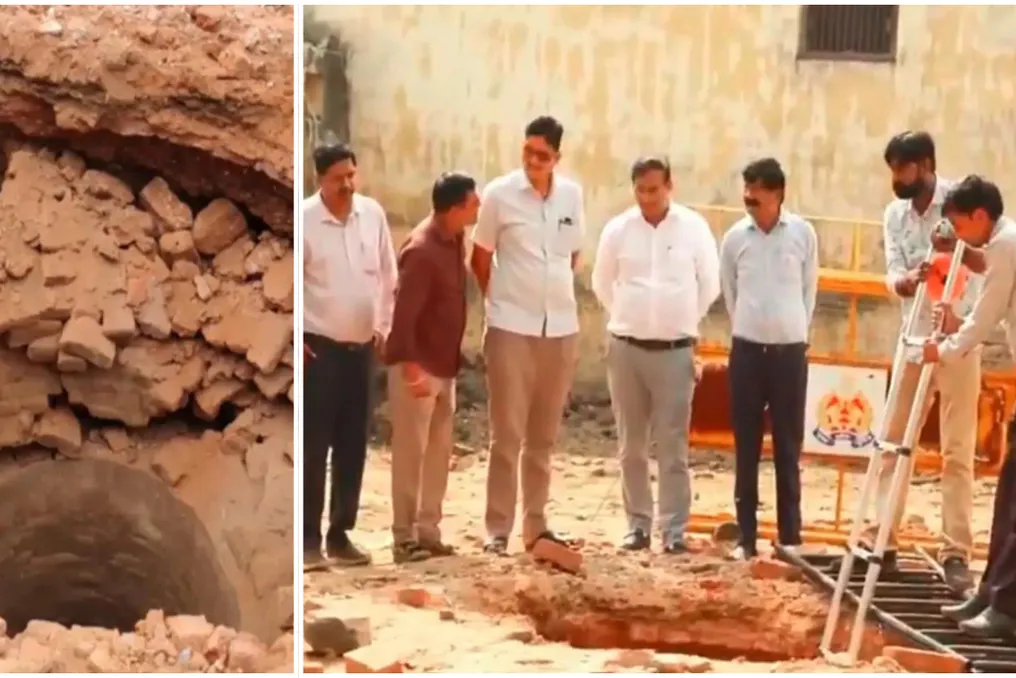
A team from the Archaeological Survey of India (ASI) inspected a well approximately 20 feet deep on Monday. It was discovered during debris removal work at the site of a mosque that was demolished within the premises of Collegiate Saharanpur. The discovery was made on Sunday when the object was found under the rubble.
The inspection was conducted to determine the age, nature, and historical significance of this structure. Enhanced police security was deployed around the site, and the well itself was cordoned off to prevent access.
Manoj Kumar Yadav from the Uttar Pradesh Department of Archaeology stated that the purpose of the check was to establish the antiquity of the structure and understand its potential historical context. He mentioned that the main task was to determine the find's age, as well as to understand the nature of the construction and link it to historical events.
According to Yadav, the structure was a well filled with debris. It was about 20 feet high from ground level and nearly three feet in diameter. The construction is made of Lahori bricks, and the binding mortar is a mixture of lime and surki. A thin layer of lime plaster is present at a depth of three feet from the top surface.
Yadav added that similar structures built using comparable methods are often found in the Upper and Middle Ganges Valley regions and typically date back to the late medieval period. On Monday afternoon, three ASI staff members arrived at the site and inspected the well in the presence of local officials. They measured its depth using a ladder and conducted photo and video documentation.
Sub-Divisional Magistrate Subodh Kumar reported that soil and brick remnants were collected from inside the well. The discovery occurred on Sunday during debris clearing operations when workers encountered a concrete slab beneath the rubble. This slab proved to be unusually strong, and after the Pokland machine could not exert significant force, workers used a cutter and uncovered the brick-lined well.
The well was approximately 20 feet deep and about 1.5 meters wide. Its exact age, purpose, and historical past have not yet been determined.
The well's discovery took place two days after the demolition of the mosque located on the Collegiate Saharanpur grounds. The district administration demolished the building early on September 5th after the mosque committee's appeal against the demolition order was rejected by the district court. The City Magistrate had previously ruled on July 17th that the structure was an illegal encroachment on government land and ordered its demolition. Furthermore, a fine of approximately 6.41 kror was imposed for the alleged encroachment and misuse of public land.
The mosque management committee challenged the City Magistrate's decision in the district court, which dismissed the appeal on September 2nd. Following this, authorities proceeded with the demolition under heavy police presence. Authorities maintain that the demolition was carried out in accordance with judicial orders and legal procedures.
This finding has led to various claims regarding the possible history of the site. Vikas Tyagi, the petitioner and former coordinator of Bajrang Dal, claimed that a temple might have existed on this spot before the mosque was built. However, Congress MP of Saharanpur, Imran Masood, stated that the well was part of the mosque and was used in earlier times to meet the university's water needs or for ablution before prayer. ASI's examination is expected to help establish the well's antiquity and historical background. Officials have not yet announced any conclusions regarding its origin or previous use.