Most companies do not possess a cohesive identification strategy; instead, they rely on a collection of fragmented solutions. Each organization independently created its own responses using the best available tools at the time. A tool for client verification was needed to comply with regulations, a specialized tool to combat fraud, and a digital path for the registration process.
Each problem was solved by a separate vendor, and the era of piecemeal solutions served its purpose: it digitized an industry that was supposed to move at the speed characteristic of the Covid period. The vendors of these tools at the time could offer nothing more. An integrated category did not yet exist.
Integrated identification platforms emerged because this 'patchwork' approach worked until scaling revealed its limitations. This is not a story of anyone's mistake, but rather of a market that matured around the solutions adopted when they were the only possible ones.
"Piecemeal solutions were not created to fail. They were designed to solve one task well, long before the need for their interaction arose."
Statistics That May Shock Executives
The research firm Liminal found that 48% of enterprises use four or more vendors when registering clients. Companies using an integrated identification platform report an 83% reduction in user drop-off rates, demonstrating the hidden costs borne by the 'patchwork quilt' system previously. About 67% of enterprises stated their desire to transition to an integrated platform within five years. Liminal published this study in 2023, meaning three of those five years have already passed.
The visible cost of such an approach is friction in the process. However, the hidden cost is blindness. When your fraud detection mechanism, registration process, and authentication level do not exchange data, decisions are made based on an incomplete picture.
This is the actual price of the 'patchwork quilt' system.
Problems Become More Obvious in Africa
In Africa, regulatory requirements such as Popia, stricter KYC (Know-Your-Customer) rules, and close scrutiny from the South African Fraud Prevention Service (SAFPS) have raised the compliance bar in the region, while customer patience has diminished. Every new territory means the necessity of building identification logic from scratch if it is distributed across seven different systems.
Threats are also increasing. According to the annual SAFPS report presented at the summit in May 2025, the number of instances of fraudulent data issuance in SAFPS increased by 38% in 2024. This is not a vendor problem; it is a system being tested under pressure that the architecture based on piecemeal solutions was not designed for.
We observe this everywhere we work—in the telecommunications sector, automotive industry, financial services, and many others. Different industries, the same 'patchwork' approach: identification logic is scattered across half a dozen vendors, each solving their small piece, but no one sees the whole picture.
Strategy Is Not the Problem, But Its Implementation
Most enterprises already have an identification strategy on paper. The complexity lies not in defining what the ideal situation should look like, but in its practical application across all channels, meeting all regulatory requirements, and in every market.
And this implementation is becoming increasingly complex. Customers expect seamless interaction. Regulators demand strictness. Boards of directors expect both, and quickly. Maintaining all of this on a 'patchwork quilt' basis worked on a smaller scale. But at corporate volume, across multiple markets, with changing baseline compliance levels and growing sophistication of fraud, it is subtly becoming the factor that limits business growth speed.
An integrated identification platform is not the strategy itself. It is the way to implement that strategy throughout the entire customer journey.
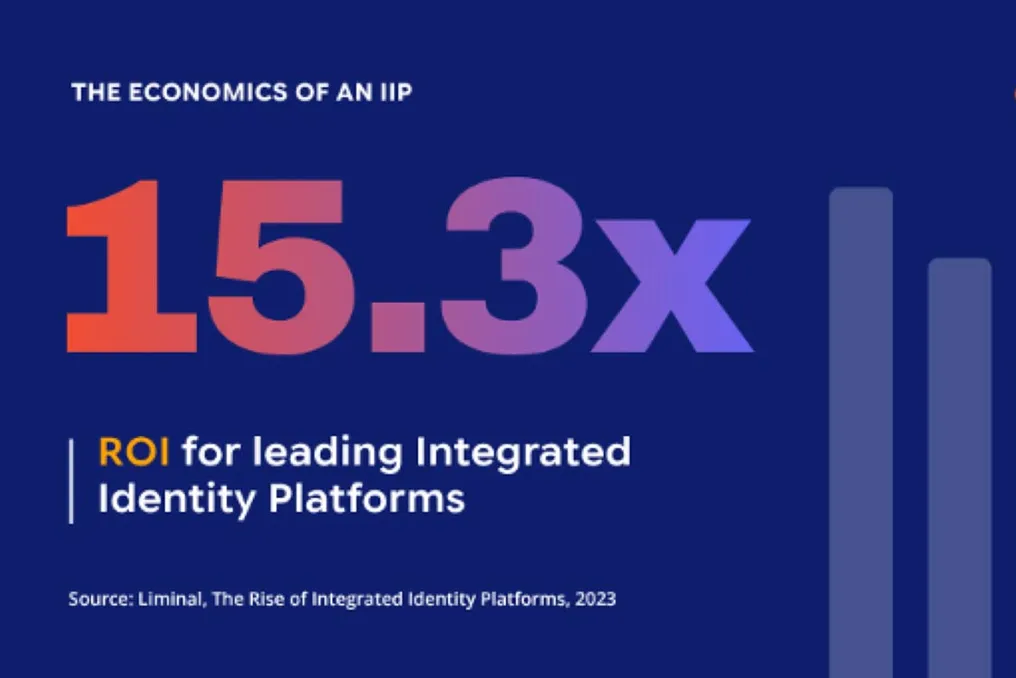
Liminal Strategy Partners, an independent firm tracking this market globally, named Contactable the regional leader for the Middle East and Africa in its Liminal Index for Financial Services Account Opening. Its 2023 study also showed that the return on investment from using leading integrated identification platforms reaches 15.3 times through reduced drop-offs, decreased fraud, and accelerated decision-making.
Most enterprises do not lack an identification strategy on paper. What they lack is a way to implement that strategy across the entire customer journey, quickly and without visible inconsistencies.