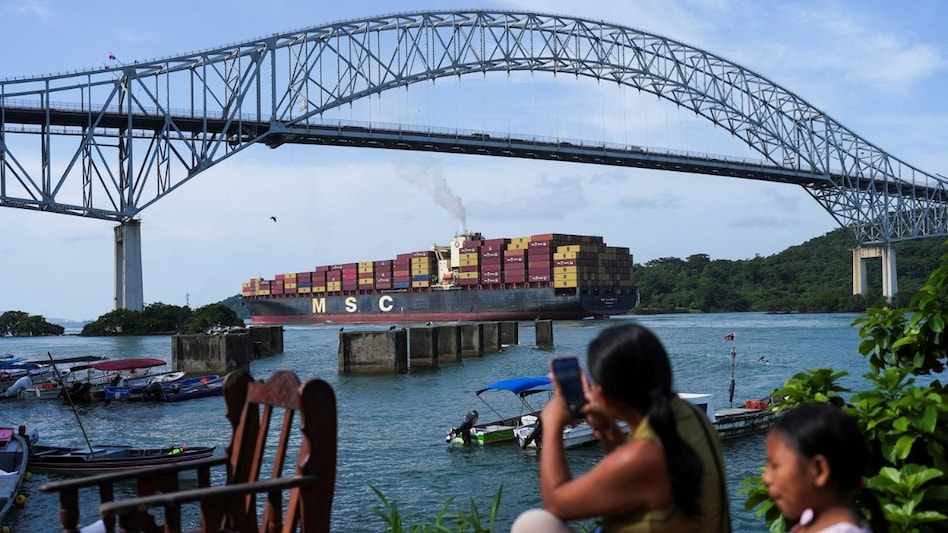
In addition to crises in the Bab el-Mandeb and Strait of Hormuz, a new alarming situation has arisen on one of the world's transit routes—the Panama Canal. The new administrator of the Panama Canal, Ilya Espino de Marota, warned of a possible decrease in the daily number of vessels passing through the canal in the coming months due to a serious water shortage. This could be another major blow to global logistics, which is already under pressure from the consequences of the war in Iran.
In an interview with the business publication Financial Times, Espino de Marota stated that daily traffic could decrease from the current 32 to 27 vessels. She called this scenario the 'worst case,' based on modeling that took into account the rainfall patterns of 1997—the driest year in the canal's history. The Panama Canal connects the Atlantic and Pacific Oceans and handles over 3 percent of global trade.
Water scarcity becomes a problem approximately every three years due to climate change. Espino de Marota emphasized that 'climate change is the most important issue, as we see that dry years are constantly increasing.' Since maintaining the water level in the canal heavily depends on rainfall, when the amount of rain decreases, the number of ships must be limited to conserve water. Traffic reductions have already occurred due to drought, but concerns about further cuts are worrying shipping companies.
Global trade routes are already facing disruptions due to military conflicts, and the war in Iran has intensified pressure on maritime routes. Therefore, a reduction in the capacity of the Panama Canal could lead to increased freight costs and delivery delays. Experts believe that in light of the long-term effects of climate change, alternative water sources and improved management are necessary.
The Panama Canal is an artificial waterway about 82 kilometers long, located in Panama, Central America. It connects the Atlantic and Pacific Oceans. Construction began in France in 1881, but the project failed due to technical difficulties. Later, the US completed the construction, and the canal opened for traffic in 1914. A key feature of the canal is its lock system, which raises ships above sea level to Gatun Lake and then lowers them on the other side, avoiding the thousands of kilometers detour around South America. This canal is critically important for world trade as it saves time and fuel when transporting goods between Asia, America, and Europe. Control of the canal fully transferred to Panama in 1999.