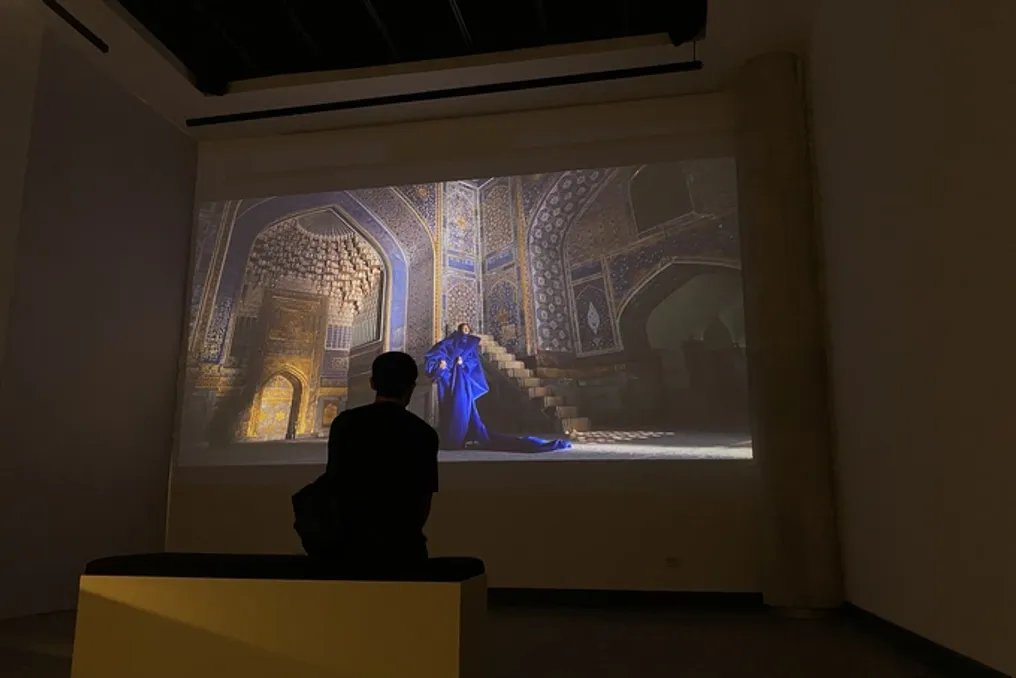
An exhibition by the Dutch-Moroccan artist and couturier Mohamed Benshellal, titled BENCHELLAL: MONUMENTAL | Sculpting Past Tomorrow, has opened at the State Museum of History of Uzbekistan. Nine mannequins dressed in voluminous solid-colored dresses, characterized by numerous folds and draperies, greet visitors at the entrance hall.
The couture collection, which drew inspiration from Uzbek architecture, was developed by the designer in 2025 during his stay at the Center for Contemporary Art in Tashkent (CCA Tashkent). Previously, in November 2024, Benshellal first presented the project BENCHELLAL: MONUMENTAL | Sculpting Past Tomorrow at the National Museum of Qatar, merging fashion, sculpture, and architecture. For this initial exhibition, he created works as part of an art residency at Liwan Design Studios and Labs in Doha, and a smaller version of the project was shown in Hong Kong.
The Tashkent exposition represents an evolution of this project, as Benshellal spent several months in Uzbekistan. The designer shared his impressions: 'I clearly remember arriving in Uzbekistan for the first time. I thought I would primarily see historical monuments and Islamic architecture, but to my surprise, I discovered a completely different side of the country—modernism—and came to love it very much. Both these worlds attracted me.'
Various architectural landmarks of Uzbekistan served as inspiration for the new collection: the Tilla-Kori madrasa, the Shah-i-Zinda ensemble and Registan Square in Samarkand, the Ark fortress, the Samanid mausoleum, and the Kalyan mosque in Bukhara, as well as the State Museum of History of Uzbekistan, the Palace of Friendship of Peoples, and the Sun helio-complex in the Parkent district. Among the latter three modernist buildings are sites listed on the UNESCO World Heritage List.
Benshellal emphasizes that his works do not feature direct copies of ornaments, domes, or silhouettes of specific buildings. Instead, he focuses on the structure, proportions, color palette, and overall feeling of these structures. The designer notes that the combination of ancient landmarks and modern constructions reflects his interest in 'opposites that complement each other.' A photo exhibition in a separate pavilion allows viewers to compare the dresses with the architectural objects that inspired them.
'I have always been drawn to complementary opposites. My works are very voluminous, yet precise; feminine, yet possessing a commanding character. In Uzbekistan, I found equally diverse yet coexisting worlds. This showed how multilayered everything we call Uzbek is,' he shares.
For the collection intended for the Tashkent exhibition, Benshellal used materials sourced from local markets and shops, including fabric sales points for furniture. He worked with remnants and unused scraps—deadstock. Since repurchasing such fabrics is usually impossible, each piece is unique.
The designer does not use preliminary sketches; instead, he immediately begins draping the fabric onto the mannequin, gradually forming the silhouette around the figure. The scale and complexity of the dress are determined by the amount of fabric used, while each model remains wearable.
Mohamed Benshellal admitted that Uzbekistan holds a special place in his heart due to its people, calm atmosphere, and the opportunity to work following his own intuition. He noted: 'It is very important for an artist to work in harmony. Uzbekistan has become one of those places for me where I can truly concentrate on creativity and hear myself. I do not doubt that my journey here will continue in some form.'
The designer plans to take the BENCHELLAL: MONUMENTAL | Sculpting Past Tomorrow project to an international level. He intends to create exhibitions based on this collection, inspired by local culture and architecture, on each of the seven continents. Mexico is the next target in 2027.
The exhibition at the State Museum of History will be open until November 8th, and admission is free.