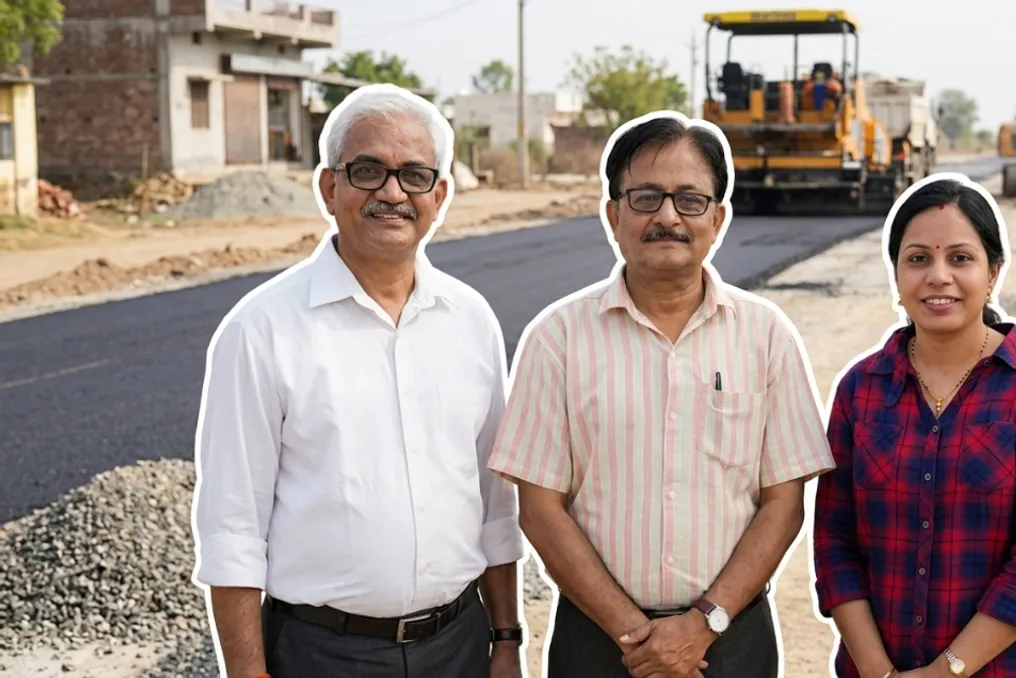
Residents who travel through coal mining areas have likely seen huge trucks daily driving on these roads with tons of coal and other mined raw materials. Over time, such load leads to road surface damage, accelerated wear, and the need for frequent repairs.
Now, researchers from NIT Rourkela have found an interesting way to solve this problem. They developed a high-strength material using coal mining waste, fly ash, and a binding agent. This material can potentially be used to create roads capable of withstanding intensive traffic from heavy trucks.
The main concept is to utilize waste from mining and industrial activities to improve road infrastructure precisely in the regions where this waste is generated.
According to the Ministry of Coal, India mines about one billion tons of raw coal annually to meet its energy and industrial needs. Nearly 94% of this coal is mined in open-pit mines, which generates significant volumes of waste.
One such waste is coal separation material—rocks and other non-coal materials separated during the mining process. Traditional disposal of this waste puts serious pressure on the environment. The NIT Rourkela team saw an opportunity in what was previously discarded.
Coal separation materials contain minerals such as silica and aluminum oxide, as well as clay minerals possessing characteristics like compressive strength and rigidity. Researchers studied how these properties could be applied in construction.
They created a composite by combining coal separation material, fly ash, and a binding agent, testing various compositions to determine a mix with the required strength and performance characteristics.
The need for such a material is particularly relevant in coal mining areas, where roads are regularly used to transport mined materials by heavy vehicles. Professor K. Umamakeswar Rao, Professor and Director of NIT Rourkela, noted: 'The developed technology is especially relevant for coal mining areas where roads regularly carry heavy vehicles with mined materials. Such roads are subjected to significant loads and repeated movement, leading to frequent deterioration of condition.'
Thus, this innovation aims to solve two problems simultaneously: finding a useful application for large volumes of mining and industrial waste and creating infrastructure that better resists harsh conditions.
The research group includes Professor K. Umamakeswar Rao, Dr. Manoj Kumar Mishra, and Research Fellow Dr. Subhasriti Choudhury from the Department of Mining Engineering at NIT Rourkela. The technology received Patent No. 597749 under application No. 202331070306.
Beyond road construction, the researchers view this development as an example of how waste from one industrial process can become a valuable resource for another industry. Professor Manoj Kumar Mishra stated: 'The developed composite is a classic example of the circular economy principle. We used two large-volume industrial wastes as a resource with significant engineering potential and economic value.'
According to him, this material can help solve waste management problems while supporting more sustainable infrastructure development using local resources. Pilot-level field tests are currently planned, after which the researchers hope to implement this innovation in real roads to assess its long-term strength and durability. This is a promising example of how India's waste streams can be reimagined as resources for building stronger and more sustainable infrastructure.