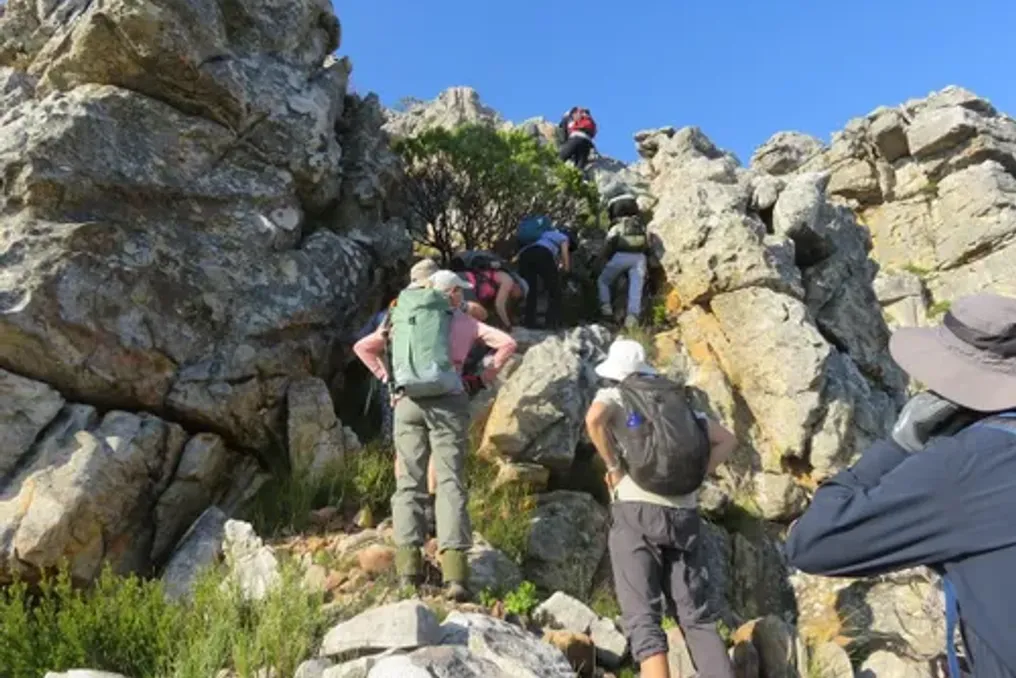
After undergoing a complex spinal fusion surgery, Bellville resident Rencia Gillespie was able to return to hiking in the Cape Town mountains.
Previously, severe back and leg pain significantly limited Gillespie's active life; she could no longer engage in sports, gardening, heavy lifting, or participate in work training courses. At night, the pain became so intense that lying down was difficult, leading to weeks of insomnia.
Conservative treatment, including painkillers, physiotherapy, and exercises, did not provide adequate relief, prompting Gillespie to undergo complex spinal fusion surgery at Netcare Kuils River Hospital.
Approximately eight months after the operation, the Bellville resident found herself back on the mountain trails she feared losing. Gillespie reported that since the surgery, she has experienced no pain, including immediately following the procedure.
According to neurosurgeon Dr. Dion Lamprecht and orthopedic surgeon Dr. Reggie King, who performed the surgery together, her condition involved issues at two levels of the lumbar spine. At the L4/L5 level, between the fourth and fifth lumbar vertebrae, Gillespie had instability caused by joint degeneration, which led to one vertebra shifting forward. This narrowed the spinal canal and put pressure on the nerve roots.
Additionally, she had a disc herniation at the L5/S1 level, where the lower lumbar vertebra connects to the sacrum, causing further narrowing and nerve compression. Gillespie noted that before her condition worsened, she was active and healthy, and the degree of damage was unexpected for her, despite her experience as a nurse.
She had experienced back pain two or three years prior, but it subsided. When the pain returned late last year, it was different. She recounted: 'I felt severe pain for about two months. The pain radiated down my leg, to my toes. Eventually, my nerves were affected, and I started feeling weakness.' She added: 'At night, I was fine if I moved, but I couldn't lie down. It was exhausting.'
The surgeons explained that spinal fusion is usually not considered solely for lower back pain. Patients requiring surgery often have debilitating neurological symptoms, reduced walking ability, or constant pain unresponsive to non-surgical treatment. However, there are symptoms requiring urgent specialist consultation, such as bowel or bladder problems due to severe nerve compression (cauda equina syndrome) or sudden onset of muscle weakness, which may require emergency surgery. In Gillespie's case, there were no such signs.
The surgeons warned that without surgery, the most likely progression would be a gradual decrease in walking distance as the narrowing around the nerves became increasingly debilitating and impacted her quality of life.
Gillespie underwent an oblique lumbar interbody fusion, or OLIF, as part of a broader spinal reconstruction. The OLIF technique differs in that access to the affected intervertebral disc is gained not only through the back but also from the side and front of the body. The damaged disc is removed, and a spacer or cage is inserted between the vertebrae to restore height and stability while creating more space around the compressed nerves. During the operation, Gillespie also had fixation performed using screws and rods to stabilize the spine posteriorly, along with decompression to relieve pressure on the affected nerves.
Dr. King noted that this approach helps avoid some muscle damage associated with posterior spinal surgeries because the surgeons access the spine through the natural space between the psoas muscle and major blood vessels. The operation itself took about five to six hours.
Lamprecht and King worked as a team because Gillespie's condition involved both spinal instability and nerve compression. Spine orthopedic surgeons provide expertise in alignment, structural reconstruction, and instrumentation, while neurosurgeons possess extensive experience in neurological decompression. Lamprecht emphasized: 'When a patient requires both decompression and fusion, combining our skills allows us to plan and perform the procedure as one team.' He added: 'Each of us has a clearly defined role, but we are working towards the same positive outcome for our patient.'
King also stressed the importance of the patient understanding the problem, what each surgeon would do, and the overall goal. Gillespie reported that these explanations helped her overcome some anxiety about the spinal surgery. She said: 'They sat down with me, discussed my case, and used pictures and diagrams to explain everything so I could understand. I knew who was doing what, why I needed the surgery, and what to expect afterward.'
Despite the successful outcome, spinal fusion is a major surgery and carries potentially serious complications. The surgeons warned that the anterior approach used in the fusion carries a risk of injuring major blood vessels, including the aorta and inferior vena cava, as these vessels must be protected and moved to access the spine. They added: 'The main risks of spinal fusion include non-union, nerve damage, infection, and medical complications.' These complications can include deep vein thrombosis and pulmonary embolism. Non-union occurs when the bones that should fuse do not heal properly and may require further surgery.
Gillespie began mobilization a few days after the operation and then underwent a week of rehabilitation. Lamprecht stated that safe restoration of patient mobility post-surgery is a crucial part of recovery. He explained: 'The ability to safely start moving again as early as possible is important because prolonged immobility itself carries risks, including blood clots and respiratory complications.'
Although Gillespie describes her recovery as exceptionally smooth, daily tasks initially required adaptation. She shared: 'Self-care was difficult at first—basic things like getting out of bed, washing, and dressing require careful maneuvering.' Bending was particularly challenging for her, and even household chores took on a new meaning. 'Hanging up a laundry basket takes on a completely different perspective.'
She followed her physiotherapy plan and regularly attended consultations, X-rays, and medical check-ups to monitor the fusion process. She recalled: 'I was told recovery from the surgery would take a year, and I wasn't sure if I could walk at that level again.' As she resumed physical activity, Gillespie felt confident in the progress made. 'I was careful, but not afraid at all.'
Following the complex spinal surgery, Rencia Gillespie returned to hiking in the Cape Town mountains after severe back and leg pain forced her to stop. Seven months later, she conquered Steenberg Buttress, including sections requiring climbing and upper body strength. 'It was the best feeling,' she said, 'to know I could do it again.'
For a woman who once doubted whether the spinal surgery would leave her with pain or weakness, returning to the mountains became more than just another milestone in her rehabilitation. It meant reclaiming a part of her life.
Within six weeks, she walked through the Kirstenbosch gardens with tourist friends. By eight weeks, she completed the 5 km parkrun Century City route. By 13 weeks, she ran a 13 km trail race in Meerendal. Five months post-operation, she was back on the mountain trails, including Vlakkenberg and the Woodstock Cave route.